Favorite Attractor Nymphs

speedbird

Life of the Party
Starting off fly fishing for trout I was always told dries are the hardest to get right, but so far all of my trout have come to hand from a dry fly. It seems like it isn't always necessary to perfectly match the hatch, and general attractors like Simulators consistently do great. I have had a tough time with nymphs, so far only had one bobber down at an Alpine Lake, and the fish consistently rejected the same fly and others that I threw. I have yet to have a fish hit then nymph in rivers or streams. What is your favorite nymph to start with, say when throwing a hopper dropper or similar general attractor pattern?
 
Starting off fly fishing for trout I was always told dries are the hardest to get right, but so far all of my trout have come to hand from a dry fly. It seems like it isn't always necessary to perfectly match the hatch, and general attractors like Simulators consistently do great. I have had a tough time with nymphs, so far only had one bobber down at an Alpine Lake, and the fish consistently rejected the same fly and others that I threw. I have yet to have a fish hit then nymph in rivers or streams. What is your favorite nymph to start with, say when throwing a hopper dropper or similar general attractor pattern?
An ant. I like this one (it's unweighted, so when I want it to go deep I tie on a beadhead nymph first, usually a variety of beadhead gold ribbed hare's ear, then tie this ant as a dropper to the weighted nymph):


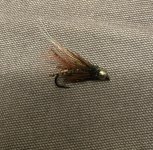
I sometimes tie this on (in small sizes, 16 or 18):

 
Beadhead prince nymph
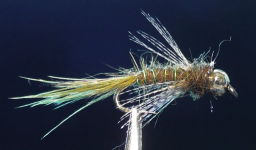
Caddis pupa in yellowy cream or bright green
BH flashback gold ribbed hare’s ear
Pheasant tail

With the above you got your attractor/small stone, a caddis, a general buggy impressionistic attractor, and a mayfly.
 
Lightning bug, caddis pupa, prince
 
Third. It is a great attractor nymph. But I dislike tying them (with all their fiddly little parts) so rarely fish them.
Fair.

Lightning bug, caddis pupa, prince
A good, streamlined list. These are basically all you need for small nymphs in summer to early fall on the Yak or its tributaries, IMO.
 
That's been my Yak selection for over 30 years, I keep the nymph box stocked with different sizes.
Sure I toss a Pat's Rubberleg too, but for dry dropper, or hopper dropper right now, that's all you really need.

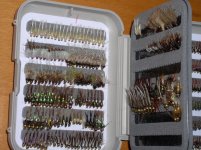
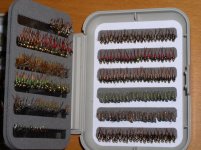
The Yak nymph box...

flys040-1.jpgflys039-2.jpg
 
Looks like Zak needs to hit up Mossy for a couple Prince Nymphs.

@Mossback how/when/where do you fish the Deep Sparkle Pupa nymphs? I've never been able to get those to do much of anything for me.
 
Looks like Zak needs to hit up Mossy for a couple Prince Nymphs.

@Mossback how/when/where do you fish the Deep Sparkle Pupa nymphs? I've never been able to get those to do much of anything for me.
I don't fish it much on the Yak, but typically under an indicator and toss it up into medium fast riffles/a medium stonefish type riffle, bouldery stuff with some white, and then let it drift into the deeper stuff. I use the old 'Leisenring Lift' at the end, and bring it steady to to upper water column, that's when i get most of the takes, on the way up.
Used to live right on the Middle Fork Sno, and used that and an EHC only for years, only things you need up there.
 
I have yet to have a fish hit then nymph in rivers or streams.
Presentation is more important than pattern. My guess, your not getting deep enough and/or the fly is moving way too fast. Get it deep and slow it down. And just tie on a bead head gold ribbed hares ear in sz 10, they'll all eat it.
 
Any jigged tungsten nymph for me. Duracell, frenchie, perdigons, Spanish bullet, etc. they just get down quickly and work.
Everywhere I’ve fished, it hasn’t seemed to matter so much which one I use.
I’ve found that some variation of PT, or Walt’s either with, or without cdc collar, and various tungsten bead sizes, and colors, pretty much cover my bases. The metallic pink, copper, and gun metal black are my favorite bead colors.
 
You need to consider whether there are hatches going on or not. Attractors are good during non hatch periods but if the fish are wired to a daily hatch, you better be imitating the hatch. Alpine lakes are a different matter. A fellow named Gary LaFontaine said that alpine lake trout feed mostly on the surface and the food items are carried to the lake by atabatic winds which carry ants and hoppers to the mountain lakes.
 
Back
Top