NFR Got any Herp pictures?

Non-fishing related
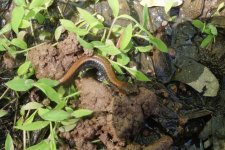
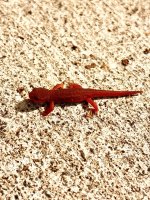
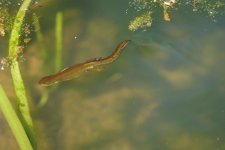
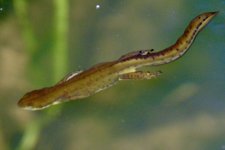
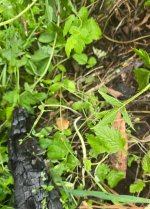
I believe what we have here is an adult Red-spotted Newt.

1747596521591.jpeg

The adult Red-spotted Newt has an olive green to yellowish brown body with small black spots and blotches scattered over the body.
There are a series of red spots that are bordered by black. The tail is narrowly keeled and compressed laterally with a variably developed caudal fin. The body is rounded and head is barely distinct from the neck.

Note the red spots with black border:

1747596952020.jpeg

Cheers
 
Moved an old log this morning and surprised what I'm pretty sure is a rubber boa. He was disappearing into a burrow by the time I got back with my phone. Terrible pic, but it was shiny and a pretty shade of olive green. View attachment 154345
you shoulda grabbed it! Yep, looks like a Rubber Boa. Really cool critters and insanely efficient rodent (albeit baby) killers.
 
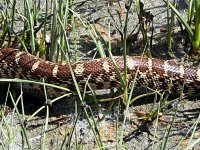
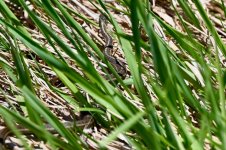
looks like it just recently shed it's skin too! those colors really pop! nice little rodent control of a gopher snake. I'm not sure your exact location but could be either the P. c. deserticola or P. c. sayi. Based solely on patterning, it almost looks like an intergrade to me, either way, great find!
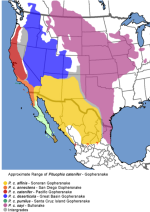
1747963337594.png

I don't know what the current nomenclature is with this genus as it seems that every few years, they change species and subspecies slightly as more becomes known through genetic research.
 
Last edited:
you shoulda grabbed it! Yep, looks like a Rubber Boa. Really cool critters and insanely efficient rodent (albeit baby) killers.
Crossed my mind. I know they are supposed to be pretty docile, but was busy getting ready with tree faller en route to drop a couple firs.

Told my wife later, figuring it was better she knew one was in the backyard, before seeing it for herself. My tinnitus is bad enough without hearing her scream. I tried the rodent control, and indicator species/healthy ecosystem sales pitches, but she wasn't buying.
 
Last edited:
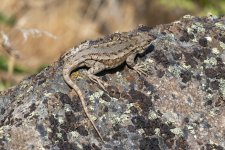
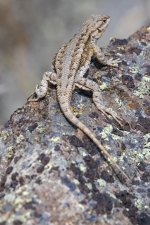
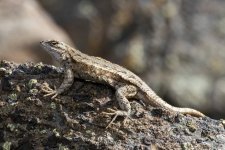
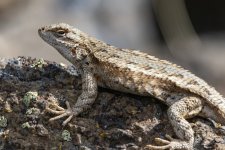
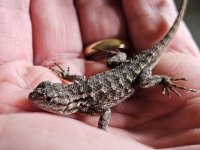
My wife and I went from a hike at Oak Creek Natural Area last weekend. We saw some cool birds (Bullock's oriole, warbling vireo, and lazuli buntings, for example) and the spring wildflowers were popping. We also encountered a cooperative Western fence lizard. In the face of a cool breeze, it was hugging the sun-kissed rocks to thermoregulate.
A01WesternFenceLizard1303.jpgA02WesternFenceLizard1286.jpg
A03WesternFenceLizard1292.jpg
A04WesternFenceLizard1295.jpg
Steve
 
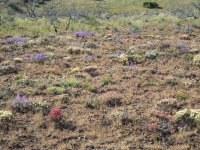
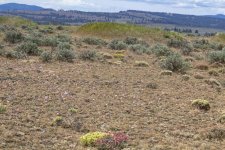
Umptanum Rd., May 24, 2025. Reptile. While on a 340-mile-loop birding trip with my wife on May 17th, we drove down the Umptanum Rd. from Ellensburg to the trailhead to the Umptanum Falls. [I just learned that both β€œUmptanum” and β€œUmtanum” are acceptable variant spellings the original Indian name for this area.]. Yes, we did see our targets, Western and mountain bluebirds (more to come), but we were really blown away by the spring wildflowers in bloom
A12ShrubSteppeWildflowersP5180304.jpg
A10BitterrootFlatAmongMounds1733.jpg
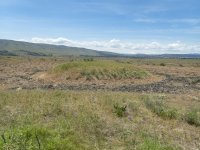
in the shrub-steppe habitat on and among the Manastash mounds.
A06ManastashMound&RockyRimP5250241.jpg
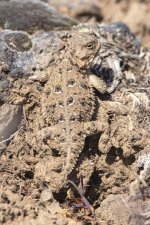
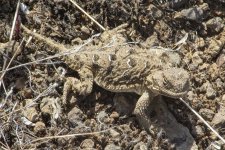
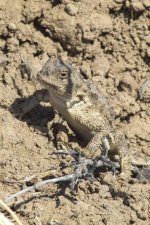
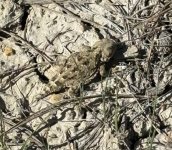
So, we decided to further explore this area in more detail the next Sunday. While hiking among the mounds, I remarked to her that I surprised that we had seen little sign of mammals or reptiles (including fang-toothed ones). But near the end of our walk, I caught movement out of the corner of my eye in the flats between mounds. This proved to be the scurrying of a pygmy short-horned lizard (Phymosoma douglasii), a new species for us. Armed with several cameras…, I captured many shots of this individual as it froze on the ground. Its pigmentation served as excellent camouflage as it blended into its environment.
A01PygmyShortHornedLizard1463.jpg
A02PygmyShortHornedLizard1771.jpg
A03PygmyShortHornedLizard1782.jpg
At about 2.5 inches, this was an adult. Like other β€œhorny-toads”, pygmy short-horned lizards feed primarily on ants, especially harvester ants. In some species (not known for pygmy short-horned lizards), individuals squirt blood from their eyes when threatened. This blood contains chemicals (perhaps derived from their ant prey) that is very distasteful to mammal predators (but not birds).
The pygmy short-horned lizard ranges across the Columbia basin of Washington, into southern Idaho, central and eastern Oregon, and northeastern California and northwestern Nevada (extirpated in southern B.C.). Its preferred habitat in Washington is primarily shrub-steppe but also includes vegetated sand dunes.
Steve
 
Caution!! Avert your eyes if you are sensitive to the mating behaviors of wild critters, what follows may be considered in some corners as "Toad Porn":

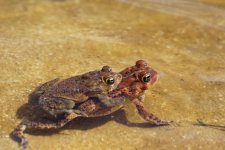
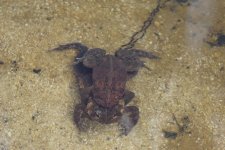
American Toad (Anaxyrus americanus): As you can see, males are significantly smaller than the female. The male will wrap his front legs around the female's chest, holding on until the female lays her eggs in the water.

1748802070622.jpeg

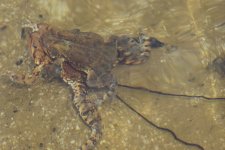
Eggs are laid in a pair of long chains, with the male depositing his sperm on top pf the eggs (note the trailing egg chain, which can reach several yards in length, with strings holding from 2,000 to 20,000 eggs):


1748800812465.jpeg


1748800927419.jpeg

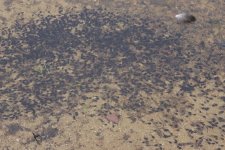
In a few days, the eggs will hatch into small black tadpoles:

1748803298300.jpeg

In about 4 to 6 weeks, the tadpoles will have absorbed their tail, sprouted legs, and developed lungs, after which they will become terrestrial critters. In the fall, with declining temperatures, they will burrow underground for the winter, emerging next spring to start the hole show ever again.

Cheers
 
Last edited:
Caution!! Avert your eyes if you are sensitive to the mating behaviors of wild critters, what follows may be considered in some corners as "Toad Porn":

American Toad (Anaxyrus americanus): As you can see, males are significantly smaller than the female. The male will wrap his front legs around the female's chest, holding on until the female lays her eggs in the water.

View attachment 155633

Eggs are laid in a pair of long chains, with the male depositing his sperm on top pf the eggs (note the trailing egg chain, which can reach several yards in length, with stings holding from 2,000 to 20,000 eggs):


View attachment 155625


View attachment 155626

In a few days, the eggs will hatch into small black tadpoles:

View attachment 155643

In about 4 to 6 weeks, the tadpoles will have absorbed their tail, sprouted legs, and developed lungs, after which they will become terrestrial critters. In the fall, with declining temperatures, they will burrow underground for the winter, emerging next spring to start the hole show ever again.

Cheers
Great pictures, thanks for sharing!
Not sure if you meant it or not, but "start the hole show" was one of the funnier things I've read in a bit.
 
Caution!! Avert your eyes if you are sensitive to the mating behaviors of wild critters, what follows may be considered in some corners as "Toad Porn":

American Toad (Anaxyrus americanus): As you can see, males are significantly smaller than the female. The male will wrap his front legs around the female's chest, holding on until the female lays her eggs in the water.

View attachment 155633

Eggs are laid in a pair of long chains, with the male depositing his sperm on top pf the eggs (note the trailing egg chain, which can reach several yards in length, with strings holding from 2,000 to 20,000 eggs):


View attachment 155625


View attachment 155626

In a few days, the eggs will hatch into small black tadpoles:

View attachment 155643

In about 4 to 6 weeks, the tadpoles will have absorbed their tail, sprouted legs, and developed lungs, after which they will become terrestrial critters. In the fall, with declining temperatures, they will burrow underground for the winter, emerging next spring to start the hole show ever again.

Cheers
Is that a new type of horny toad?
 
Back
Top