LiFePO4 Batteries

_WW_

The Elitist Geriatric Skagit Swinger
Forum Supporter
This is something that needs it's own thread.
First thing to know is that these are not Lithium Ion batteries. This is newer technology and getting cheaper all the time.
Second thing to know is that these are not for using as service, (starting) batteries in automobiles or boats. They shine as trolling motor or RV batteries, especially when coupled with solar.

Some of the advantages:
They can be discharged almost fully without harming the battery. When You get a 100ah battery, that is the available energy. The older lead acid batteries are only meant to be discharged to 50%. So with LA batteries a 100ah is in reality only a 50ah.

They are half the weight or even lighter.

Depending on the brand they can be discharged 80% or more many thousands of times. Think about that for a second. How many times a year would you discharge one to 80% in a year. How long would it take you to reach 5,000 times.

They can be hooked up in parallel or series.

They now make them in group 24 size at 100ah!

There is no off gassing so they can be stored inside. and most of them can even be used when lying on their side.

Some of the disadvantages:
Currently it is not recommended to charge or discharge at temps below freezing. Many RVers move them to the inside of the RV so they are operating in heated space. There are models with built in heaters. This limitation normally affects only 4 season users.

You need a compatible charger of the amperage recommended by the battery manufacturer. Most modern chargers come with the option to select the battery type. With solar, the charge controller will normally suffice by detecting the battery type.

Things to know:
Be sure to get one with a built in BMS, (Battery Management System)
The newer BMS also include low temperature cut off. Here's a typical, but somewhat poorly translated BMS description:
"battery is equipped with upgraded intelligent BMS, which can protect your battery from overcharging, discharging, overcurrent, and overheating which will affect your using experience. The BMS has dustproof, waterproof, and low-temperature cut-off kinetic energy to ensure the safety of use in low-temperature environments, is designed for the harsh environment of the sea, rain and humidity or dusty conditions, to provide high-quality use experience and long service life"

They even come with bluetooth if you think you need that.

These are the basics. I switched over several years ago and will never go back. I have two for the RPOD, two for boats, and one for the van build I'm working on.

These batteries and BMS systems are evolving rapidly. As with all things - READ THE EFFING MANUAL.
 
Last edited:
I just have my first impressions of one of these batteries. I got my 1st of two 12v 100AH mini, smaller than group 24. Received two days ago. Topped it off overnight before fishing yesterday.

Previously, I only got ~ 2hrs trolling time using my rather new group 24 Bimart deep cycle LA battery. Partially due to being a 12V 55lb bow mount pulling a 17' Whaler. It runs at inefficient thrust levels, especially with a little headwind. I plan to go 24v as soon as I sell my little boat.

Anyhow, I trolled for around 4hrs and didn't need to swap to my backup battery. It only weighs 22lb and the small size will help my installation application.

I am a fan so far. I just hope the low temp charging limitation doesn't come into play during colder months.
 
I just have my first impressions of one of these batteries. I got my 1st of two 12v 100AH mini, smaller than group 24. Received two days ago. Topped it off overnight before fishing yesterday.

Previously, I only got ~ 2hrs trolling time using my rather new group 24 Bimart deep cycle LA battery. Partially due to being a 12V 55lb bow mount pulling a 17' Whaler. It runs at inefficient thrust levels, especially with a little headwind. I plan to go 24v as soon as I sell my little boat.

Anyhow, I trolled for around 4hrs and didn't need to swap to my backup battery. It only weighs 22lb and the small size will help my installation application.

I am a fan so far. I just hope the low temp charging limitation doesn't come into play during colder months.
You can charge them in the garage if it's above 30° or the house.
Also it's not an issue to discharge them in under 32° temperatures.
I have 20' foot aluminum sled with a 24 volt 80 lb thrust Minn Kota Terrova bow mount trolling motor.
I have LiTime 12v 100ah TM Bluetooth Life po4 batteries.
I trolled for 4 hours a week ago and used only 14% of the batteries at full charge.
 
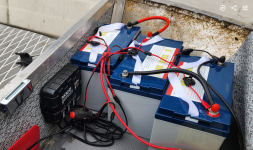
This is from when I first put them in last year. I've updated since then and added some quick disconnects for the on board charger set up.

On my 16' boat, I'm running an overkill 36V Minn Kota bow mount with three 100ah batteries running in series. This thing gets worked hard, and often gets used for long spot lock sessions on the Columbia. Longest I've had it spot lock me was anchor fishing for steelhead for 6hrs. Still had juice to do some carp fishing after.

1742470888688.png
I would really like to get some kind of meter to tell me what my battery life is. They do exist, but the meter on the Minn Kota is only designed to read lead batteries, so it thinks the Li batteries are always full.
 
Last edited:
This is something that needs it's own thread.
First thing to know is that these are not Lithium Ion batteries. This is newer technology and getting cheaper all the time.
Second thing to know is that these are not for using as service, (starting) batteries in automobiles or boats. They shine as trolling motor or RV batteries, especially when coupled with solar.

Some of the advantages:
They can be discharged almost fully without harming the battery. When You get a 100ah battery, that is the available energy. The older lead acid batteries are only meant to be discharged to 50%. So with LA batteries a 100ah is in reality only a 50ah.

They are half the weight or even lighter.

Depending on the brand they can be discharged 80% or more many thousands of times. Think about that for a second. How many times a year would you discharge one to 80% in a year. How long would it take you to reach 5,000 times.

They can be hooked up in parallel or series.

They now make them in group 24 size at 100ah!

There is no off gassing so they can be stored inside. and most of them can even be used when lying on their side.

Some of the disadvantages:
Currently it is not recommended to charge or discharge at temps below freezing. Many RVers move them to the inside of the RV so they are operating in heated space. There are models with built in heaters. This limitation normally affects only 4 season users.

You need a compatible charger of the amperage recommended by the battery manufacturer. Most modern chargers come with the option to select the battery type. With solar, the charge controller will normally suffice by detecting the battery type.

Things to know:
Be sure to get one with a built in BMS, (Battery Management System)
The newer BMS also include low temperature cut off. Here's a typical, but somewhat poorly translated BMS description:
"battery is equipped with upgraded intelligent BMS, which can protect your battery from overcharging, discharging, overcurrent, and overheating which will affect your using experience. The BMS has dustproof, waterproof, and low-temperature cut-off kinetic energy to ensure the safety of use in low-temperature environments, is designed for the harsh environment of the sea, rain and humidity or dusty conditions, to provide high-quality use experience and long service life"

They even come with bluetooth if you think you need that.

These are the basics. I switched over several years ago and will never go back. I have two for the RPOD, two for boats, and one for the van build I'm working on.
What brand and size are you using?
 
This is from when I first put them in last year. I've updated since then and added some quick disconnects for the on board charger set up.

On my 16' boat, I'm running an overkill 36V Minn Kota bow mount with three 100ah batteries running in series. This thing gets worked hard, and often gets used for long spot lock sessions on the Columbia. Longest I've had it spot lock me was anchor fishing for steelhead for 6hrs. Still had juice to do some carp fishing after.

View attachment 146179
I would really like to get some kind of meter to tell me what my battery life is. They do exist, but the meter on the Minn Kota is only designed to read lead batteries, so it thinks the Li batteries are always full.

Are you happy with the 5A charger? Do you think you could charge overnight for back to back trips? I'm looking at the 10Ax2 Noco instead.
 
T
Are you happy with the 5A charger? Do you think you could charge overnight for back to back trips? I'm looking at the 10Ax2 Noco instead.

I just plug it in when I get home and it's always recharged by the next morning on all three no matter how long I've run them. So I haven't felt a need to get anything more yet.
 
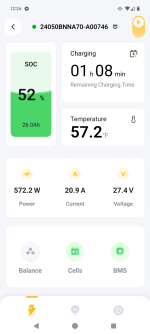
I put a 24v 50ah PowerQueen in my boat for my bow mount. PowerQueen, LiTime, ReDoDO, and I think TimeUSB are all the same company. I paid $175 for it through their eBay store with a coupon. Mine has low temperature charging protection, the BMS will not allow it to charge below freezing. It also has Bluetooth where I can view battery info.

Screenshot_20241230-122630.png

Even with the smaller 50ah capacity, a full day of spot lock and cruising up and down shorelines in Puget Sound on the whaler left me with 60% capacity at the end of the day.

This is a good YouTube channel to check out some LifePo4 battery tear downs and other battery info: https://youtube.com/@willprowse?si=SyDx9nG0suWvhn-T
 
I put a 24v 50ah PowerQueen in my boat for my bow mount. PowerQueen, LiTime, ReDoDO, and I think TimeUSB are all the same company. I paid $175 for it through their eBay store with a coupon. Mine has low temperature charging protection, the BMS will not allow it to charge below freezing. It also has Bluetooth where I can view battery info.

View attachment 146198

Even with the smaller 50ah capacity, a full day of spot lock and cruising up and down shorelines in Puget Sound on the whaler left me with 60% capacity at the end of the day.

This is a good YouTube channel to check out some LifePo4 battery tear downs and other battery info: https://youtube.com/@willprowse?si=SyDx9nG0suWvhn-T
I have watched some of his videos...very well done.
One in particular was his full review on the 12v, 300 ah Wattcycle which is the size that I'm interested in using in my 48v off grid solar home. The system currently has 8 L-16 6 volt, 400ah lead acid batteries charged by 3600 watts of solar panels.
 
Really great thread. I have two big 12V deep cycle I am using for my trolling motor, and two Trojan 6V I use for our trailer. All four are very heavy. My back really wants me to check out the batteries in this thread.
 
I have 2 100 ah lithiums running my 24V 80# terrova riptide TM. I got $$$ Dakotas because they had an 11 yr warranty and they are a US based company, though the batteries are made overseas. I have run my TM all day, 8+ hrs, and I don't think I have ever even used 30% of their capacity because they fully charge back in 3-4 hrs on a 6 amp/hr charger. I am pretty sure I could run my TM for 2 full days around Puget sound with no charging, but I haven't had the courage to try yet. I might hook up a battery monitor one of these days to figure out exactly what I use, but I am now thinking 100ah is overkill, and for a day with 80# TM, 50-75 ah is probably more than you need for dawn to dark fishing days unless you are keeping your TM pegged at near max settings for quite a long time.
 
  • Like
Reactions: ffb
This is a great thread that answers almost every question a newbie could have about the differences in lithium technology. Hopefully it will allay the concern and doubt among those that haven't converted over yet. What timing! The new batteries came along just when us old guys were getting too old to lug around those lead acid fossils any longer! And who would have thought that we could recharge them with electricity from the sky!!!
 
I have 2 100 ah lithiums running my 24V 80# terrova riptide TM. I got $$$ Dakotas because they had an 11 yr warranty and they are a US based company, though the batteries are made overseas. I have run my TM all day, 8+ hrs, and I don't think I have ever even used 30% of their capacity because they fully charge back in 3-4 hrs on a 6 amp/hr charger. I am pretty sure I could run my TM for 2 full days around Puget sound with no charging, but I haven't had the courage to try yet. I might hook up a battery monitor one of these days to figure out exactly what I use, but I am now thinking 100ah is overkill, and for a day with 80# TM, 50-75 ah is probably more than you need for dawn to dark fishing days unless you are keeping your TM pegged at near max settings for quite a long time.
Part of the reason I took the chance with the 50ah is because of space constraints in my boat. I have only had it out once so far but I think it's going to end up being perfect. The fun part with the app is it shows discharge rate and expected battery life remaining as well. Sitting on just spot lock with a nearly full battery told me anywhere from 12-15+hrs of remaining battery. At max speed it showed about 2 hours of capacity.
 
Part of the reason I took the chance with the 50ah is because of space constraints in my boat. I have only had it out once so far but I think it's going to end up being perfect. The fun part with the app is it shows discharge rate and expected battery life remaining as well. Sitting on just spot lock with a nearly full battery told me anywhere from 12-15+hrs of remaining battery. At max speed it showed about 2 hours of capacity.

How big and how heavy is that battery? I am thinking about putting something similar in my boat, which is even more space constrained than yours.

Do you have it set up to charge via the alternator when your outboard is running? Is there even any way to do that?
 
Part of the reason I took the chance with the 50ah is because of space constraints in my boat. I have only had it out once so far but I think it's going to end up being perfect. The fun part with the app is it shows discharge rate and expected battery life remaining as well. Sitting on just spot lock with a nearly full battery told me anywhere from 12-15+hrs of remaining battery. At max speed it showed about 2 hours of capacity.
Just playing around with charging times, speeds, etc I sort of calculated that I think I could go at least 12-15 miles on the TM, at a minimum, without any tidal assist. I trolled at 1.5+ mph nearly all afternoon on a lake one day with the kids, and it didn't take very long to recharge at all. I have no idea, it might even be able to push the boat 20 miles.

People who haven't tried lithiums should also just lift one and carry to see what a 25-32 lb battery feels like. I guarantee you won't expect how light a battery could feel when you are used to the weight of lead batteries. 2 lithiums are also 65 lbs of lead my boat doesn't have to push around every minute it runs.
 
How big and how heavy is that battery? I am thinking about putting something similar in my boat, which is even more space constrained than yours.

Do you have it set up to charge via the alternator when your outboard is running? Is there even any way to do that?
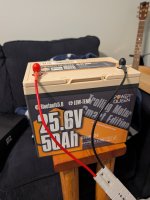
The model I have is the same size as a Group 24 deep cycle and only weighs 21lbs. I bought the PowerQueen 20a charger and plug it in at home. At full discharge it would only take a little over 2 hours to fully charge. I'm not sure there is a good way to charge LifePo4 batteries off the outboard alternator especially with a 24v battery.

1000002405.jpg
 
I would really like to get some kind of meter to tell me what my battery life is.
Not a really expensive item. You'll want one with a shunt and not one that just relies on voltage. That kind will answer the all important question - how much is left?
 
Back
Top