
How to fish wide runs?

bluelines

Just Hatched
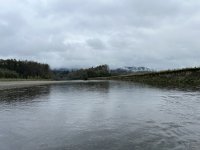
Encountered this wide run (is this called a riffle? ranged from 2-3 ft., maybe around 4 ft. near the steep bank). I didn't find any fish here, but I think I made a few mistakes (nymphing under an indicator):
1. I only focused on the edge near the bank which was deeper. I was convinced there were no fish in the shallower areas, but I was probably scaring them by wading through the middle of the river.
2. I had a hard time mending. The edge toward the steep bank was slow moving, but the water in front was fast moving. I did mend constantly, tried to reach cast, but the water in front was moving very quickly. Not sure if I mended effectively.

Any other tips on fishing water like this?
IMG_2287.jpg
 
Hi @bluelines and welcome to the forum. Here's what I'd do. Fish your feet first. Swing or drift a softhackle or streamer in the shallows before you get near the edge. Break it up into small pieces across and up/downstream. Cover the shallows this way as you work out to the deeper water start working that nymph. Fish the inside seam edge as well as that outside edge. If you wade carefully you can get petty close. Long casts across like that tend to give very short effective drifts, me anyways. I'd cast as short as possible and use a tight line technique.
Lots of folks here with more experience than me, I'm sure the group can help you figure it out. Good luck!
 
Last edited:
Encountered this wide run (is this called a riffle? ranged from 2-3 ft., maybe around 4 ft. near the steep bank).
....
Any other tips on fishing water like this?

View attachment 129406
Personally I'd also call that a run because of the lack of broken - choppy surface water
I didn't find any fish here, but I think I made a few mistakes (nymphing under an indicator):
1. I only focused on the edge near the bank which was deeper. I was convinced there were no fish in the shallower areas, but I was probably scaring them by wading through the middle of the river.
Continuing with the previous posts, I've caught quite a number of fish in shin deep water during periods of low contrast light (early AM, sundown, grey skies). Under those conditions unless I can clearly see there are no larger rocks or troughs to provide cover-holding water, I fish the near water as I enter the stream, and fish a semi-circular pattern with short drifts as I move out into the stream to reach the water near the far bank, then pivot and work upstream or downstream. I have stumbled into too many unseen troughs that could hold fish on my way up-down a stream to only concentrate on the deep water at the far bank, and feel like an idiot when I spook a fish directly in front of me that I may have hooked continuing to fish that semi-circular pattern.
2. I had a hard time mending. The edge toward the steep bank was slow moving, but the water in front was fast moving. I did mend constantly, tried to reach cast, but the water in front was moving very quickly. Not sure if I mended effectively.
I'm a weirdo that has been primarily fishing streams for trout with a Tenkara rod since 2018. In that stream I would probably be fishing *soft hackle* wet flies, or weighted nymphs using a 13 ft rod with a hi-vis 13'-16' light level (0X-12lb) fluorocarbon line, and 3-5ft of tippet. A 12 o'clock to 2 o'clock overhead cast and a high rod stop gives me a 20' reach on a tight line presentation with no line on the water and almost never need to mend. With no line on the water I can also "steer" the drift, put subtle, life-like movement (jigging) on the fly that can trigger strikes, detect strikes faster-easier, and get quick solid hook sets. If I use a semi-circular casting pattern I can cover up to a 40' wide swath as I move upstream-downstream.

Once a floating fly line's *rear* taper is out of the rod tip mending gets harder. When I did-do use a western fly rod with a floating line & bobber to fish nymphs, I try to mend so the line almost goes to the bobber. I often need(ed) to make multiple mends through a drift if I saw a belly of line starting to bow.
 
Last edited:
If I can't fish the water near the steep bank from the shallow side due to the nature of the current(s), I'd cross the river and fish it from the steep bank side.
You are more experienced than I but if the water is 4' deep off the steep bank on river right(?) as stated by the OP that could make wading tricky if an unseen hole is encountered there. Personally I feel better when I have a large, shallow egress path behind me. Also I am right hand dominant and casting upstream (with non-dominant arm?) on river right against a steep bank is a lot harder for me. The OP pic is a situation where I think a 20' reach with a light line off the water works pretty well.
 
Last edited:
  • Like
Reactions: Zak
You are more experienced than I but if the water is 4' deep off the steep bank on river right(?) as stated by the OP that could make wading tricky if an unseen hole is encountered there. Personally I feel better when I have a large, shallow egress path behind me. Also I am right hand dominant and casting upstream (with non-dominant arm?) on river right against a steep bank is a lot harder for me. The OP pic is a situation where I think a 20' reach with a light line off the water works pretty well.
When the OP wrote "wide" run, I took that to mean that the river was too wide, in terms of current and depth, to wade out far enough to fish the potential lie water near the steep bank due to currents that compromised any attempts to mend line. I would certainly try all my options for fishing from the shallow side first, but if I just couldn't, then it's time to cross the river if one really wants to fish that location. Steep bank slots come in at least two types. One is the truly vertical bank that drops immediately into water too deep and or swift to wade. In that case, I might try a few casts from the top of the high bank and not worry about landing any fish I might hook. The second type of steep bank slopes toward the thalweg that is 10' or further out and allows at least some standing and or wading space. I fish a lot of that kind of water, although it's often not a comfortable place to wade - I'm still sporting skinned shins from slipping on boulders last July.
 
Contrary opinion: I wouldn’t. Assuming you came from camera left, after I fished the rocks camera left, I’d head upriver to that bend. I also wouldn’t be mid-river in this spot without a compelling reason.

If you came from the bank, I’d fish the bank edge and he’d upriver.
I agree. You can tell from the shallow bank pea gravel substrate, the lack of wood overall and the eroding fine sediment steep bank, and the slick water surface indicating laminar flow that there’s really no structure here. Fish are very patchily distributed in these types on PNW rivers and I think fishing this stretch is a poor investment of limited fishing time if I wanna catch something. Go fish where there’s broken water surface, and/or bank structure/complexity and/or bottom structure to give fish some cover and a reason to be there. That’s my opinion.

Also after looking again I’m pretty sure I know where that is and I still agree with my own advice haha. Go upstream or downstream to the structure and just below the structure.

Oh one other thing—I call the whole thing from riffle to tailout the “run” but the part shown is a “glide” which is often just above the tailout.
 
I am surprised that no one has mentioned it. There is one universal clue that can help you find fish when there’s no obvious surface activity. That is the bubble line. If you cross sectioned a river, the slowest water will be at the bottom and sides of the flow. The fastest water will be at the surface of the flow. Bubbles have no motive power and move at the whims of the current and in some cases the wind. Bubbles get sucked into the fastest flow and cannot move out of it. In flows like you describe most likely somewhere along the deeper bank there is a bubble line. It indicates the fastest moving section of river and it foilows that drifting nymphs, pupa or worms get moved into that faster flow as well. Nymphing or swinging soft-hackles or streamers through the bubble line is the most logical place to find fish when there is no obvious surface activity. Bubble lines may meander a bit through a run but that is a good indicator of both deeper or faster sections of the river which might not be close to the bank.
 
Anyone ask the OP what they were fishing for and how they were fishing? Or maybe even where in the river (in relation to salt) this piece is?

Salmon to trout to bass, stripers, and shad, dry-fly to swing to dirty-ass bead rig, I see about 10 different ways to approach the water in the pic.
 
Thanks for all the advice so far. I definitely want to try swinging wet flies and starting shallow to deeper next time. Only had nymphs, dries, and streamers in my box :(

Salmo_g:
> When the OP wrote "wide" run, I took that to mean that the river was too wide, in terms of current and depth, to wade out far enough to fish the potential lie water near the steep bank due to currents that compromised any attempts to mend line.
> The second type of steep bank slopes toward the thalweg that is 10' or further out and allows at least some standing and or wading space.
> There is one universal clue that can help you find fish when there’s no obvious surface activity. That is the bubble line.
I was able to wade out far enough to reach the potential lie water. It was probably more my inexperience in being able to mend my line in the faster water in front of me or maybe my nymph was not getting deep enough. Yes, definitely more the second type of steep bank. And yes! I was trying to reach that deeper water because most of the bubble lines were flowing along there.

Matt B:
> I agree. You can tell from the shallow bank pea gravel substrate, the lack of wood overall and the eroding fine sediment steep bank, and the slick water surface indicating laminar flow that there’s really no structure here.
> ...but the part shown is a “glide” which is often just above the tailout.
Spot on, and spot on again. This was right above the tailout where there were many coho splashing their tails.

G_smolt:
> Anyone ask the OP what they were fishing for and how they were fishing? Or maybe even where in the river (in relation to salt) this piece is?
I was hoping to run into some sea run cutthroat trout. I thought the recent rains might have led some of them into the river system. There were lots of what I think were coho salmon, but I wasn't interested nor did I have the gear for them.
 
Anyone ask the OP what they were fishing for and how they were fishing? Or maybe even where in the river (in relation to salt) this piece is?
Good point. Once I realized the location, and given the question and how it was presented, I assumed it was SRC. Not always the best approach, making assumptions.
I was hoping to run into some sea run cutthroat trout. I thought the recent rains might have led some of them into the river system. There were lots of what I think were coho salmon, but I wasn't interested nor did I have the gear for them.
Salmon splashing in the tailout sounds like spawning activity. Good job avoiding the spawners and not trampling the redds.

My approach to SRC is usually stripping streamers of various kinds, or dries twitched, skated and sometimes dead drifted. SRC in general, in my experience, like structure in the river. They will definitely hang in slow, flat, “froggy” stuff, but the more structure the better, especially downed wood. They seem to love downed wood and overhanging trees.
 
Good point. Once I realized the location, and given the question and how it was presented, I assumed it was SRC. Not always the best approach, making assumptions.

Salmon splashing in the tailout sounds like spawning activity. Good job avoiding the spawners and not trampling the redds.

My approach to SRC is usually stripping streamers of various kinds, or dries twitched, skated and sometimes dead drifted. SRC in general, in my experience, like structure in the river. They will definitely hang in slow, flat, “froggy” stuff, but the more structure the better, especially downed wood. They seem to love downed wood and overhanging trees.
Boy, I've had a few terrific days in a couple of small streams drifting nymphs just downstream from spawning Kokanee and into a dark undulating ball of schooled Cutts posted up waiting for a meal. An "egg" fly would probably have brought out the "Catch ME First" signs.
 
Boy, I've had a few terrific days in a couple of small streams drifting nymphs just downstream from spawning Kokanee and into a dark undulating ball of schooled Cutts posted up waiting for a meal. An "egg" fly would probably have brought out the "Catch ME First" signs.
Absolutely. I don’t know why, but when I head out for SRC in the fall, that’s what I am thinking, streamers and dries. Just my “phase 5” approach I suppose. 🙂
 
Back
Top