
Navigation
Install the app
How to install the app on iOS
Follow along with the video below to see how to install our site as a web app on your home screen.
Note: This feature may not be available in some browsers.
More options
Style variation
You are using an out of date browser. It may not display this or other websites correctly.
You should upgrade or use an alternative browser.
You should upgrade or use an alternative browser.
NFR Got any mammal pictures
- Thread starter Cabezon
- Start date
Non-fishing related


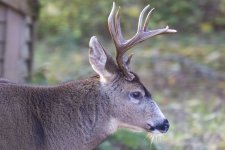
My backyard is a highway for deer. In the late spring and summer, the traffic is mostly does and their fawns. But in the fall, the wary bucks wander through, especially at dusk and dawn, presumably looking for receptive does. These range from young spike bucks to massive, bruiser bucks with big racks. The latter are especially cautious but sometimes they can be captured with the camera, like this dominant buck.
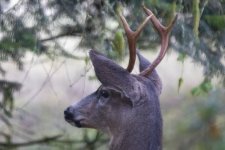
or this subordinate buck.
Steve
or this subordinate buck.
Steve
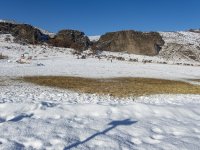
On New Years Day, my wife and I took advantage of a sunny day from the Westside to the Eastside to visit the elk feeding area at Oak Creek Wildlife Area near Naches. WDFW feed hay to mountain elk herds to keep them out of the lowland orchards and yards, their natural winter range. There were about 100 elk waiting patiently for the distribution of hay at 1:30PM.
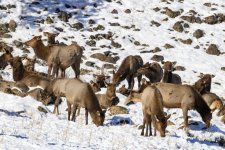
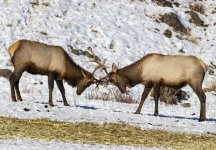
While we were waiting, two near-top quality bulls did some play-sparring.
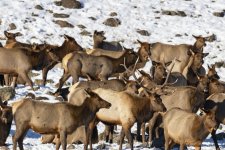
Closer to dinner time, everyone got up and started to wander through the paddock.
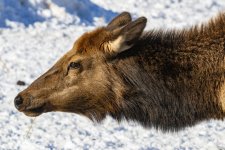
The biggest two bulls were not interested in playing games.
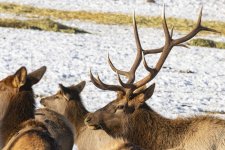
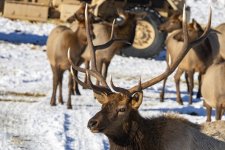
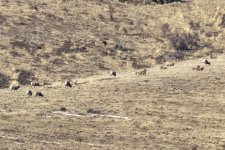
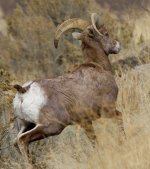
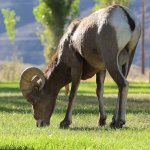
Later, we stopped by the bighorn feeding area near the junction of Hwy. 12 and Hwy. 410. While not as close, there were about 30 bighorns grazing high on the hillside.
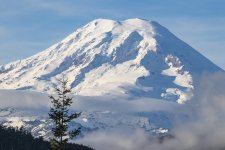
And we had a great view of Mt. Rainier as we headed down the west side of White Pass.
Steve
While we were waiting, two near-top quality bulls did some play-sparring.
Closer to dinner time, everyone got up and started to wander through the paddock.
The biggest two bulls were not interested in playing games.
Later, we stopped by the bighorn feeding area near the junction of Hwy. 12 and Hwy. 410. While not as close, there were about 30 bighorns grazing high on the hillside.
And we had a great view of Mt. Rainier as we headed down the west side of White Pass.
Steve
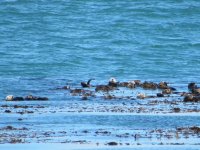

Michael1227
Smolt
While camping at Wallowa last year this youngster wandered by my bbq (I was in the campsite next to us to take these pics.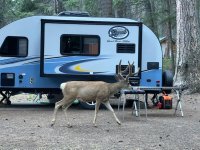

Gyrfalcon22
Legend
Big Otter was working an old slough yesterday that we could occasionally catch coastal cutthroats up and maybe a tad over 20" in the late 70's
Missed the focus on this very small mole below-thought it was a shrew at first until I saw the big diggers in front
Missed the focus on this very small mole below-thought it was a shrew at first until I saw the big diggers in front
Last edited:

My cat dug a mole up under the grass in the yard. Quite a site with her pulling and mole trying to stay in the ground. The kitty won!
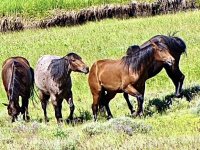
Looks like the second horse from the left has quite the set of dreads
Gyrfalcon22
Legend
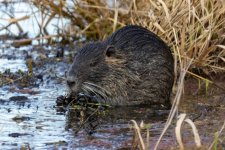
Smallish Nutria having a good time. With all the predators locally, I only see one of these a year at most.
Last edited:
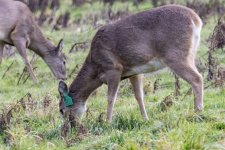
You visit Ridgefield for the birds, but there are mammals too that are commonly seen on the Auto Route too. Ridgefield is one of the core restoration areas for Columbian white-tailed deer, an endangered subspecies of the white-tailed deer. There are approximately 1200 individuals in the lower Columbia River of Washington. As part of the management process, some individuals have been reallocated into the refuge. These individuals, like this doe (Ms. 201), are marked with ear tags.
A less welcome member of the mammal fauna is the introduced nutria. They are native to South American and can reach over 30 pounds in mass. They were introduced to the U.S. for their furs, but due to escapees, they have been spreading across the waterways of the U.S. These rodents can be very destructive as their burrowing activity into the banks of canals and earthen dam can weaken these structures.
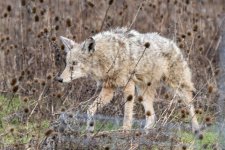
 In several visits at the tail end of 2023, we have seen several coyotes out hunting in the day. I suspect that these individuals consists of a breeding pair and their mangy offspring from the summer. There are lots of rodents here. Migratory birds weakened by their efforts or injured by hunters can be easy prey too.
 Steve
Steve
A less welcome member of the mammal fauna is the introduced nutria. They are native to South American and can reach over 30 pounds in mass. They were introduced to the U.S. for their furs, but due to escapees, they have been spreading across the waterways of the U.S. These rodents can be very destructive as their burrowing activity into the banks of canals and earthen dam can weaken these structures.
In several visits at the tail end of 2023, we have seen several coyotes out hunting in the day. I suspect that these individuals consists of a breeding pair and their mangy offspring from the summer. There are lots of rodents here. Migratory birds weakened by their efforts or injured by hunters can be easy prey too.Steve
Bass-O-Matic
Life of the Party

That stalk of dried grass sticking out of the corner of the mouth sort of reminds me of a male human with a toothpick protruding out of their mouth LOL

Bass-O-Matic
Life of the Party
Lawn mower - Vantage, WA
“There was an old lady who swallowed a fly. Perhaps she’ll die”. The history of European rabbits and red foxes on San Juan Island (SJI) shares many aspects of the old nursery rhyme. Whatever land mammals may have been on SJI were wiped out by the last glacial maximum 20,000 years ago and the island’s distance from the mainland has been a barrier to recolonization (a field of science known as island biogeography). As a result, San Juan Island lacks some of the mammals found on the mainland or even some of the other San Juan Islands. For example, the only squirrel species on San Juan Island is the elusive Northern flying squirrel. There are no gray squirrels or chipmunks or native rabbits on San Juan.
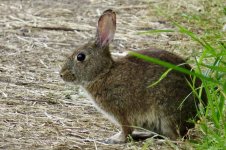
But European domestic rabbits were first introduced in the late 1800’s by a lighthouse keeper on San Juan Island (for sale as meat in Seattle) and some escaped / were released. As a result, these feral European rabbits have been quite common and can be found across the island, especially in broad warrens along the southern slopes of American Camp National Historic Monument. At times, the rabbit population has exploded; a single pair can produce 180 rabbits in 18 months. I have heard tales of Friday Harbor Labs graduate students in the 1970’s who competed with the local bald eagles to harvest road-killed rabbits – perhaps legend, perhaps some truth (suspects available on request). High rabbit numbers have meant chewed-up vegetable gardens and grasslands/prairies that have been badly overgrazed and disturbed by rabbit burrows. There is a vast rabbit warren off Pickett’s Lane leading to South Beach at American Camp. It is easy to see by the mounds of earth and the short-cropped grasses where the rabbit warrens are concentrated.
Efforts to remove / control these nuisance rabbits have include hunting them, infecting them with nasty viruses, and introducing a non-native predator, the red foxes (hence the nursery rhyme reference above). These SJI foxes are not even the native Western Washington red foxes, but came from population from Alaska and Western Canada which show genetic differences from the native foxes. These introduced animals had been domesticated for the fur trade before some were released on San Juan Islands; therefore, the islands have both the more common red fur morphs and silver morphs.
The introduction of the foxes has been partially successful; they do eat European rabbits. But these foxes also feed on a number of other native bird and mammal species. It seemed to me that when foxes invaded the Friday Harbor Labs reserve, the number of California quail dropped dramatically. Exactly their impact on native ground-nesting birds, mammals, and reptiles (garter snakes and alligator lizards) is unknown.
And the interactions foxes and rabbits and humans have brought new problems: the “foxerazzi”. In spring, the adult foxes hunt rabbits and pass them to their kits who have left the family den, but which are not yet adept hunters on their own. But the resident bald eagles, ever eager for an easy meal, keep watch over the warrens and will swoop in to steal the rabbits from the foxes. In one famous photograph, an eagle has grabbed a fox’s rabbit in its talons and attempted to carry it off, but the fox has kept its hold on the rabbit and all three are in the air (honorable mention at the 2019 Audubon photograph award). [In the end, the fox kit let go and fell to the ground unharmed and the eagle made off with its stolen meal.].
The opportunity to photograph cute fox kits in the wild and perhaps photograph this unusual three-species interaction has led to an explosion of photographers who want to capture these kinds of images = “foxerazzi”. In response, the park service had had to put up signs that limit where people can go to maintain some distance between the wildlife (albeit introduced wildlife), especially the fox dens, and the people. And some people appear to be feeding the foxes, either to draw them in closer for photographs or in the mistaken belief that they are hungry. This habituates the foxes to people and can lead to unfortunate interactions (bites, disease transmission, etc.).
The Robert’s Redoubt (built in part by Lieutenant Henry Robert who later wrote Robert’s Rules of Order) location at American Camp National Historic Monument provides commanding views of the South end of San Juan Island, across to Griffin Bay, South Beach, and the Strait of Juan de Fuca. That’s why it was a great location for a military base when the U.S. and Great Britain were at odds during the “Pig War” which started in 1859 when an American farmer shot a Hudson Bay Company pig that was rooting in his garden (look it up…). While we were observing short-eared owls on New Year’s Day from the slopes of the redoubt, we also had a great view into the rabbit warrens along Pickett’s Road (yes, that Civil War Pickett). We saw first one silver-phase fox, then a second silver-phase, and then a third red[phase fox wander onto the warrens in the late afternoon.
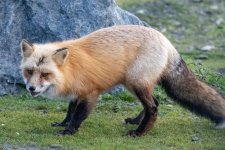
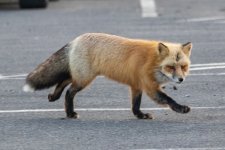
After absorbing our fill of short-eared owls and Northern harriers, we drove down Pickett’s Lane and then onto South Beach. The red-phase fox had trotted through the thicket of trees/shrubs that separate the slope with the rabbit warrens from the beach flat and small dunes. My wife indicated that this was the male. He was clearly on a mission, sniffing behind the parking area for any dropped food and then through the picnic area. I managed a few choice pictures through the driver’s side window.
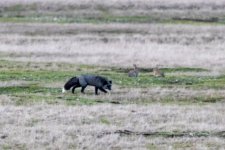
Heading back up Pickett’s lane in the dwindling light, I was in position to photograph the two silver-fox individuals that were in the middle of the rabbit warrens. One individual was curled up into a gray/silver ball as it napped. The other trotted across a warren not far from a pair of alert, but unperturbed rabbits.
Steve
But European domestic rabbits were first introduced in the late 1800’s by a lighthouse keeper on San Juan Island (for sale as meat in Seattle) and some escaped / were released. As a result, these feral European rabbits have been quite common and can be found across the island, especially in broad warrens along the southern slopes of American Camp National Historic Monument. At times, the rabbit population has exploded; a single pair can produce 180 rabbits in 18 months. I have heard tales of Friday Harbor Labs graduate students in the 1970’s who competed with the local bald eagles to harvest road-killed rabbits – perhaps legend, perhaps some truth (suspects available on request). High rabbit numbers have meant chewed-up vegetable gardens and grasslands/prairies that have been badly overgrazed and disturbed by rabbit burrows. There is a vast rabbit warren off Pickett’s Lane leading to South Beach at American Camp. It is easy to see by the mounds of earth and the short-cropped grasses where the rabbit warrens are concentrated.
Efforts to remove / control these nuisance rabbits have include hunting them, infecting them with nasty viruses, and introducing a non-native predator, the red foxes (hence the nursery rhyme reference above). These SJI foxes are not even the native Western Washington red foxes, but came from population from Alaska and Western Canada which show genetic differences from the native foxes. These introduced animals had been domesticated for the fur trade before some were released on San Juan Islands; therefore, the islands have both the more common red fur morphs and silver morphs.
The introduction of the foxes has been partially successful; they do eat European rabbits. But these foxes also feed on a number of other native bird and mammal species. It seemed to me that when foxes invaded the Friday Harbor Labs reserve, the number of California quail dropped dramatically. Exactly their impact on native ground-nesting birds, mammals, and reptiles (garter snakes and alligator lizards) is unknown.
And the interactions foxes and rabbits and humans have brought new problems: the “foxerazzi”. In spring, the adult foxes hunt rabbits and pass them to their kits who have left the family den, but which are not yet adept hunters on their own. But the resident bald eagles, ever eager for an easy meal, keep watch over the warrens and will swoop in to steal the rabbits from the foxes. In one famous photograph, an eagle has grabbed a fox’s rabbit in its talons and attempted to carry it off, but the fox has kept its hold on the rabbit and all three are in the air (honorable mention at the 2019 Audubon photograph award). [In the end, the fox kit let go and fell to the ground unharmed and the eagle made off with its stolen meal.].
The opportunity to photograph cute fox kits in the wild and perhaps photograph this unusual three-species interaction has led to an explosion of photographers who want to capture these kinds of images = “foxerazzi”. In response, the park service had had to put up signs that limit where people can go to maintain some distance between the wildlife (albeit introduced wildlife), especially the fox dens, and the people. And some people appear to be feeding the foxes, either to draw them in closer for photographs or in the mistaken belief that they are hungry. This habituates the foxes to people and can lead to unfortunate interactions (bites, disease transmission, etc.).
The Robert’s Redoubt (built in part by Lieutenant Henry Robert who later wrote Robert’s Rules of Order) location at American Camp National Historic Monument provides commanding views of the South end of San Juan Island, across to Griffin Bay, South Beach, and the Strait of Juan de Fuca. That’s why it was a great location for a military base when the U.S. and Great Britain were at odds during the “Pig War” which started in 1859 when an American farmer shot a Hudson Bay Company pig that was rooting in his garden (look it up…). While we were observing short-eared owls on New Year’s Day from the slopes of the redoubt, we also had a great view into the rabbit warrens along Pickett’s Road (yes, that Civil War Pickett). We saw first one silver-phase fox, then a second silver-phase, and then a third red[phase fox wander onto the warrens in the late afternoon.
After absorbing our fill of short-eared owls and Northern harriers, we drove down Pickett’s Lane and then onto South Beach. The red-phase fox had trotted through the thicket of trees/shrubs that separate the slope with the rabbit warrens from the beach flat and small dunes. My wife indicated that this was the male. He was clearly on a mission, sniffing behind the parking area for any dropped food and then through the picnic area. I managed a few choice pictures through the driver’s side window.
Heading back up Pickett’s lane in the dwindling light, I was in position to photograph the two silver-fox individuals that were in the middle of the rabbit warrens. One individual was curled up into a gray/silver ball as it napped. The other trotted across a warren not far from a pair of alert, but unperturbed rabbits.
Steve

They also eat Cheez-Its. I watched some touron hop out of their car at the Nat'l Monument with a box of Cheez-Its and a red fox trotted right on up to the guy and happily took the handout.The introduction of the foxes has been partially successful; they do eat European rabbits.
Bass-O-Matic
Life of the Party
Back in my ranching days one of the old guys fed stale donuts to the coyotes. I always thought that wasn't doing them a favor?They also eat Cheez-Its. I watched some touron hop out of their car at the Nat'l Monument with a box of Cheez-Its and a red fox trotted right on up to the guy and happily took the handout.
Gyrfalcon22
Legend
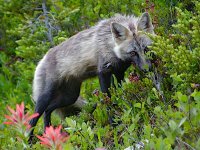
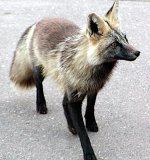
Really interesting stuff @Cabezon ! I had to look up and see more about the foxes. So the ones we'd see at Paradise are endangered Cascade red foxes.
The ones I very rarely locally see to me..and a few I've seen in Mud Bay/downtown Olympia, I wonder what they mean by "introduced" populations? They are not likely the same source as the ones from the San Juans, but Cascade foxes? Or regular American red's?
Paradise Cascade red fox
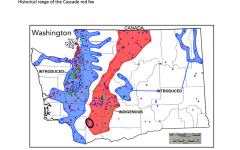
The ones I very rarely locally see to me..and a few I've seen in Mud Bay/downtown Olympia, I wonder what they mean by "introduced" populations? They are not likely the same source as the ones from the San Juans, but Cascade foxes? Or regular American red's?
Paradise Cascade red fox
Last edited: