U.S. drafts plan to bring grizzly bears back to Washington’s North Cascades (WAPO)

Status
Not open for further replies.
Most wildlife would spend the bulk of their time in areas of high food source availibility, so I would think Grizzly populations in the 1800's in Washington were primarily in the lowlands and valleys.

Reading the early Yellowstone explorers diaries and comments from their trips up there, one quote has always stood out:

'A buzzard would have to pack a lunch to cross that country' ( from memory, may not be word for word) as there were few if any large mammals up there prior to settlement of lowlands around there. Small game were there, and beavers that were trapped out, but certainly less large mammals than today.

Of course that makes sense, given the vast amounts of open space grasslands available for wildlife, as opposed to the comparatively harsh climate and limited food resources on the Yellowstone plateau.
 
Although there are grizzly bears in southwest British Columbia, their numbers are depressed because of habitat fragmentation, human development, and associated effects on bear security (e.g. poaching, human conflict) and genetic diversity. Because of barriers such as the Fraser River Valley and TransCanada Highway, the North Cascades Ecosystem is not well-connected to grizzly bear populations in the B.C. Coast and Chilcotin Ranges so there are no readily available source bear populations to recolonize the North Cascades naturally. On top of the connectivity barriers, grizzly bears are slow to increase in numbers because of their reproductive biology – they are the second slowest reproducing land animal in North America, next to the musk ox. All of these factors combine to make natural recolonization of the North Cascades by grizzly bears traveling in from elsewhere nearly impossible.
 

There may only be a handful of grizzly bears left in the North Cascades, making their population functionally extinct, Ransom said.

Grizzlies are tied with the muskox as one of the slowest reproducing mammals in North America, Ransom said. Grizzlies birth one to three cubs every two to four years, he said. Over a roughly 30-year lifespan, biologists said that’s not enough bears to repopulate the North Cascades.

“Not that many cubs in a lifetime. They’re slow growers as a population goes,” Ransom said.

Over the past five years, one grizzly bear has been spotted in the British Columbia section of the North Cascades Ecosystem, roughly 20 miles from the U.S. border, said Ann Froschauer, deputy state supervisor for the U.S. Fish and Wildlife Service.

“We don’t believe that there are enough bears or that the population is growing in the Canadian portion of the North Cascades Ecosystem that we could expect that those bears would be able to naturally recover in the U.S. portion of the ecosystem,” Froschauer said.
 
Although there are grizzly bears in southwest British Columbia, their numbers are depressed because of habitat fragmentation, human development, and associated effects on bear security (e.g. poaching, human conflict) and genetic diversity. Because of barriers such as the Fraser River Valley and TransCanada Highway, the North Cascades Ecosystem is not well-connected to grizzly bear populations in the B.C. Coast and Chilcotin Ranges so there are no readily available source bear populations to recolonize the North Cascades naturally. On top of the connectivity barriers, grizzly bears are slow to increase in numbers because of their reproductive biology – they are the second slowest reproducing land animal in North America, next to the musk ox. All of these factors combine to make natural recolonization of the North Cascades by grizzly bears traveling in from elsewhere nearly impossible.
Connectivity issues are something I can definitely get behind. The animal overpasses on 90 are a great example of reestablishing connectivity, with moose and wolves seen crossing into the southern cascades to exploit suitable habitat.

I think the issues I'm having with relocating bears to the NCE is that I dont believe theyll be successful there without the ability to seasonally exploit distant food sources. Establishing connection with southern BC salmon sources would certainly help that effort.
 
It's pretty obvious where grizzlies are finding success and where they are expanding in this more modern world.

This success is based on a protein source. Alaska bears have salmon and caribou with rich estuaries and so on. Yellowstone area has bison and elk and so on. Idaho has a mix of elk and deer.

The North Cascades has? The deer population is crap and getting chomped by wolves and cougars. Elk are almost non existent. Moose are almost nonexistent. Salmon nonexistent and so on. Maybe our goal is to create the first vegetarian bear? 🤔
 
It's pretty obvious where grizzlies are finding success and where they are expanding in this more modern world.

This success is based on a protein source. Alaska bears have salmon and caribou with rich estuaries and so on. Yellowstone area has bison and elk and so on. Idaho has a mix of elk and deer.

The North Cascades has? The deer population is crap and getting chomped by wolves and cougars. Elk are almost non existent. Moose are almost nonexistent. Salmon nonexistent and so on. Maybe our goal is to create the first vegetarian bear? 🤔
Note that Inland Grizzly, once a strong 3,500 plus group in the North Cascades, made it mostly on a (85%) diet of berries. I would think up to 200 bears would have easy pickings.

Alaskan "Brown" bears are Grizzly bears but are quite different from Inland Grizzlies. Brown bears push a half ton while a very large Inland Grizz might make 400 to 500 pounds. So, you are pretty close on the vegetarian bear but it's far from the first one.

I will disagree on your "success based on protein" source in Yellowstone but that topic has been hammered to death in other threads.
 
Last edited:
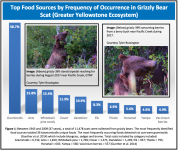
Grizzly bear diets are primarily vegetarian...
Even in the areas you mentioned.

screen-shot-2019-06-20-at-11-03-07-pm_orig.png
 
Connectivity issues are something I can definitely get behind. The animal overpasses on 90 are a great example of reestablishing connectivity, with moose and wolves seen crossing into the southern cascades to exploit suitable habitat.

I think the issues I'm having with relocating bears to the NCE is that I dont believe theyll be successful there without the ability to seasonally exploit distant food sources. Establishing connection with southern BC salmon sources would certainly help that effort.
I don't believe they'll be successful there without the ability to seasonably exploit distant food sources - your point

If 3,500 bears once made it until we nearly wiped them out, wouldn't 200 bears have it made?
 
Grizzly bear diets are primarily vegetarian...
Even in the areas you mentioned.

View attachment 89487
Cute graphic. Why didn't you include this part?

Mammals: Grizzly bears most often use mammals as a food source during the spring and fall (Mattson et al. 1990). Ungulates (elk, bison, deer) comprise a huge portion of the mammals consumed. Importantly, grizzly bears would rather scavenge on winter-killed ungulates, or wolf killed ungulate carcasses rather than exert the energy to engage in predation (opportunistic). Grizzly bears will seek out winter-killed ungulates (wolf killed ungulates) and weakened animals during the early spring; during the fall, bears will seek out ungulates weakened by the rut (elk in September/October, bison in August/September) (Schleyer 1983).

the-end-al-bundy.gif
 
  • Like
Reactions: JS
Cute graphic. Why didn't you include this part?

Mammals: Grizzly bears most often use mammals as a food source during the spring and fall (Mattson et al. 1990). Ungulates (elk, bison, deer) comprise a huge portion of the mammals consumed. Importantly, grizzly bears would rather scavenge on winter-killed ungulates, or wolf killed ungulate carcasses rather than exert the energy to engage in predation (opportunistic). Grizzly bears will seek out winter-killed ungulates (wolf killed ungulates) and weakened animals during the early spring; during the fall, bears will seek out ungulates weakened by the rut (elk in September/October, bison in August/September) (Schleyer 1983).

View attachment 89491
This point has been made. Inland Grizzly bears are lazy as hell and, as you say, are opportunistic omnivores. It doesn't dismiss the fact that 85% of their diets are different types of berries. I wish I could cut my red meat consumption to 15% or less.
 
This point has been made. Inland Grizzly bears are lazy as hell and, as you say, are opportunistic omnivores. It doesn't dismiss the fact that 85% of their diets are different types of berries. I wish I could cut my red meat consumption to 15% or less.
I won't dismiss that they eat a lot of berries (never really was) if you don't dismiss the importance of the rest of their diet...😁
 
Omnivores by definition eat everything.
That includes meat, so just as I said, the available data shows a primarily vegetarian diet.
By percentage, it is more vegetarian than carnivore. My 'cute' graphic shows elk among their diet.

Winter kill ungulates, and carcasses from other predator kills...
As your quote states :

...grizzly bears would rather scavenge on winter-killed ungulates, or wolf killed ungulate carcasses rather than exert the energy to engage in predation (opportunistic).

Put another way, they prefer an already dead animal to hunting down and killing a healthy one.

😁
 
Omnivores by definition eat everything.
That includes meat, so just as I said, the available data shows a primarily vegetarian diet.
By percentage, it is more vegetarian than carnivore. My 'cute' graphic shows elk among their diet.

Winter kill ungulates, and carcasses from other predator kills...
As your quote states :

...grizzly bears would rather scavenge on winter-killed ungulates, or wolf killed ungulate carcasses rather than exert the energy to engage in predation (opportunistic).

Put another way, they prefer an already dead animal to hunting down and killing a healthy one.

😁
Exactly. Elk. There isn't elk in the North Cascades...

Not a measurable amount anyway....maybe we should stock them?😁
 
  • Like
Reactions: JS
Better to stock the North Cascades with Soap Lake girls...
Easier to catch and more calories.
Elk are quite lean, not much fat.
That can't be said about Soap Lake girls...
🙂
 
Sounds like some triploid vegan or vegetarian grizzly plants are called for.
SF
 
Triploid grizz...
Stock 'em by float plane, raise 'em on Humpies...
;)
 
Status
Not open for further replies.
Back
Top