jerajames -
Good question about the salt being closed while allowing coho fishing in the rivers. It is a more complex issue than it might appear on the surface.
First and foremost must recognize that virtual all the marine fisheries are mixed stock fisheries, that is there are multiple stocks (fish from different river systems) in the fishery. Such fisheries can be controlled by the weakest (that which is the worst shape) with fishing being closed when impacts on that weaker stock is reach even though there can be abundant coho from other systems.
Conversely, those fish returning to a river with abundant stocks (in excess of escapement needs) fish can be allowed while some marine areas can be closed.
Maybe a simple example lets assume a simple fishery in a single MA with two coho stock A one of which is robust run) expect to be well above escapement needs) the other with a weaker stock B (with a limited excess of escapement needs). Once the limit excess is taken the marine fishery might be closed, in river fishery in Stock A river allowed and the river in stock B closed. It can be further complicated if the decision is made in the NOF process is to share those limited excess for Stock B between the marine fishery and the in-river fishery. In that case because the coho are caught earlier in the year than those in the river it may be the case that the marine fish would close an in-river for stock B would be allowed until that excess is taken.
At times later in the season there can be updates to a particular run (often based on terminal commercial fishery catches). In those cases the amount of river fishing can be adjusted either to longer or shorter time on the water. The timing of those updates typically are late enough to provide meaningful opportunity in the salt.
Also remember that we are fishing the salt months and, in some cases, year-round prior to the coho even showing up in the rivers in meaningful numbers so the peak marine fishing will always be earlier than that in the rivers.
Experience has proven that there is a lot less than can go wrong in handling fish for the mature in-river fish than those caught weeks or months prior to entering the river. The handling mortality on in-river fish (especially those close to sexual maturity) than those in the salt. This is due in large part to the changes those maturing fish undergo that toughen them up to handle the rigors of spawning. One is that a coho scales are actual contained within an envelope of skin. As the fish matures and stops growing that skin thickens and essentially embeds the scale making it more difficult to significantly injure the fish. You may have noticed early in the summer a coho readily sheds scales as we handle them, a few week later the scale loss is less and by the time the fish begins to color the individual scales are difficult to remove.
All the above is a simplistic look at the question and with most things in fisheries management there can be exceptions or more complex turns.
hope this helps
Curt



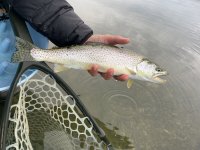


 One other small fish to had and a couple weak grabs and that was it.