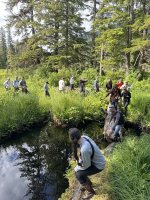
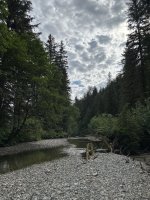
Spent a wonderful 8 days visiting and cruising the inland waterways north of Sitka with an old friend who lives there. Our main interest was flyfishing the streams and their mouths for searun Dollies and Cutts. Although the quest was futile (runs were not yet occurring), I did learn a few things about fishing in that gorgeous and somewhat intimidating environment.
1) A deep respect for the ferocity of tides in a very complex system of channels and islands. Interesting and a bit overwhelming to a flatwater lake guy like myself.
2) A lot of rain, even in the 'best weather' time of the year...no surprises there; that's SE Alaska.
3) The short streams (often only a few miles long and fed by snowmelt/heavy rainfall) are quite sterile and do not appear to have resident trout, which makes complete sense since the the saltwater they discharge to teems with nourishing prey. The biological value of the stream completely revolves around spawning.
4) Devils Club grows in great tangles along the streams...with stalks up to 8 feet high covered with a dense coat of long thorns. The toughest waders are simply no match for these aptly named plants.
5) A species of blood sucking blackfly called 'White Socks' inhabit such environments, and are attracted in great numbers around anyone unfortunate to be out and about on a windless day. The 'honey badgers' of the dipteran world, they do not seem to be affected by DEET in any significant manner. I hate them and (like baldfaced hornets and yellow jackets), pray for the demise of their species even if it resulted in great ecological harm.
6) The streamsides are also thick with Giant Cow Parsnip, whose sap is capable of producing large blistering burns if subjected to sunlight. Clothing and skin is easily contaminated with the sap when busting through streamside brush. My Alaskan friend was far more concerned about potential exposure to Parsnip sap than contact with bears....
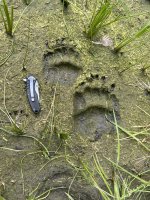
7) We saw several large (to me anyway) brown bears walking the tidal zones of the bays we were visiting. Some with cubs as big as our 'lower 48' black bears. There's something a bit unsettling about scrambling through thick brush, knowing that rather large predators are absolutely roaming about in one's immediate vicinity....as evidenced by coming across a recently vacated 'bear bed' the size of a VW.
I took some slight solace from the fact that my friend is an old Alaska hand, was equipped with a 454 Casull in a chest harness, and a bum leg. I suspect our streamside rambles were one of the few times he was grateful that my tendency (as he so delicately puts it) to 'never fucking shut up' was marginally useful as a bear deterrent. I was pointlessly equipped with a 45 automatic (roughly equivalent to a toddler's 'Busy Driver' toy in serious bear country) which might have useful to dispatch myself to save the bear some trouble.
In summary...I would go back in a heartbeat, but next time I hope some sort of searun salmonid run is occurring (although that's when the bears go streamfishing too!).
1) A deep respect for the ferocity of tides in a very complex system of channels and islands. Interesting and a bit overwhelming to a flatwater lake guy like myself.
2) A lot of rain, even in the 'best weather' time of the year...no surprises there; that's SE Alaska.
3) The short streams (often only a few miles long and fed by snowmelt/heavy rainfall) are quite sterile and do not appear to have resident trout, which makes complete sense since the the saltwater they discharge to teems with nourishing prey. The biological value of the stream completely revolves around spawning.
4) Devils Club grows in great tangles along the streams...with stalks up to 8 feet high covered with a dense coat of long thorns. The toughest waders are simply no match for these aptly named plants.
5) A species of blood sucking blackfly called 'White Socks' inhabit such environments, and are attracted in great numbers around anyone unfortunate to be out and about on a windless day. The 'honey badgers' of the dipteran world, they do not seem to be affected by DEET in any significant manner. I hate them and (like baldfaced hornets and yellow jackets), pray for the demise of their species even if it resulted in great ecological harm.
6) The streamsides are also thick with Giant Cow Parsnip, whose sap is capable of producing large blistering burns if subjected to sunlight. Clothing and skin is easily contaminated with the sap when busting through streamside brush. My Alaskan friend was far more concerned about potential exposure to Parsnip sap than contact with bears....
7) We saw several large (to me anyway) brown bears walking the tidal zones of the bays we were visiting. Some with cubs as big as our 'lower 48' black bears. There's something a bit unsettling about scrambling through thick brush, knowing that rather large predators are absolutely roaming about in one's immediate vicinity....as evidenced by coming across a recently vacated 'bear bed' the size of a VW.
I took some slight solace from the fact that my friend is an old Alaska hand, was equipped with a 454 Casull in a chest harness, and a bum leg. I suspect our streamside rambles were one of the few times he was grateful that my tendency (as he so delicately puts it) to 'never fucking shut up' was marginally useful as a bear deterrent. I was pointlessly equipped with a 45 automatic (roughly equivalent to a toddler's 'Busy Driver' toy in serious bear country) which might have useful to dispatch myself to save the bear some trouble.
In summary...I would go back in a heartbeat, but next time I hope some sort of searun salmonid run is occurring (although that's when the bears go streamfishing too!).
Last edited:


 I have a picture somewhere of the mount.