
Coach Potter
Legend
I have a Nikon Z-6 II. I’m still learning how to use it.

Follow along with the video below to see how to install our site as a web app on your home screen.
Note: This feature may not be available in some browsers.


the OM/Zuiko 12-100 f/4, at ~$950 used, is the one lens that I'd pick that covers a lot of the range of the three lenses you've chosen (which are all good choices). This is the lens that lives on my camera 80% of the time. 15% 150-400 and 5% 7-14.OM System (formerly Olympus) is probably the best company for folks with an outdoors lifestyle; they are the only company that has an IP rating on their interchangeable lens system. In other words, they’re the only company with weather sealing that is proven to actually work.
TG-6 or TG-7 are a decent option, if all you want is a basic point and shoot. They are waterproof and have great macro. You won’t really be able to get blurry backgrounds though and the resolution isn’t great. It’s basically an iPhone level camera. If you have an iPhone Pro, all you would really be gaining is waterproofing.
The micro four thirds platform is the more interesting option. This is what I use. An Olympus E-M5 III can be found, used, for around $500. Below are the lenses I would recommend, in order.
Fun fact: Chris Niccolls is a fly fisher and one of the most well known camera reviewers (DPReview, PetaPixel, etc). He has access to anything he wants, but he has used Olympus almost exclusively for many years.
- 17mm f/1.8 II: Very compact. Captures more or less what you see with your own eyes. Good for low light. $550 new.
- 14-150mm f/4-5.6 II: Super zoom. Wide enough for landscapes. Long enough for some basic wildlife usage. Not good for low light. $250 used.
- 12-40mm f/2.8: Jack of all trades. $400 used.

Do you find that using a super zoom on a small camera system is unwieldy?the OM/Zuiko 12-100 f/4, at ~$950 used, is the one lens that I'd pick that covers a lot of the range of the three lenses you've chosen (which are all good choices). This is the lens that lives on my camera 80% of the time. 15% 150-400 and 5% 7-14.
the OM/Zuiko 12-100 f/4, at ~$950 used, is the one lens that I'd pick that covers a lot of the range of the three lenses you've chosen (which are all good choices). This is the lens that lives on my camera 80% of the time. 15% 150-400 and 5% 7-14.
The OM-1 (m4/3) 150-400 is far more capable and significantly lighter than my D500 (1.5 crop) and 200-500. I never use a tripod and always have one hand on the body and another supporting the lens. Everything seems balanced between those two points of contact.Do you find that using a super zoom on a small camera system is unwieldy?
I ask because my small camera system is a Fuji crop sensor and I have considered but heretofore avoided big lenses for it because it seems they would be unbalanced.
I may have to give Fuji zooms another look. Would be nice to have a 70-200 2 or 2.8 equivalent for times when I don’t feel like hauling the boat anchors around.The OM-1 (m4/3) 150-400 is far more capable and significantly lighter than my D500 (1.5 crop) and 200-500. I never use a tripod and always have one hand on the body and another supporting the lens. Everything seems balanced between those two points of contact.
Edit: I’ve heard people complain about certain bodies not fitting well in their hands, but never balance.

With ISO and AI noise reduction being so good these days, having super fast lenses - at great weight and cost penalties - isn’t as important as it once was. If you need that shallow DoF then maybe…I may have to give Fuji zooms another look. Would be nice to have a 70-200 2 or 2.8 equivalent for times when I don’t feel like hauling the boat anchors around.
I agree with you on ISO (25,600 is crazy clean and vibrant on my R1s) but I’m often working in bad light and especially for the crop sensors a wider max aperture gives me more flexibility for controlling ambient with flash, background separation, etc.With ISO and AI noise reduction being so good these days, having super fast lenses - at great weight and cost penalties - isn’t as important as it once was. If you need that shallow DoF then maybe…
"Content authenticity" is an interesting concept when it comes to photography.I agree with you on ISO (25,600 is crazy clean and vibrant on my R1s) but I’m often working in bad light and especially for the crop sensors a wider max aperture gives me more flexibility for controlling ambient with flash, background separation, etc.
As for AI noise reduction—it’s not for me. I don’t and won’t use any AI in any of my images, and what little I do in post anyway is limited to color correction and maybe cropping. All my images are run through content authenticity from start to finish. Everyone is welcome to their own opinions, it’s just not for me.
I also agree on size, which is why my tiny Fujis have fast primes on them. Thus my initial question. Right now I save the big lenses for the Canons and the medium format Fuji.
100%With ISO and AI noise reduction being so good these days, having super fast lenses - at great weight and cost penalties - isn’t as important as it once was. If you need that shallow DoF then maybe…

Wasn't the Mamiya 7 a beautiful camera system? Amazing! I lugged one into the Enchantments and other favorite hiking spots and still enjoying looking at the big long rolls from time to time. Also, although not as aesthetically pleasing to hold and use, the Fuji "plastic Leica" 6x9's in the GSW690 and GW690 ii's were bargain gems as well.Before the above, I spent most of my time with an Ebony SW45 4"x5" large format view camera with several nice Schneider lenses and a Mamiya 7 medium format rangefinder. Lately been thinking about getting a copy stand to use the A7R to digitize some of the boxes and boxes of negatives in storage. Maybe when I retire in a couple years.
I was just up on Vancouver Island and stumbled across a bird walk hosted by a local heavy hitting birder. There were some photogs around with big Canon kits including an 800mm f4 and 1.4x teleconverter. The thing looked extremely unwieldy! I was quite happy with my 150-400 with built-in 1.25x TC.100%
I was hiking in the desert last weekend and came up on some bird photographers with what looked like a 400/2.8. Looked heavy as hell. I'd love to have some longer legs in my rig but no way I'm lugging one of those things around in the desert/mountains even if cost wasn't the concrete barrier that it is.
Yes. I had both a 6 and a 7. Loved them both. Still around but super pricy on the secondary market. Really loved it with Fomapan 400 processed in Rodinal for street and other on the fly stuff.Wasn't the Mamiya 7 a beautiful camera system? Amazing! I lugged one into the Enchantments and other favorite hiking spots and still enjoying looking at the big long rolls from time to time. Also, although not as aesthetically pleasing to hold and use, the Fuji "plastic Leica" 6x9's in the GSW690 and GW690 ii's were bargain gems as well.
Fun stuff !!
Yes, when I checked prices not long ago I realized film cameras were not dead as predicted. Haha.Yes. I had both a 6 and a 7. Loved them both. Still around but super pricy on the secondary market. Really loved it with Fomapan 400 processed in Rodinal for street and other on the fly stuff.
I do love the 150-400! I didn't love the price at first but the slight discount via my former employer was helpful. Gotta say... the AF is pretty amazing. I'm still learning all the bells and whistles for the OM-1 as well.One huge plus about the newer big fast glass -such as the 600/f4 lenses from now, the big three: Sony, Nikon and Canon, are that the materials used make them are lighter than they look. I once had an old manual focus Nikon 600/4 that tipped the scales at 14 pounds. The newest 600/4's weigh around 6 pounds. Huge difference. Your wallet will feel much lighter as well. Yowza!!
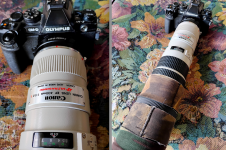
@adamcu280 Bet you are enjoying the Olympus 150-400? Great reputation. I shoot the poor man's version on my old Olympus EM1 Mark II. I use my old trusted Canon 400mm f5.6 prime adapted to my EM1. It has been a stellar field outfit. I manually focus out of habit so lacking AF only brings out a few swear words every other trip out. I think for about $1000 combined, I'd stack this against anything out there-for those willing to forgo AF, of course.
View attachment 152688
With ISO and AI noise reduction being so good these days, having super fast lenses - at great weight and cost penalties - isn’t as important as it once was. If you need that shallow DoF then maybe…