
Navigation
Install the app
How to install the app on iOS
Follow along with the video below to see how to install our site as a web app on your home screen.
Note: This feature may not be available in some browsers.
More options
Style variation
You are using an out of date browser. It may not display this or other websites correctly.
You should upgrade or use an alternative browser.
You should upgrade or use an alternative browser.
Weather forecast-who do you trust?
- Thread starter iveofione
- Start date


fkajwg
formerly known as ...
Graupel Sunday afternoon.The snow at my house in south Kennewick is much deeper than at your house it appears. I'll have to scrape a couple inches of snow from my truck before I go play tennis this morning.
3-4 inches heavy wet snow Monday morning here in west richland, very fast.
Solved one of my pruning problems.
Icy mix Tuesday afternoon accumulated an inch some places
Happily, our unseasonably cold April is sending some precipitation to southern Or and Ca where it is desperately needed.
J

Dustin Chromers
Legend
Cliff Mass.

Wunderground, NOAA and then Windy.
I really try and dig into the "hourly" forecast section of Wunderground, because I have found that it has the best hourly precipitation forecast. So, if you only looked at the summary of the day it might show "rain" but if you dig deeper the hourly shows that it will rain at 2,3 and 4 am, and total accumulation is 0.05". And that will most likely not even get you wet.
Windy, provides the best forecasted wind speed and direction for the day. Also, a friend that had to watch and report it daily told me "any wind prediction post 48 hours is going to be a guess, because weather is weather and it changes in weird ways".
And my grandpa used to say "what does the weather matter, you can't catch fish sitting on the couch or in the parking lot"
I really try and dig into the "hourly" forecast section of Wunderground, because I have found that it has the best hourly precipitation forecast. So, if you only looked at the summary of the day it might show "rain" but if you dig deeper the hourly shows that it will rain at 2,3 and 4 am, and total accumulation is 0.05". And that will most likely not even get you wet.
Windy, provides the best forecasted wind speed and direction for the day. Also, a friend that had to watch and report it daily told me "any wind prediction post 48 hours is going to be a guess, because weather is weather and it changes in weird ways".
And my grandpa used to say "what does the weather matter, you can't catch fish sitting on the couch or in the parking lot"

I actually use the Weather Channel (weather.com). I find the hourly projections (upcoming 48 hours) amazingly accurate. Perhaps it's easier forecasting here on the dry side, but when I want to know cloud cover for the coming night and next night (stargazing), it has been surprisingly accurate for me. I suspect they get their data from NOAA.
cheers
cheers

I too find the hourly forecast from them really helpful and accurate. The cloud cover is useful as well. I've found several helpful relationships between cloud cover and what to expect, and that helps fly and rod choices.I really try and dig into the "hourly" forecast section of Wunderground, because I have found that it has the best hourly precipitation forecast. So, if you only looked at the summary of the day it might show "rain" but if you dig deeper the hourly shows that it will rain at 2,3 and 4 am, and total accumulation is 0.05". And that will most likely not even get you wet.

Windfinder is incredible. It's a game changer for my ocean fishing, and even use it quite a bit when fishing close to home in the Columbia Gorge. NOAA I just plain stopped using except to do comparisons with Windfinder. When making a "go or no go" off shore fishing call, I look at Windfinder, Windy and NOAA. If they all agree on a good day, I go. If 2 of 3 agree, I still typically go. But that one odd man out is always NOAA.I look at NOAA, WU, Weather.com, Windy.com and Windfinder.com. I agree with you Ive, NOAA seems to be least accurate - although the "snow" word would be nice up high.
For casual weather checks for my day-to-day, wunderground is tough to beat.

I use Windy.com and Windfinder.com anytime I'm loading a boat and heading out. My Fat Cat is a sail if I find myself on a lake with a long hike home. I too like WX underground. I looked at NOAA this morning, calling for more snow here in Ephrata; sunny, blue skies (could change, I know).Windfinder is incredible. It's a game changer for my ocean fishing, and even use it quite a bit when fishing close to home in the Columbia Gorge. NOAA I just plain stopped using except to do comparisons with Windfinder. When making a "go or no go" off shore fishing call, I look at Windfinder, Windy and NOAA. If they all agree on a good day, I go. If 2 of 3 agree, I still typically go. But that one odd man out is always NOAA.
For casual weather checks for my day-to-day, wunderground is tough to beat.

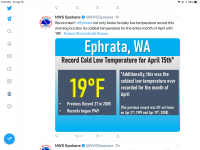
I went out about 10:00 this morning thinking I'd water the roses with the garden hose. When I picked up the hose I heard ice crunching. Fortunately the valve didn't break and after a couple minutes of water dribbling out the nozzle, the ice melted. I knew it was going to freeze but man, it took me by surprise.

mems
Steelhead
You guys should get the My Radar app on your phones. it gives real time weather conditions and warns of earthquakes like the two we had this morning and Tsunamis. They have an overlay feature and you can see wind, rain etc. It is also a great way to check the weather anywhere on the planet if you are going on a trip.


FinLuver
Native Oregonian…1846
The other day on the wet side, we had four seasons in about a six hour time frame…I actually use the Weather Channel (weather.com). I find the hourly projections (upcoming 48 hours) amazingly accurate. Perhaps it's easier forecasting here on the dry side, but when I want to know cloud cover for the coming night and next night (stargazing), it has been surprisingly accurate for me. I suspect they get their data from NOAA.
cheers


Chris Johnson
Steelhead
DittoWeather Underground for me. As others have said, the 10 day graph and wind forecasts are generally pretty accurate.
The other day on the wet side, we had four seasons in about a six hour time frame…
We're getting 1 season, seems winter has suddenly decided to show up - snow in the cherry blossoms

Cheers
Last edited:

There are web sites that actually track forecast accuracy. How they determine accuracy and what is included in their accuracy statistics vary. This site: Forecast advisor for Seattle focuses on high and low temperature and precipitation. For these factors, Weather Underground, The Weather Channel, and Accuweather come out on top for Seattle, about 8% more accurate than the National Weather Service forecasts.
As a fisher, I am less concerned about temperature details and more concerned about precipitation and wind. In essence, each forecast source is relying on weather models that take initial atmospheric conditions and predict how they will change in the future. The models vary in the spatial scale that they are incorporating into their models; the finer the spatial scale, the more accurate the forecast (but also the more powerful the computer required to do the calculations). The best models (e.g., European Forecasting Center) run a series of simulations with slightly different starting conditions. From these multiple simulations, they can construct a consensus forecast and indicate a level of confidence (do all the model runs converge on the same forecast or do they diverge). Some commercial companies weigh various forecasts from several national/international sources in crafting their own forecasts.
Traditionally, governmental predictions of wind speeds have focused more on predicting damaging winds (see Wind forecasting tools) versus fine-scaled measurements. The growth of wind farms has driven more interest in better precision forecasting of wind speeds because this impacts the market (selling/buying price) for power.
Steve
As a fisher, I am less concerned about temperature details and more concerned about precipitation and wind. In essence, each forecast source is relying on weather models that take initial atmospheric conditions and predict how they will change in the future. The models vary in the spatial scale that they are incorporating into their models; the finer the spatial scale, the more accurate the forecast (but also the more powerful the computer required to do the calculations). The best models (e.g., European Forecasting Center) run a series of simulations with slightly different starting conditions. From these multiple simulations, they can construct a consensus forecast and indicate a level of confidence (do all the model runs converge on the same forecast or do they diverge). Some commercial companies weigh various forecasts from several national/international sources in crafting their own forecasts.
Traditionally, governmental predictions of wind speeds have focused more on predicting damaging winds (see Wind forecasting tools) versus fine-scaled measurements. The growth of wind farms has driven more interest in better precision forecasting of wind speeds because this impacts the market (selling/buying price) for power.
Steve
Last edited:
FinLuver
Native Oregonian…1846
Seattle forecast…There are web sites that actually track forecast accuracy. How they determine accuracy and what is included in their accuracy statistics vary. This site: Forecast advisor for Seattle focuses on high and low temperature and precipitation. For these factors, Weather Underground, The Weather Channel, and Accuweather come out in top for Seattle, about 8% more accurate than the National Weather Service forecasts.
As a fisher, I am less concerned about temperature details and more concerned about precipitation and wind. In essence, each forecast source is relying on weather models that take initial atmospheric conditions and predict how they will change in the future. The models vary in the spatial scale that they are incorporating into their models; the finer the spatial scale, the more accurate the forecast (but also the more powerful the computer required to do the calculations). The best models (e.g., European Forecasting Center) run a series of simulations with slightly different starting conditions. From these multiple simulations, they can construct a consensus forecast and indicate a level of confidence (do all the model runs converge on the same forecast or do they diverge). Some commercial companies weigh various forecasts from several national/international sources in crafting their own forecasts.
Traditionally, governmental predictions of wind speeds have focused more on predicting damaging winds (see Wind forecasting tools) versus fine-scaled measurements. The growth of wind farms has driven more interest in better precision forecasting of wind speeds because this impacts the market (selling/buying price) for power.
Steve
RAIN.
Who can get that wrong??