We Got These Shad Comin' In

When I was researching an article for shad fishing on the Umpqua, I found that shad are a big deal game fish on the east coast ... so much so a gentleman brought barrels and barrels of the American Shad to California and dumped them in the Sacramento ... he thought he was doing the western anglers a favor.

Then the shad went nutso and started invading warm rivers that flow into the Pacific... one is the Umpqua, another is the Siuslaw and what I've heard from fish biologists, chances are they are setting up digs in many other rivers ... we just don't know it... yet.

So we're stuck with them. Do they have an effect on the native species? Hard to tell. Usually a river that is warm enough to support shad also supports bass and the like so there you go. Lots of non-native fish in the rivers.
 
If you're interested in the history of shad fishing in the US I'd recommend The Founding Fish by John McPhee. Probably more info that anyone might ever need, but an interesting read by a very talented writer. (For instance you'll learn about the role that shad played in the survival of George Washington's half-starved army during the revolutionary war.)
 
If anyone near north Seattle catches shad this year and ends up with too many or wants to get rid of some, I’ll take them off your hands.
Thanks
SF
 
Don’t believe shad will compete much, if at all, in salmon and steelhead fresh waters. They either die off or go back to the ocean after spawning. Where they might compete and have similar food sources are in the salt water.
 
Have you figured out how to eat them yet?
I have! Through a series of black magic steps I turn them into crab. It involves lots of patience and the right friends but it works. Next year I might even get the tool (small powerboat) to do it myself.

In all seriousness I have the following questions, most of which I can probably find out myself:

Where do they spawn?
Do they compete with steelhead and salmon smolts?
Does their biomass help the overall system?
Does their outmigration attract predators that otherwise wouldn’t be around? Does that help or hurt steelhead salmon outmigration?
Where do they go in the ocean?
What is their food source in the ocean?
Do they compete for ocean resources with salmon steelhead?

Really the only way I can see they help would be their biomass and perhaps providing cover for out migrating smolt.
 
Maybe the BPA should take a page out of their northern pikeminnow play book and offer bounty for them. At $5/shad displaced anglers would find a lucrative pastime for a few months, a nice way for retired anglers to support their fishing habit. Not only would there be an alternative to steelhead and spring Chinook anglers it might even attract folks from the lakes and rivers leading to less crowding on those waters.

Truly a win win solution!

curt
 
Maybe the BPA should take a page out of their northern pikeminnow play book and offer bounty for them. At $5/shad displaced anglers would find a lucrative pastime for a few months, a nice way for retired anglers to support their fishing habit. Not only would there be an alternative to steelhead and spring Chinook anglers it might even attract folks from the lakes and rivers leading to less crowding on those waters.

Truly a win win solution!

curt
A bounty on shad? Even I could get rich at that.
 
Just since it isn't said in the article, but while we get a few million of these fish each year they typically come through in around 8 weeks. Its nothing, one big surge, nothing.
 
Just since it isn't said in the article, but while we get a few million of these fish each year they typically come through in around 8 weeks. Its nothing, one big surge, nothing.
Sure, but after spawning and hatching, what effect do the fry have on the food resources in the river before they head out. Could be nothing much but until there is some understanding of their life cycle, I wouldn't assume anything.
They are a herring, I wonder if anything in the pacific is preying on them. Lionfish were introduced in the carribean, and nothing preys on them there, while in their home range in the pacific they are eaten by grouper. Not exactly the same, but I wonder.
 
Maybe the BPA should take a page out of their northern pikeminnow play book and offer bounty for them. At $5/shad displaced anglers would find a lucrative pastime for a few months, a nice way for retired anglers to support their fishing habit. Not only would there be an alternative to steelhead and spring Chinook anglers it might even attract folks from the lakes and rivers leading to less crowding on those waters.

Truly a win win solution!

curt
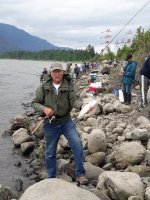
There’s no shortage of fishing opportunity. During the shad run, it’s shoulder to shoulder for a couple of miles below the Bonneville Dam. The Russians and Cambodians have certainly figured out how to eat them. I watched fishermen carrying buckets of fish up to coolers in the truck for hours. 8CFB41B3-3B39-4E1A-B4EE-9F8DA9451311.jpeg
 
The bounty programs are pure greatness, slap a little money towards ppl and you’ll have a hoot of folks cleaning them out.

Also could alter benefits for youth to encourage kids to get out and fish. Ez step to save that 1-x number of kids that would of chose something bad with that free time.
 
Back
Top