WDFW did not request funding for a 2027 Skagit-Sauk season

I am not disputing their conclusions about the decline of anglers, hunters, and the rise of voters who want to remove opportunities like a Skagit Sauk season.
I didn't see any conclusions about the Skagit or Sauk, or voters for that matter, just some data points that easily found in a number of places.
 
I didn't see any conclusions about the Skagit or Sauk, or voters for that matter, just some data points that easily found in a number of places.
Again, I don't dispute their data. The organization's mission is to "reform state wildlife management in the U.S. to be more democratic, just, compassionate and focused on protecting wild species and ecosystems". I admit I am making an assumption that their primary demographic is wildlife viewing participants who believe "wild animals as sentient beings worthy of our empathy and respect" (admittedly they truly are). And that demographic, unlike recreational anglers, would probably like to limit opportunities for anglers to disturb the natural behavior of fish, pierce their mouths with sharp metal hooks, and yank them out of their environment.

 
I give fishing and hunting in the state of Washington 20 years max before they are overtly outlawed.
 
WDFW used to spend $220,000 to raise hatchery steelhead for release into the Skagit. They haven't done that for 13 years now. Where the fvck is that money, and why can't part of it be used to fund monitoring of the CNR season?
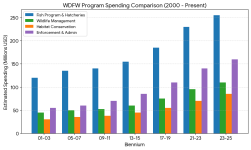
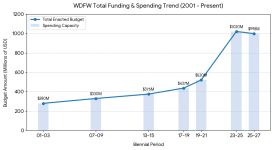
I searched for WDFW Biennial budget since 2000.
Program spending is reportedly fixed by the state. Search results do not report granularity of program spending.
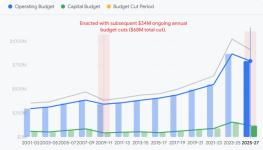
1788795823958.png
1788796318681.png
1788796611654.png
Additonal Detail from searches
According to NW Sportsman's Magazine & Congressional Sportsmans Foundation...
1. The Fund-Swap Illusion (2025–2026)
When the state increased fishing and hunting license fees, it generated new revenue for WDFW. However, instead of letting WDFW use that money to expand services, the Washington Legislature used it as a replacement. Lawmakers cut WDFW’s General Fund tax allotments by the exact amount generated by the fee hikes. Total spending authority on paper remained flat or slightly increased, but actual general fund support dropped, creating a net loss in real spending power. [1, 2]

According to the WDFW blog on the Medium blog platform and Congressional Sportsmans Foundation...
2. Compounding Budget Cuts (Passed March 2026)
Faced with broad state deficits, the legislature enacted aggressive, direct cuts to WDFW's operational budget: [1, 2]
    • 2025 Session: Ongoing cuts of $20 million per fiscal year were enacted.
    • 2026 Supplemental Budget: Lawmakers tacked on an additional $14.4 million reduction per fiscal year.
    • The Impact: WDFW is operating with $34 million less per year ongoing—slashing 10% of the agency's entire general fund allocation. [1, 2, 3]
According to the WA Office of Financial Management and WDFW... (granted, this is the WDFW and the State defending itself)
3. Inflation & Maintenance Costs (2025–2027 Biennium)
The cost to maintain existing programs (salaries, vehicle fleets, equipment, gas) has dramatically outpaced nominal budget growth. Even if the agency technically receives more total dollars than a prior biennium, it cannot afford the same level of service. [1, 2, 3]

Does this funding priority for WDFW reflect what the majority of Washington State voters expect from the Governor and Legislative majority they have elected?

 
I think you guys are reading more into this thing than what's really there.
I don't think so, if you listen to the comments on the commission meetings, there are a ton of people commenting from anti-hunting and fishing organizations. They have more momentum, are much better funded and organized than the recreational hunting and fishing user groups are.

I think dismissing this agenda and their groups could be a very large and costly misstep from people who enjoy hunting and fishing in this state.

I also believe we have a generation of WDFW employees that are much more environmentalists minded, than they are hunters or fishermen. The Curt Kramer and Brett Barkdull's of WDFW are very few and far between.
 
...there are a ton of people commenting from anti-hunting and fishing organizations. They have more momentum, are much better funded and organized than the recreational hunting and fishing user groups are.

I think dismissing this agenda and their groups could be a very large and costly misstep from people who enjoy hunting and fishing in this state.
^^^This... and from my 1st post
WDFW says that only 17% of Washington residents (voters) actively participate in fishing, AND 66% of Washington residents express satisfaction with the state's options for enjoying fish and wildlife resources, while only 9% are dissatisfied.

and my second post
...a few organizations promoting the national R3 Movement to recruit, retain, and reactivate more sportsmen
https://www.tandfonline.com/doi/full/10.1080/10871209.2026.2644512 And our own WDFW
https://wdfw.wa.gov/sites/default/files/publications/02323/wdfw02323.pdf
 
Back
Top