
Navigation
Install the app
How to install the app on iOS
Follow along with the video below to see how to install our site as a web app on your home screen.
Note: This feature may not be available in some browsers.
More options
Style variation
You are using an out of date browser. It may not display this or other websites correctly.
You should upgrade or use an alternative browser.
You should upgrade or use an alternative browser.
Walk the dog Musky flies
- Thread starter N. Metz
- Start date

FinLuver
Native Oregonian…1846
Calling Clarkman…Clarkman?…Clarkman?…I am trying to up my walk the dog game. What fly characteristics have you found to give a great walk the dog motion for larger flies?
Thanks,
Nick
Ps: check out Gunnar Brammer tying videos


Good idea. I watched some awhile ago. He's a good tier.Calling Clarkman…Clarkman?…Clarkman?…
Ps: check out Gunnar Brammer tying videos

watch some Blaine Chocklett videos too....although he ties almost everything in game changer format.
I really like how clear and concise Gunnar is though not to mention his precision (things that I am not unless I really have to be....lol).
For me, I've modeled much of my base construction on a combination of Brad Bohen's Buford (fur, feather, flash) and Eli Berant's Optimus Swine (especially the innards here). There are several ways to do it.
One is to make it where the back end hits the front end causing the entire thing to jack-knife like a semi. This works best with flies with at least 2 shanks because you would tie the back shank a bit sparser than the front (should be doing this anyway) and denser as you make your way to the head so that it pushes more water and stops in a hurry on the pause.
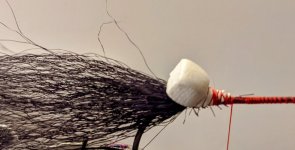
What Eli does is create instability within the fly by adding a reverse popper head towards the back end of the hook. On mine, I tie a little bit of foam off of the hook bend (after I lay down my initial bucktail), then taper up to the head as usual. If I really want a hard stop on the front end, I'll make the front third of the fly super dense by packing in bucktail (this is where the backside of a bucktail can come in really handy because it's the perfect length to do this plus is flares VERY well--at least with good bucktail). On Bohen's Buford, his finished head is this type of spun bucktail and then trimmed. I like to reverse tie some long dubbing for my heads just because I find it easier & quicker (Nightmare Musky Flies has some great stuff that's 3-4" long and perfect for this--Titan and Baitfish builder). You can also give it a little more glide action by counter balancing the front end with weight and making the front end slightly less dense. plus adjusting your cadence when you fish it.
I also don't reverse tie any of my bucktail for tigers because I've found that they typically prefer something less bulky. If I lived in the Midwest, I would be doing that in addition to upsizing some of my stuff (currently still 7-9" is the sweet spot)...then again, some of those guys regularly throw stuff the smaller size I'm throwing because you can do it all day. One of my motto's is if you're having trouble casting a fly all day, you're not going to fish it well.
Oh, check out Musky Fool's Youtube channel too...maybe even drop some coin at the shop. They won't steer you wrong, have lots of great materials. My go-to.

example of how I do the foam (which isn't necessary to get that movement, it just helps amplify).
I really like how clear and concise Gunnar is though not to mention his precision (things that I am not unless I really have to be....lol).
For me, I've modeled much of my base construction on a combination of Brad Bohen's Buford (fur, feather, flash) and Eli Berant's Optimus Swine (especially the innards here). There are several ways to do it.
One is to make it where the back end hits the front end causing the entire thing to jack-knife like a semi. This works best with flies with at least 2 shanks because you would tie the back shank a bit sparser than the front (should be doing this anyway) and denser as you make your way to the head so that it pushes more water and stops in a hurry on the pause.
What Eli does is create instability within the fly by adding a reverse popper head towards the back end of the hook. On mine, I tie a little bit of foam off of the hook bend (after I lay down my initial bucktail), then taper up to the head as usual. If I really want a hard stop on the front end, I'll make the front third of the fly super dense by packing in bucktail (this is where the backside of a bucktail can come in really handy because it's the perfect length to do this plus is flares VERY well--at least with good bucktail). On Bohen's Buford, his finished head is this type of spun bucktail and then trimmed. I like to reverse tie some long dubbing for my heads just because I find it easier & quicker (Nightmare Musky Flies has some great stuff that's 3-4" long and perfect for this--Titan and Baitfish builder). You can also give it a little more glide action by counter balancing the front end with weight and making the front end slightly less dense. plus adjusting your cadence when you fish it.
I also don't reverse tie any of my bucktail for tigers because I've found that they typically prefer something less bulky. If I lived in the Midwest, I would be doing that in addition to upsizing some of my stuff (currently still 7-9" is the sweet spot)...then again, some of those guys regularly throw stuff the smaller size I'm throwing because you can do it all day. One of my motto's is if you're having trouble casting a fly all day, you're not going to fish it well.
Oh, check out Musky Fool's Youtube channel too...maybe even drop some coin at the shop. They won't steer you wrong, have lots of great materials. My go-to.
example of how I do the foam (which isn't necessary to get that movement, it just helps amplify).
Last edited:
Interesting, good stuff. Another way that I’ve heard and used is to have more weight in the back end of the fly, this allows that portion of the fly to have more mass and will push the front part of the fly on the stop (which will tend to want to move to the side). Particularly good with a 2 hooked fly (not as much with the multiple shanked setups). That said, it may not give as wide of a glide but will still move side to side well.
Alex lafkas put out a video recently that seemed interesting where he ties on a shank off the back of the hook (but the shanks is tied onto the hook so no ‘connection’ or pivot point). Haven’t used it so I can’t attest to the effectiveness but plan on doing so.
Almost all of my fishing is done on rivers (even if current is fairly slow in the pools) and a big factor to get good motion for me is to fish down and across and after stripping the fly, give a little line back to allow a little slack and let the fly move (often I strip and pull the rod back a little at the same time, shares the demand for the strip to both arms, then I can return the rod out in front a little to give this slack)
Alex lafkas put out a video recently that seemed interesting where he ties on a shank off the back of the hook (but the shanks is tied onto the hook so no ‘connection’ or pivot point). Haven’t used it so I can’t attest to the effectiveness but plan on doing so.
Almost all of my fishing is done on rivers (even if current is fairly slow in the pools) and a big factor to get good motion for me is to fish down and across and after stripping the fly, give a little line back to allow a little slack and let the fly move (often I strip and pull the rod back a little at the same time, shares the demand for the strip to both arms, then I can return the rod out in front a little to give this slack)
I do this a lot. Shank to shank won't ever wear out. I hate 2 hooks....for a variety of reasons, but even with the shank behind the hook, the point is still at a position where I just don't miss many of fish. Plus, this allows you to make the tail more proportionate. Vs a 9" fly where 3/4 of it is essentially tail.Alex lafkas put out a video recently that seemed interesting where he ties on a shank off the back of the hook (but the shanks is tied onto the hook so no ‘connection’ or pivot point). Haven’t used it so I can’t attest to the effectiveness but plan on doing so.
Actually, looking at what's currently in my box, 75% of my flies are tied this way. Got a couple of game changers in there for good measure...
@clarkman the lafkas video he ties on a long shank but say on half of it, then attached this shank to the hook shank with thread (after cutting of the eye of the shank. About 12min into the video. Is this what you do or do you connect shank to shank and the second shank is cut and tied onto the hook?
Attachments
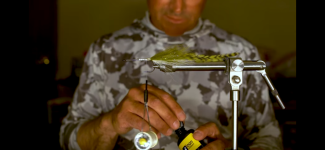
kind of. Instead of tying the single shank directly to the hook, I tie a separate shank to the hook and the rear shank with my tail/back body materials goes onto the back loop of that shank (I actually tie those together prior to tying the front shank to the hook). That way I at least have one pivot point built in plus whatever movement I get out of the tail material. For larger musky and bull trout stuff, I use 35mm shanks
Musky fool is awesome. I try and buy all my stuff from them. They' really helpful too. You would probably like their podcast Clarkman; it's called "The Spot Burn Podcast"watch some Blaine Chocklett videos too....although he ties almost everything in game changer format.
I really like how clear and concise Gunnar is though not to mention his precision (things that I am not unless I really have to be....lol).
For me, I've modeled much of my base construction on a combination of Brad Bohen's Buford (fur, feather, flash) and Eli Berant's Optimus Swine (especially the innards here). There are several ways to do it.
One is to make it where the back end hits the front end causing the entire thing to jack-knife like a semi. This works best with flies with at least 2 shanks because you would tie the back shank a bit sparser than the front (should be doing this anyway) and denser as you make your way to the head so that it pushes more water and stops in a hurry on the pause.
What Eli does is create instability within the fly by adding a reverse popper head towards the back end of the hook. On mine, I tie a little bit of foam off of the hook bend (after I lay down my initial bucktail), then taper up to the head as usual. If I really want a hard stop on the front end, I'll make the front third of the fly super dense by packing in bucktail (this is where the backside of a bucktail can come in really handy because it's the perfect length to do this plus is flares VERY well--at least with good bucktail). On Bohen's Buford, his finished head is this type of spun bucktail and then trimmed. I like to reverse tie some long dubbing for my heads just because I find it easier & quicker (Nightmare Musky Flies has some great stuff that's 3-4" long and perfect for this--Titan and Baitfish builder). You can also give it a little more glide action by counter balancing the front end with weight and making the front end slightly less dense. plus adjusting your cadence when you fish it.
I also don't reverse tie any of my bucktail for tigers because I've found that they typically prefer something less bulky. If I lived in the Midwest, I would be doing that in addition to upsizing some of my stuff (currently still 7-9" is the sweet spot)...then again, some of those guys regularly throw stuff the smaller size I'm throwing because you can do it all day. One of my motto's is if you're having trouble casting a fly all day, you're not going to fish it well.
Oh, check out Musky Fool's Youtube channel too...maybe even drop some coin at the shop. They won't steer you wrong, have lots of great materials. My go-to.
example of how I do the foam (which isn't necessary to get that movement, it just helps amplify).
View attachment 120827
Last edited:
I also tie a shank right off the back of the hook to extend the body quite a bit. It looks unnatural if I don’t on a 10 or 12 inch fly. All tail otherwise
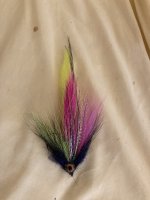
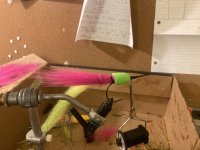
I tried the foam trick on a fly last night. I’m gunna see how it fishes. I might break out my knife and cut some away on the water
I tried the foam trick on a fly last night. I’m gunna see how it fishes. I might break out my knife and cut some away on the water
Attachments
Last edited:
Yeah, I love that podcast. Those guys are just solid all around dudes!Musky fool is awesome. I try and buy all my stuff from them. They' really helpful too. You would probably like their podcast Clarkman; it's called "The Spot Burn Podcast"
I do that all the time! get an idea, tie it up, wait until I can fish it, make adjustments as needed either on water or after I get home.I also tie a sharp m off the back of the hook to extend the body quite a bit. It looks unnatural if I don’t on a 0 or 12 inch fly. All tail otherwise
I tried the foam trick on a fly last night. I’m gunna see how it fishes. I might break out my knife and cut some away on the water
