
I wanted to bring this up again since we are a few days from the MA 9 opener.
Comments, suggestions, questions and criticisms are welcome. If I don’t have the answer to your question, I’ll direct it to the appropriate WDFW staff.
Please feel free to share this on other forums or groups prior to the 7/16
In 2024, a WDFW regulation change in MA 9 only allowed coho and pink fishing on days that chinook fishing was open. In years past, you could fish for coho and pinks on non-chinook days.
The end result of that regulation change is as follows.
2023 – We had 19 days of July Coho and Pink fishing.
2024 – We had 3 days of Coho fishing out of a potential 14 days.
2025 – We had 3 days of Coho and Pink fishing out of a potential 15 days.
2026 – We’ll have three days of coho fishing scheduled out of a potential 16 days unless additional chinook days are added. With this year’s reduced chinook quota, that is very unlikely.
I would like to change this but will need your help.
Here is my ask.
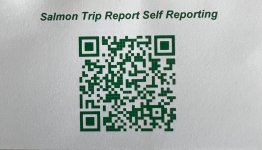
Please fill out a Voluntary Trip Report (VTR) form after each boat or beach trip this summer, not just July. The form can be found online using the link below. You can also scan the QR code I’ve provided from the WDFW sampling team business card.
Please submit a report even if you don’t catch anything.
https://wdfw.wa.gov/licenses/fishing/trip-reporting
This is very important. In the area on the form that asks for your name, please put Beach Angler followed by your name.
Example - Beach Angler / John Doe
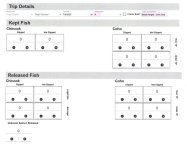
I have attached a photo example of what the Voluntary Trip Report looks like on WDFW’s website. I’m also working with WDFW to get the VTR form updated to reflect beach angling.
With your help, my goal is to have beach angling for coho, and pinks open in MA 9 on non-chinook days in future seasons.
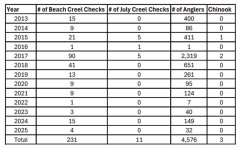
Since beach creel checks have become rather uncommon these days, WDFW and the co-managers want data regarding chinook impacts from beach fisheries. We know chinook impacts from the beach are not zero, but they are extremely low based on my beach fishing experience.
In my lifetime, MA 9 has gone from being open year-round to two months and three days, which is our season this year. Hopefully, the data we gather can prove this and we can get back our July MA 9 opportunity in the future. This is also not a new fishery. We had this fishery for years prior to 2024.
Some people I have spoken with have expressed concern that WDFW will use data from these trip reports against us. There is also a lot of distrust of WDFW. I understand that and some of it is deserving. Please note that VTRs are used in post season fisheries analysis, not in season management.
I understand anglers concerns but other than outright closures can our fishing opportunities really be reduced much more than they currently are? We have lost all of October and now most of July.
As we have learned in other fisheries, closing things is easy, getting them back open again is not.
Beach only fishing is not a new concept. It has been used as a management tool in both MA 9 and MA 11 in the past. This would have been a perfect year to have this regulation change with a forecast of 900k+coho. MA 9 has had excellent July resident coho fishing in past years plus the early portion of the pink run will be available in 2027, yet we will only get three July days as of now.
I like to see what we can accomplish as an angling community by using citizen science to collect data via the voluntary trip reports to gain more opportunity. I cannot promise I can get this done or that it will be easy, but I will work hard and continue my efforts to do so. I appreciate any help you can provide.
For full transparency, I am a member of the WDFW Puget Sound Sport Fishing Advisory Group.
Thanks,
Brian Stone
Comments, suggestions, questions and criticisms are welcome. If I don’t have the answer to your question, I’ll direct it to the appropriate WDFW staff.
Please feel free to share this on other forums or groups prior to the 7/16
In 2024, a WDFW regulation change in MA 9 only allowed coho and pink fishing on days that chinook fishing was open. In years past, you could fish for coho and pinks on non-chinook days.
The end result of that regulation change is as follows.
2023 – We had 19 days of July Coho and Pink fishing.
2024 – We had 3 days of Coho fishing out of a potential 14 days.
2025 – We had 3 days of Coho and Pink fishing out of a potential 15 days.
2026 – We’ll have three days of coho fishing scheduled out of a potential 16 days unless additional chinook days are added. With this year’s reduced chinook quota, that is very unlikely.
I would like to change this but will need your help.
Here is my ask.
Please fill out a Voluntary Trip Report (VTR) form after each boat or beach trip this summer, not just July. The form can be found online using the link below. You can also scan the QR code I’ve provided from the WDFW sampling team business card.
Please submit a report even if you don’t catch anything.
https://wdfw.wa.gov/licenses/fishing/trip-reporting
This is very important. In the area on the form that asks for your name, please put Beach Angler followed by your name.
Example - Beach Angler / John Doe
I have attached a photo example of what the Voluntary Trip Report looks like on WDFW’s website. I’m also working with WDFW to get the VTR form updated to reflect beach angling.
With your help, my goal is to have beach angling for coho, and pinks open in MA 9 on non-chinook days in future seasons.
Since beach creel checks have become rather uncommon these days, WDFW and the co-managers want data regarding chinook impacts from beach fisheries. We know chinook impacts from the beach are not zero, but they are extremely low based on my beach fishing experience.
In my lifetime, MA 9 has gone from being open year-round to two months and three days, which is our season this year. Hopefully, the data we gather can prove this and we can get back our July MA 9 opportunity in the future. This is also not a new fishery. We had this fishery for years prior to 2024.
Some people I have spoken with have expressed concern that WDFW will use data from these trip reports against us. There is also a lot of distrust of WDFW. I understand that and some of it is deserving. Please note that VTRs are used in post season fisheries analysis, not in season management.
I understand anglers concerns but other than outright closures can our fishing opportunities really be reduced much more than they currently are? We have lost all of October and now most of July.
As we have learned in other fisheries, closing things is easy, getting them back open again is not.
Beach only fishing is not a new concept. It has been used as a management tool in both MA 9 and MA 11 in the past. This would have been a perfect year to have this regulation change with a forecast of 900k+coho. MA 9 has had excellent July resident coho fishing in past years plus the early portion of the pink run will be available in 2027, yet we will only get three July days as of now.
I like to see what we can accomplish as an angling community by using citizen science to collect data via the voluntary trip reports to gain more opportunity. I cannot promise I can get this done or that it will be easy, but I will work hard and continue my efforts to do so. I appreciate any help you can provide.
For full transparency, I am a member of the WDFW Puget Sound Sport Fishing Advisory Group.
Thanks,
Brian Stone
Last edited: