Navigation
Install the app
How to install the app on iOS
Follow along with the video below to see how to install our site as a web app on your home screen.
Note: This feature may not be available in some browsers.
More options
Style variation
You are using an out of date browser. It may not display this or other websites correctly.
You should upgrade or use an alternative browser.
You should upgrade or use an alternative browser.
Tuna 2023
- Thread starter SilverFly
- Start date
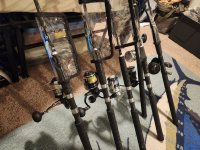

Here's a picView attachment 74399
Dammit Dennis, now I have to add another pattern to the tuna box.
 Seriously, this is great stuff. Thanks for posting!
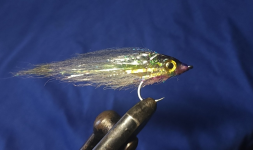
Based on your juvenile widow rockfish pic:
Last edited:

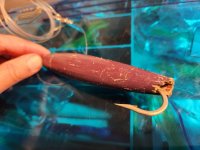

Hey @Nick Clayton - how long you think til this one shits the bed?
Hell ya, love it! Theyre like a favorite pair of jeans, just gets better the more worn they become.

Denwor54
Life of the Party
Well the rockfish and coho like my imitation, which at first I thought would be to small. Lots of coho around and the guides are saying the tuna are still sparse.Dammit Dennis, now I have to add another pattern to the tuna box.
Based on your juvenile widow rockfish pic:
View attachment 74842

Here is the latest sea surface temperatures (and current direction data) from Nanoos.Just got in weather was perfect conditions but the water temps jumped 5% which put the bait rockfish and coho down. We were able to find cooler water for coho which ended up being close to shore which is rare. This should definitely help bring the tuna in closer.
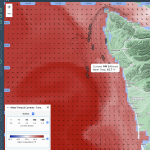
This image indicates warm surface waters across the Washington coast. Interesting, most of the current arrows inside the continental shelf are toward the west, This would be consistent with the development of coastal upwelling, which would cool the waters closer to shore as this warm water moving offshore is replaced by cooler deeper water (though there is no strong indication of this cool, nutrient water in the image, yet.
Steve
So tuna yesterday.
Sometimes you're the windshield, sometimes you're the bug.
Left my place in Gresham at 3am Saturday morning headed for Hammond. Got the boat in the water and on the way by 5:30 to the 125 / 46 corners that had been productive basically every fishable day so far this year.
Was a little lumpy for the first 10 or so miles then softened up a bit until we got to the 124.45 line or so. Also saw some funnel clouds around that time. (may need to zoom in)
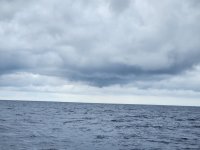
Got tired of trying to get back up to a good cruising speed of 20+mph so put lines out at about the 124.52 and kept trolling west.
Not a thing happening and radio chatter was about as encouraging. Any boat with fish was 1-2 fish.
Around Noon we finally had a troll rod go off. I immediately dropped my flatside jig down about 200' and immediately hooked up as well. We got both those fish in and felt like our day was about to get more exciting. I've had plenty of days where the bite was dead til early afternoon.
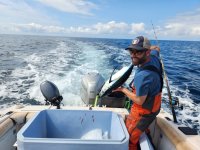
Got back on the troll and that rod went off again about 5min later. No jig eats though
Then, nada for several more hours. We stayed west of the 125 a few miles and covered some ground. Radio chatter remained bleak.
Between 2-3 we decided we'd salvage the day trolling salmon on the way back so picked up and headed east. Managed to get two nice chinook bonked and a few coho released. So a little pick-me-up after a hard day.
Back at the dock and met several other long faces. Boats with between 0-2 fish. We felt fortunate for our 3.
Then made the mistake of checking in with friends and acquaintances who were also out. Apparently if we had stayed til 4, we'd have filled the boat up. Or if we had launched from Garibaldi and gone due west, we also would have filled our totes up. C'est la vie.
To make matters worse, today was like the best day ever out there and I had originally planned to head out today (Sunday) opting for Saturday to have a rest day before work.
Headed to Alaska this week to fish with a friend there til next Monday, then on to plotting my revenge trip.
Sometimes you're the windshield, sometimes you're the bug.
Left my place in Gresham at 3am Saturday morning headed for Hammond. Got the boat in the water and on the way by 5:30 to the 125 / 46 corners that had been productive basically every fishable day so far this year.
Was a little lumpy for the first 10 or so miles then softened up a bit until we got to the 124.45 line or so. Also saw some funnel clouds around that time. (may need to zoom in)
Got tired of trying to get back up to a good cruising speed of 20+mph so put lines out at about the 124.52 and kept trolling west.
Not a thing happening and radio chatter was about as encouraging. Any boat with fish was 1-2 fish.
Around Noon we finally had a troll rod go off. I immediately dropped my flatside jig down about 200' and immediately hooked up as well. We got both those fish in and felt like our day was about to get more exciting. I've had plenty of days where the bite was dead til early afternoon.
Got back on the troll and that rod went off again about 5min later. No jig eats though
Then, nada for several more hours. We stayed west of the 125 a few miles and covered some ground. Radio chatter remained bleak.
Between 2-3 we decided we'd salvage the day trolling salmon on the way back so picked up and headed east. Managed to get two nice chinook bonked and a few coho released. So a little pick-me-up after a hard day.
Back at the dock and met several other long faces. Boats with between 0-2 fish. We felt fortunate for our 3.
Then made the mistake of checking in with friends and acquaintances who were also out. Apparently if we had stayed til 4, we'd have filled the boat up. Or if we had launched from Garibaldi and gone due west, we also would have filled our totes up. C'est la vie.
To make matters worse, today was like the best day ever out there and I had originally planned to head out today (Sunday) opting for Saturday to have a rest day before work.
Headed to Alaska this week to fish with a friend there til next Monday, then on to plotting my revenge trip.

Good on ya getting out all the same. Rather jealous.So tuna yesterday.
Sometimes you're the windshield, sometimes you're the bug.
Left my place in Gresham at 3am Saturday morning headed for Hammond. Got the boat in the water and on the way by 5:30 to the 125 / 46 corners that had been productive basically every fishable day so far this year.
Was a little lumpy for the first 10 or so miles then softened up a bit until we got to the 124.45 line or so. Also saw some funnel clouds around that time. (may need to zoom in)
View attachment 75305
Got tired of trying to get back up to a good cruising speed of 20+mph so put lines out at about the 124.52 and kept trolling west.
Not a thing happening and radio chatter was about as encouraging. Any boat with fish was 1-2 fish.
Around Noon we finally had a troll rod go off. I immediately dropped my flatside jig down about 200' and immediately hooked up as well. We got both those fish in and felt like our day was about to get more exciting. I've had plenty of days where the bite was dead til early afternoon.
View attachment 75306
Got back on the troll and that rod went off again about 5min later. No jig eats though
Then, nada for several more hours. We stayed west of the 125 a few miles and covered some ground. Radio chatter remained bleak.
Between 2-3 we decided we'd salvage the day trolling salmon on the way back so picked up and headed east. Managed to get two nice chinook bonked and a few coho released. So a little pick-me-up after a hard day.
Back at the dock and met several other long faces. Boats with between 0-2 fish. We felt fortunate for our 3.
Then made the mistake of checking in with friends and acquaintances who were also out. Apparently if we had stayed til 4, we'd have filled the boat up. Or if we had launched from Garibaldi and gone due west, we also would have filled our totes up. C'est la vie.
To make matters worse, today was like the best day ever out there and I had originally planned to head out today (Sunday) opting for Saturday to have a rest day before work.
Headed to Alaska this week to fish with a friend there til next Monday, then on to plotting my revenge trip.
Seems to support @Irafly ’s theory/superstition that albacore is a 1-day-hot-1-day-cold fishery.

That seems to be true from my limited experienced. First trip was super slow, I have a pic of @Irafly sleeping with rod in hand. Next day report was red hot.Good on ya getting out all the same. Rather jealous.
Seems to support @Irafly ’s theory/superstition that albacore is a 1-day-hot-1-day-cold fishery.
Second trip with @jasmillo was really great with calm seas. Previous day was canceled due to weather.


1. Here's a video I made a few years ago showing how I typically tie mine. I will often experiment and substitute materials, but tend to stick pretty close to this.
IMO the biggest factors that I focus on is a semi anchovy-ish color scheme. Basically I tend to work with white/grey/barred grizzly, those kinds of colors. Since I'm trying to imitate an anchovy skittering along the surface I try to avoid unnatural colors.
I also like to use a head big enough that it will keep the fly right on the surface in any ocean condition I'd actually be fishing it on. This can be a bit challenging as it takes a lot of flotation to keep something on top when it's being stripped through ocean waves.
And IMO the most important thing is tying it slider style, and not as an actual "popper" that pops and gurgles and makes a commotion. (Those kinds of poppers can work at times but I find a slider that just leaves a steady V wake to be much more effective across the board).
I wish I could list exactly what heads I use, but I'm still kinda dialing that in. When I originally started tying these I had the perfect heads on hand, but I didn't pay too close attention to the specific brand/size as I didn't realize it might be difficult to find the perfect size. So now days I just go for the biggest slider head I can find. To me the head is simply about keeping it on top and helping to produce that V wake. Even if it looks abnormally large compared to the overall fly, it doesn't seem to matter to the fish.
In a nut shell this is simply a larger and simplified version of the Miyawaki Popper minus the trailing hook. Just no need for a trailer with albacore.
2. When I first started fishing these I would tend to bust out the floater only on a lake flat ocean when the fish were up and boiling on our chum regularly. And in these scenarios this fly works great. Over the last couple of years I've found myself fishing on top more and more in conditions that would seem less than ideal to do so, and have been impressed with the results. I dont really enjoy fishing topwater when the ocean is super choppy or mixed up. It can still be done, but I just prefer slightly calmer conditions to be able to see what's going on and it is easier to keep the fly on top. What I've been learning is that in just about any scenario where we can keep the fish focused on the boat, even if they aren't just right on the surface destroying anchovies, it is still a very effective method. My best day of topwater ever was a day when we could get them on cast flies well enough but we weren't seeing a lot of aggressive surface activity. I've basically come to believe that anytime we can get albacore on cast flies, they can most usually be enticed to eat a popper. I've fished topwater in a lot of conditions that didn't immediately scream "fish a popper dummy!" and the results have given me a ton of confidence.
3. I think the "how" to fish this fly is probably the most important aspect. I've mentioned this before but I started down this path because when I was a deckhand I used to chum the water with anchovies and sometimes I would pitch one into the water and it wouldn't swim down. It would just kinda skitter along the surface, almost with its head angled out of the water. Generally when this happened they would just swim in a circle. Always seemed like these were anchovies that didn't fare well in the bait tank and weren't long for this world. In these scenarios, if there were fish around, they would almost always just lose their minds and destroy that anchovy on top. Was always one of my favorite things to watch. I started thinking that Lelands popper would basically be a perfect imitation as that's essentially what his fly is tied to mimic. So that lead me down this road.
With that in mind, I find the absolute most effective way to fish this fly is to cast it out and then retrieve in a medium pace with steady strips. Just keeping the fly moving at a pace that leaves a nice V wake but isn't actually popping and making an unnatural commotion. I think most anglers natural inclination, mine too when I first started, is to really snap those strips and try to make that fly really lunge and pop, but this has resulted in piss poor results for me.
If you recall Abigail's amazing popper hookup that day last year, it took her probably a dozen casts or so to hook up. When she first started she was really popping that fly, and I stood there next to her and helped her get her retrieve dialed in. Soon as she relaxed and just made that thing glide across the surface it got destroyed. I truly think that's the single most important factor. Making it look as natural as possible like a dying anchovy that is just at the surface skittering along. That seems to be irresistible to those fish.
The last thing I'll mention is the hookset. This can be the hardest part. I find the best thing to do is keep your rod tip nice and low, pointed right in line with your line. On a calmer day you can generally see the fish come up on the popper at Mach 6 and it can be so difficult to hook them as it's very easy to react prematurely and pull it out of their face before they actually eat it. So I like to do basically nothing. Keep that rod tip low and just let them eat it and turn. They will come up and eat this fly and head back to the depths insanely quickly. If you try to lift the rod and set it often doesn't end well. Instead do nothing. Keep the rod low until the fish eats it, turns back down, and your line comes tight. Let them hook themselves. It's definitely easier said than done but it's pretty important.
I've developed a ton of confidence fishing on top and am convinced it can be an extremely effective method even when you aren't seeing them on top a ton. But if they can be caught 20' down on cast flies they can definitely be caught on top, potentially just as well. I obviously have a huge advantage in that I'm not a paying customer and I'm out there so often, so messing about with techniques that are new or don't feel as effective or whatever isn't a sacrifice. I totally understand how hard it could be to commit to topwater as a paying customer when its likely your only trip out for the year. But I'm convinced that this is a viable method of catching these fish and the only way to do so is to somewhat commit to it. If you wait until it looks like all the stars are aligned then you'll be missing some good opportunities.
Thanks again for posting this Nick. Gotta say, it's funny hearing you say in the popper vid that you weren't sure if the pattern would work. Well, we now know it DOES. But that's what happens when sharp observations are applied to fly tying.
Having done a few bait trips, I know exactly what you are talking about with the surface "puttering" anchovies. Even though I'm sure I've seen it happen, I never made the connection that albacore specifically keyed on that behavior. Or that it could be a surface feeding trigger. Probably why my previous albacore poppers, even though (I think) looked pretty, haven't hooked up.
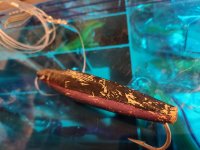
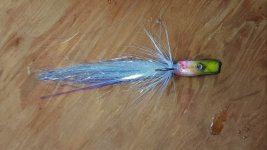
Here's what I came up with based on your input. Not sure whether this is a slider, or something else, but the idea was to float in a nose-up attitude with a slender, anchovy-like profile seen from below. Nothing fancy. I just cut up an old chinook bobber to shape a thin, mostly triangular head. Also angled to plane upwards instead of diving, popping, or wobbling. Maybe too skinny because it doesn't make much of a wake.
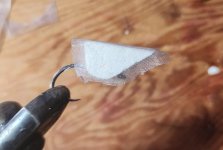
Craft ribbon wrapped over 2-part epoxy.
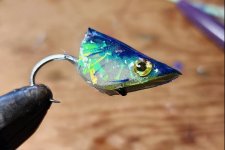
Markers, eyes, and flecks of saltwater flashabou
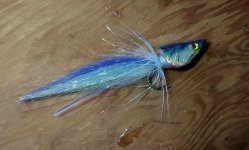
Side profile. White, aqua, and blue nayat, mixed with FTD crystal hair, saltwater flashabou, and white hackle collar. 4.5" length, tied on 2/0 Kona Big Game.
Bathroom sink test
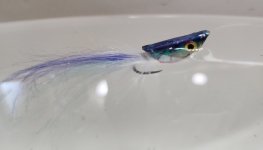
Tuna view from below
Last edited:
Awesome marker/paint job!Thanks again for posting this Nick. Gotta say, it's funny hearing you say in the popper vid that you weren't sure if the pattern would work. Well, we now know it DOES. But that's what happens when sharp observations are applied to fly tying.
Having done a few bait trips, I know exactly what you are talking about with the surface "puttering" anchovies. Even though I'm sure I've seen it happen, I never made the connection that albacore specifically keyed on that behavior. Or that it could be a surface feeding trigger. Probably why my previous albacore poppers, even though (I think) looked pretty, haven't hooked up.
Here's what I came up with based on your input. Not sure whether this is a slider, or something else, but the idea was to float in a nose-up attitude with a slender, anchovy-like profile seen from below. Nothing fancy. I just cut up an old chinook bobber to shape a thin, mostly triangular head. Also angled to plane upwards instead of diving, popping, or wobbling. Maybe too skinny because it doesn't make much of a wake.
Craft ribbon wrapped over 2-part epoxy.
View attachment 75922
Markers, eyes, and flecks of saltwater flashabou
View attachment 75920
Side profile. White, aqua, and blue nayat, mixed with FTD crystal hair, saltwater flashabou, and white hackle collar. 4.5" length, tied on 2/0 Kona Big Game. View attachment 75919
Bathroom sink test
View attachment 75918
Tuna view from below
View attachment 75921

ThatGuyRyRy
Life of the Party
Just the simplicity of fly fishing...Thanks again for posting this Nick. Gotta say, it's funny hearing you say in the popper vid that you weren't sure if the pattern would work. Well, we now know it DOES. But that's what happens when sharp observations are applied to fly tying.
Having done a few bait trips, I know exactly what you are talking about with the surface "puttering" anchovies. Even though I'm sure I've seen it happen, I never made the connection that albacore specifically keyed on that behavior. Or that it could be a surface feeding trigger. Probably why my previous albacore poppers, even though (I think) looked pretty, haven't hooked up.
Here's what I came up with based on your input. Not sure whether this is a slider, or something else, but the idea was to float in a nose-up attitude with a slender, anchovy-like profile seen from below. Nothing fancy. I just cut up an old chinook bobber to shape a thin, mostly triangular head. Also angled to plane upwards instead of diving, popping, or wobbling. Maybe too skinny because it doesn't make much of a wake.
Craft ribbon wrapped over 2-part epoxy.
View attachment 75922
Markers, eyes, and flecks of saltwater flashabou
View attachment 75920
Side profile. White, aqua, and blue nayat, mixed with FTD crystal hair, saltwater flashabou, and white hackle collar. 4.5" length, tied on 2/0 Kona Big Game. View attachment 75919
Bathroom sink test
View attachment 75918
Tuna view from below
View attachment 75921
... Yeah, got me there. Well, simplicity in terms of not having a bunch of hardware between fish and fisherman. No shortage of rabbit holes beyond that.Just the simplicity of fly fishing...
I just got done reading through this thread. I am one who reaches for the jig rods when live bait is onboard. After seeing the amazing flies you guys tie I think I want to give it a shot this season. At least one to check it off my list.
Like @Evan B said, when the boxes are reaching capacity and they are still on the chew. I had a few days like that last season, leaving acres of jumpers, so I'm hopeful.
Like @Evan B said, when the boxes are reaching capacity and they are still on the chew. I had a few days like that last season, leaving acres of jumpers, so I'm hopeful.
Ah, that September trip last year was just crazy when we had them jumping all the way in to like the .35. Gonna remember that one for a long time.I just got done reading through this thread. I am one who reaches for the jig rods when live bait is onboard. After seeing the amazing flies you guys tie I think I want to give it a shot this season. At least one to check it off my list.
Like @Evan B said, when the boxes are reaching capacity and they are still on the chew. I had a few days like that last season, leaving acres of jumpers, so I'm hopeful.
I don't know if the albacore are out there, but the water temperatures sure look very suitable. This screenshot includes water temperature and current direction from the Tuna Fishers application of the Nanoos web site. Except for tight against the coast, there is warm water throughout the region, except tight to the coast.
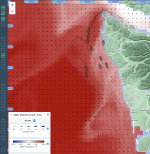
Normally, you would expect to see cooler nutrient-rich, green upwelled water along the continental shelf as northerly winds drive upwelling and warmer water offshore. Then warm, blue, nutrient-poor water is evident at the continental shelf. But as Cliff Mass described in his latest blog, atmospheric pressure patterns are blocking the winds that drive upwelling. That is consistent with this recent summary of the satellite data above.
Yesterday, I was on a "grocery trip" with my BIL, SIL, and a friend yesterday on a chartered boat out of Neah Bay. [I brought fly rods, but there wasn't a real opportunity to use them.]. The captain told us that there were abundant small bait (yoy herring, sand lance, and juvenile rockfish) along the coast. We later headed 30+ miles offshore to target deep-water ling cod. As we blasted out at 22 knots, we quickly transitioned from green coastal water to blue open-ocean water. While there was too much chop to see any surfacing tuna busting bait at the surface, we did see multiple bird balls of pink-footed shearwaters. There were also storm petrels and albatross.
So, the table is set. We just need reports that the long-finned guests of honor have arrived.
Steve
Normally, you would expect to see cooler nutrient-rich, green upwelled water along the continental shelf as northerly winds drive upwelling and warmer water offshore. Then warm, blue, nutrient-poor water is evident at the continental shelf. But as Cliff Mass described in his latest blog, atmospheric pressure patterns are blocking the winds that drive upwelling. That is consistent with this recent summary of the satellite data above.
Yesterday, I was on a "grocery trip" with my BIL, SIL, and a friend yesterday on a chartered boat out of Neah Bay. [I brought fly rods, but there wasn't a real opportunity to use them.]. The captain told us that there were abundant small bait (yoy herring, sand lance, and juvenile rockfish) along the coast. We later headed 30+ miles offshore to target deep-water ling cod. As we blasted out at 22 knots, we quickly transitioned from green coastal water to blue open-ocean water. While there was too much chop to see any surfacing tuna busting bait at the surface, we did see multiple bird balls of pink-footed shearwaters. There were also storm petrels and albatross.
So, the table is set. We just need reports that the long-finned guests of honor have arrived.
Steve