Top water sand shrimp pattern

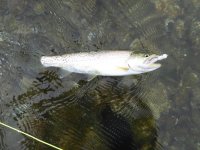
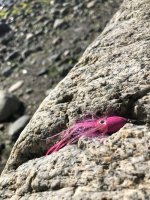
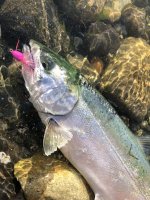
I use the top water sand shrimp pattern 80 to 90 % of the time when fishing for sea-run cutthroat. Frist picture shows this pattern while the second picture shows a nice sized fish with the pattern hooked in the side of its mouth. This fly is a modification of the Dejlia Squid pattern. It is extremely easy and quick to tie using HMH micro tubing. A nice v-wake occurs when it is retrieved. I normally have about a 50% hook-up ratio with it being higher on good days. If sea-run cutthroat miss the pattern on the first try, they will often come back and strike it again. This pattern is effective year around since sand shrimp are plentiful year around. This fly is just flat extremely effective and is why I use it almost exclusively when fishing for sea-run cutthroat.

Roger
 

Attachments

  • P1010178.JPG
    P1010178.JPG
    97.1 KB · Views: 79
  • P1010107.JPG
    P1010107.JPG
    248.2 KB · Views: 75
I use the top water sand shrimp pattern 80 to 90 % of the time when fishing for sea-run cutthroat. Frist picture shows this pattern while the second picture shows a nice sized fish with the pattern hooked in the side of its mouth. This fly is a modification of the Dejlia Squid pattern. It is extremely easy and quick to tie using HMH micro tubing. A nice v-wake occurs when it is retrieved. I normally have about a 50% hook-up ratio with it being higher on good days. If sea-run cutthroat miss the pattern on the first try, they will often come back and strike it again. This pattern is effective year around since sand shrimp are plentiful year around. This fly is just flat extremely effective and is why I use it almost exclusively when fishing for sea-run cutthroat.

Roger

I had my best day ever fishing topwaters for searuns with this pattern of Roger’s.
The hook-up ratio is the best by far that I’ve ever used. I think having a stationary hook on the tube really helps with hook-ups versus having a stinger hook that is flopping around.
SF
 
This great. I've been mainly using top water flies for chasing SRC and been think about how to tie some tube versions. I think I'm going to try this out. @roger stephens any tips on how your tying your tube flies?
 
The question is, have you ever seen an actual sand shrimp anywhere near the surface of the water?
 
The question is, have you ever seen an actual sand shrimp anywhere near the surface of the water?
Some of the big sandy estuaries have a late may early june top water column shrimp hatch. They look a little more like classic shrimp than sand shrimp. The terns and searuns go nuts. A floating pattern, perhaps smaller than Roger's would kill it and with a little more gold/rust. A shrimp emerger, under a float or not, also is a hoot
 
I use the top water sand shrimp pattern 80 to 90 % of the time when fishing for sea-run cutthroat. Frist picture shows this pattern while the second picture shows a nice sized fish with the pattern hooked in the side of its mouth. This fly is a modification of the Dejlia Squid pattern. It is extremely easy and quick to tie using HMH micro tubing. A nice v-wake occurs when it is retrieved. I normally have about a 50% hook-up ratio with it being higher on good days. If sea-run cutthroat miss the pattern on the first try, they will often come back and strike it again. This pattern is effective year around since sand shrimp are plentiful year around. This fly is just flat extremely effective and is why I use it almost exclusively when fishing for sea-run cutthroat.

Roger
Have great success with the Delia Squid pattern over the years. Never thought about putting a foam cone on it to make it a floater.
 
I use the top water sand shrimp pattern 80 to 90 % of the time when fishing for sea-run cutthroat. Frist picture shows this pattern while the second picture shows a nice sized fish with the pattern hooked in the side of its mouth. This fly is a modification of the Dejlia Squid pattern. It is extremely easy and quick to tie using HMH micro tubing. A nice v-wake occurs when it is retrieved. I normally have about a 50% hook-up ratio with it being higher on good days. If sea-run cutthroat miss the pattern on the first try, they will often come back and strike it again. This pattern is effective year around since sand shrimp are plentiful year around. This fly is just flat extremely effective and is why I use it almost exclusively when fishing for sea-run cutthroat.

Roger
Roger what foam do you use at the front?
 
This great. I've been mainly using top water flies for chasing SRC and been think about how to tie some tube versions. I think I'm going to try this out. @roger stephens any tips on how your tying your tube flies?
I use a tube tying tool made by HMH and is probably carried or can be ordered by most fly shop. It is shown in first photo. The second photo shows HMH micro tube inserted into the tool. A small round metal rod is inserted into the tubing and secured onto the tool with round nut at bottom of the tool. Fly patterns can then be tied onto the tube just like shank hook patterns. IMHO tube patterns are easier to tie than shank patterns.

Roger
 

Attachments

  • IMG_0049[1].JPG
    IMG_0049[1].JPG
    84.2 KB · Views: 13
  • IMG_0051[1].JPG
    IMG_0051[1].JPG
    89 KB · Views: 16
Some of the big sandy estuaries have a late may early june top water column shrimp hatch. They look a little more like classic shrimp than sand shrimp. The terns and searuns go nuts. A floating pattern, perhaps smaller than Roger's would kill it and with a little more gold/rust. A shrimp emerger, under a float or not, also is a hoot
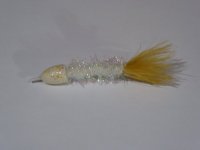
In the past I have had excellent success with a subsurface coon strip shrimp pattern which have gold/rust color that you described. Last year I tied up several top water coon strip shrimp patterns in those colors as shown in the photo. Coon strip shrimp are really available in much of Marine Area 13. I have not tried this pattern but hope that they work as well as the top water shrimp pattern.

Roger
 

Attachments

  • IMG_0052[1].JPG
    IMG_0052[1].JPG
    138.9 KB · Views: 25
Back
Top