Top 10 Inshore Flats Patterns — Central Gulf Coast

Mike Cline

Life of the Party
Forum Supporter
BZN90789.JPG
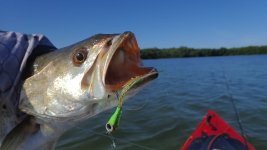
I visit the Tampa Bay - Sarasota Bay region every Nov-Dec for a few weeks of inshore flats fishing targeting mostly speckled trout, ladyfish and Spanish mackerel, but also occasionally hookup with snook, redfish, pompano, grouper, sharks, bluefish and flounder. Deep grass, potholes, channels and mangrove shorelines provide endless opportunity for a kayak angler that knows where and how to take advantage of the region’s moderate tides and vast shallow flats. I’ve tied 100s if not 1000s of saltwater patterns over the years and have too many boxes of flies to prove it. However, this year’s foray will focus on ten patterns that have delivered in the past and all be tied on Firehole barbless predator series hooks. (Mostly the 802P series). I’ll tie up at least a couple 100 flies with these patterns before the summer ends. I’ve used FH barbless before in the salt, and they’ve stood well if rinsed well at the end of the day. As far as hooking goes, they work just as well as regular saltwater looks and are much easier to dislodge from deeply hooked or feisty fish.

There are lots of “Best of:” lists out there and one can always debate the efficacy of what’s on them, but here’s mine. All patterns are unweighted with exception of the Clouser and redfish slider. I tie them in a variety of color combinations. They are fished with either one of two setups. I carry two TFO Axiom IIX 7 weight rods. One is lined with SA Sonar 200 grain 30 Warm and 4-5’ of 0X Flouro, the other with an SA Intermediate clear tip and standard 9’ 0X saltwater leaders. All the patterns are connected with a non-slip loop knot. I do carry pre-tied 0X tippets with 40# bite tippets just in case I encounter large schools of mackerel or bluefish. If you are getting bit off on the strike, it’s most likely one of those toothy critters.
P6230598.JPG
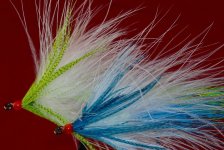
Gartside Soft-hackle streamer: This is my goto pattern. Lightweight easy to cast, with extreme movement in the water. Deadly on trout.
P6230600.JPG
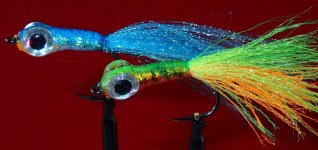
Myakka Minnow: A dense pattern that performs extremely well in deep channels and potholes.
P6230602.JPG
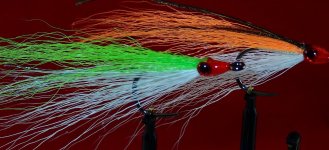
Bucktail Deceiver: A classic pattern that works extremely well in the potholes.
P6240608.JPG
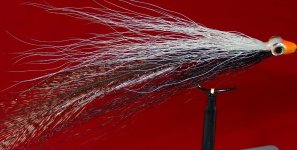
Half and half Clouser/Deceiver (unweighted plastic eyes): Very much like the bucktail deceiver but the hackle tail allows you to create flies with a much longer profile without additional weight.
P6230601.JPG
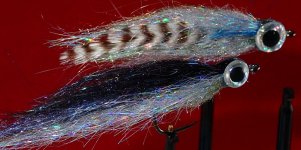
Diamond Hair baitfish: Standard minnow hair baitfish type pattern that can be tied in an almost infinite arrays of color combinations. Diamond Hair sheds water extremely well.
P6230603.JPG
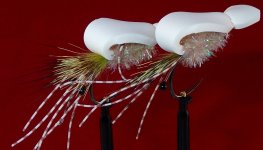
Shrimp Gurgler or standard Gurgler: Tied with internal rattles. Early morning in low light conditions the gurglers draw explosive strikes from trout and ladyfish over deep grass.
P6240606.JPG
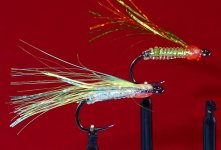
Flash Minnow: This is a simple pattern that is very useful when there is a lot of small bait, fish, glass minnows, etc. in the water.
P6230599.JPG
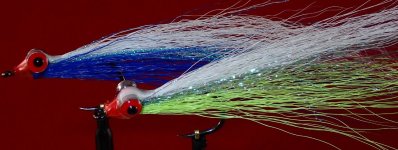
Clouser Minnow: I generally only fish weighted Clousers over extensive sandy bottoms where I might typically encounter flounder.
P6230604.JPG
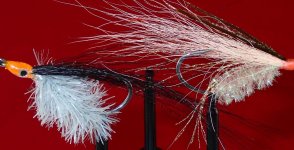
Bend Back: Bend back patterns are essential when the tide has risen and push the water deep into the mangroves where the snook, grouper and redfish hang out around ambush points. They can be cast into overhanging mangroves and rarely get snagged.
P6240607.JPG
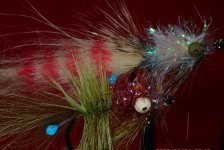
Redfish Crack/Slider: Got to carry something like this in case you encounter tailing redfish.
 
Last edited:
View attachment 158180
I visit the Tampa Bay - Sarasota Bay region every Nov-Dec for a few weeks of inshore flats fishing targeting mostly speckled trout, ladyfish and Spanish mackerel, but also occasionally hookup with snook, redfish, pompano, grouper, sharks, bluefish and flounder. Deep grass, potholes, channels and mangrove shorelines provide endless opportunity for a kayak angler that knows where and how to take advantage of the region’s moderate tides and vast shallow flats. I’ve tied 100s if not 1000s of saltwater patterns over the years and have too many boxes of flies to prove it. However, this year’s foray will focus on ten patterns that have delivered in the past and all be tied on Firehole barbless predator series hooks. (Mostly the 802P series). I’ll tie up at least a couple 100 flies with these patterns before the summer ends. I’ve used FH barbless before in the salt, and they’ve stood well if rinsed well at the end of the day. As far as hooking goes, they work just as well as regular saltwater looks and are much easier to dislodge from deeply hooked or feisty fish.

There are lots of “Best of:” lists out there and one can always debate the efficacy of what’s on them, but here’s mine. All patterns are unweighted with exception of the Clouser and redfish slider. I tie them in a variety of color combinations. They are fished with either one of two setups. I carry two TFO Axiom IIX 7 weight rods. One is lined with SA Sonar 200 grain 30 Warm and 4-5’ of 0X Flouro, the other with an SA Intermediate clear tip and standard 9’ 0X saltwater leaders. All the patterns are connected with a non-slip loop knot. I do carry pre-tied 0X tippets with 40# bite tippets just in case I encounter large schools of mackerel or bluefish. If you are getting bit off on the strike, it’s most likely one of those toothy critters.

View attachment 158181
Gartside Soft-hackle streamer: This is my goto pattern. Lightweight easy to cast, with extreme movement in the water. Deadly on trout.
View attachment 158184
Myakka Minnow: A dense pattern that performs extremely well in deep channels and potholes.
View attachment 158185
Bucktail Deceiver: A classic pattern that works extremely well in the potholes.
View attachment 158190
Half and half Clouser/Deceiver (unweighted plastic eyes): Very much like the bucktail deceiver but the hackle tail allows you to create flies with a much longer profile without additional weight.
View attachment 158183
Diamond Hair baitfish: Standard minnow hair baitfish type pattern that can be tied in an almost infinite arrays of color combinations. Diamond Hair sheds water extremely well.
View attachment 158186
Shrimp Gurgler or standard Gurgler: Tied with internal rattles. Early morning in low light conditions the gurglers draw explosive strikes from trout and ladyfish over deep grass.
View attachment 158188
Flash Minnow: This is a simple pattern that is very useful when there is a lot of small bait, fish, glass minnows, etc. in the water.
View attachment 158182
Clouser Minnow: I generally only fish weighted Clousers over extensive sandy bottoms where I might typically encounter flounder.
View attachment 158187
Bend Back: Bend back patterns are essential when the tide has risen and push the water deep into the mangroves where the snook, grouper and redfish hang out around ambush points. They can be cast into overhanging mangroves and rarely get snagged.
View attachment 158189
Redfish Crack/Slider: Got to carry something like this in case you encounter tailing redfish.
Thanks for this! Awesome ties and photos and so many ideas for the bench!
 
I’m liking those a lot…great idea on a rattle tied into the gurgler…I’m going to try that…
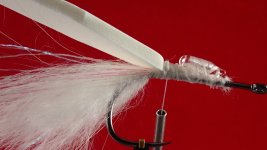
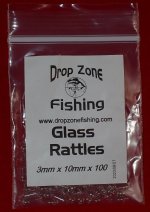
@Brute: Here's a few tips. 1) You don't need a large rattle. I use 3mm x 10mm with two balls by DropZoneFishing.com 2) When you tie in the tailing material cover most of the hook shank to provide a solid base for the rattle. Leave the front part of the hook bare to crimp the foam down tight. 3) After tying in the foam secure the rattle with thread wraps leaving ~ 1/8" space at the hook bend. This ensures a clean tie-in point for the body material. While ensuring the rattle is parallel to the hook shank secure both sides with UV resin.
P6240610.JPGP6240611.JPG
 
@Brute: Here's a few tips. 1) You don't need a large rattle. I use 3mm x 10mm with two balls by DropZoneFishing.com 2) When you tie in the tailing material cover most of the hook shank to provide a solid base for the rattle. Leave the front part of the hook bare to crimp the foam down tight. 3) After tying in the foam secure the rattle with thread wraps leaving ~ 1/8" space at the hook bend. This ensures a clean tie-in point for the body material. While ensuring the rattle is parallel to the hook shank secure both sides with UV resin.
View attachment 158221View attachment 158222
Awesome…mahalo brah…
 
View attachment 158180
I visit the Tampa Bay - Sarasota Bay region every Nov-Dec for a few weeks of inshore flats fishing targeting mostly speckled trout, ladyfish and Spanish mackerel, but also occasionally hookup with snook, redfish, pompano, grouper, sharks, bluefish and flounder. Deep grass, potholes, channels and mangrove shorelines provide endless opportunity for a kayak angler that knows where and how to take advantage of the region’s moderate tides and vast shallow flats. I’ve tied 100s if not 1000s of saltwater patterns over the years and have too many boxes of flies to prove it. However, this year’s foray will focus on ten patterns that have delivered in the past and all be tied on Firehole barbless predator series hooks. (Mostly the 802P series). I’ll tie up at least a couple 100 flies with these patterns before the summer ends. I’ve used FH barbless before in the salt, and they’ve stood well if rinsed well at the end of the day. As far as hooking goes, they work just as well as regular saltwater looks and are much easier to dislodge from deeply hooked or feisty fish.

There are lots of “Best of:” lists out there and one can always debate the efficacy of what’s on them, but here’s mine. All patterns are unweighted with exception of the Clouser and redfish slider. I tie them in a variety of color combinations. They are fished with either one of two setups. I carry two TFO Axiom IIX 7 weight rods. One is lined with SA Sonar 200 grain 30 Warm and 4-5’ of 0X Flouro, the other with an SA Intermediate clear tip and standard 9’ 0X saltwater leaders. All the patterns are connected with a non-slip loop knot. I do carry pre-tied 0X tippets with 40# bite tippets just in case I encounter large schools of mackerel or bluefish. If you are getting bit off on the strike, it’s most likely one of those toothy critters.

View attachment 158181
Gartside Soft-hackle streamer: This is my goto pattern. Lightweight easy to cast, with extreme movement in the water. Deadly on trout.
View attachment 158184
Myakka Minnow: A dense pattern that performs extremely well in deep channels and potholes.
View attachment 158185
Bucktail Deceiver: A classic pattern that works extremely well in the potholes.
View attachment 158190
Half and half Clouser/Deceiver (unweighted plastic eyes): Very much like the bucktail deceiver but the hackle tail allows you to create flies with a much longer profile without additional weight.
View attachment 158183
Diamond Hair baitfish: Standard minnow hair baitfish type pattern that can be tied in an almost infinite arrays of color combinations. Diamond Hair sheds water extremely well.
View attachment 158186
Shrimp Gurgler or standard Gurgler: Tied with internal rattles. Early morning in low light conditions the gurglers draw explosive strikes from trout and ladyfish over deep grass.
View attachment 158188
Flash Minnow: This is a simple pattern that is very useful when there is a lot of small bait, fish, glass minnows, etc. in the water.
View attachment 158182
Clouser Minnow: I generally only fish weighted Clousers over extensive sandy bottoms where I might typically encounter flounder.
View attachment 158187
Bend Back: Bend back patterns are essential when the tide has risen and push the water deep into the mangroves where the snook, grouper and redfish hang out around ambush points. They can be cast into overhanging mangroves and rarely get snagged.
View attachment 158189
Redfish Crack/Slider: Got to carry something like this in case you encounter tailing redfish.
Did you use a cdl on the half and half clouser/deceiver? If so, do you find those feathers to transparent/thin?
Nice flies.
 
Did you use a cdl on the half and half clouser/deceiver? If so, do you find those feathers to transparent/thin?
Nice flies.
YES. In my experience almost all hackle compresses on the retrieve and expands when tension is released. CDL is not an exception. When the feather is not compressed is does present a translucent appearance in the water. (Not unlike real baitfish). When compressed, the strong dark hackle stem does a good job of replicating a lateral line. I’ve used CDL hackle with streamers for a long time and it’s always produced.
 
YES. In my experience almost all hackle compresses on the retrieve and expands when tension is released. CDL is not an exception. When the feather is not compressed is does present a translucent appearance in the water. (Not unlike real baitfish). When compressed, the strong dark hackle stem does a good job of replicating a lateral line. I’ve used CDL hackle with streamers for a long time and it’s always produced.
Thanks. I am just starting to experiment with the hackles. I really like the way the look.
 
Back
Top