

With lake season now in full swing, I thought I'd share a few tips that have worked for me in recent days and weeks. Nothing sophisticated and certainly no magic, I tend to stick with the overly simple...as in it simply works and someone like you or me can execute on it. Feel free join in and add any of your own. Maybe we end up with a resource 
Try up high out in the middle: When risers number greater than one or two, but less than a bunch, give this a shot. The beauty here is floating or sinking line works. I'm staying with the same setup, Type V full sink and whatever I am already throwing. It's like any other cast/retrieve, just without the count. Soon as it hits the water, I'm stripping back.
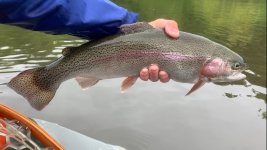
Sizable trout are rare where I live - A few days ago this one exploded on my fly within inches of the surface.
Tight to shore means tight to shore: Comes from general intuition and countless hours working the weeds. To be clear, it means within one foot of vegetation, rocks or whatever makes up the line. A reasonable amount of hand/eye and some practice will have you pitching like a pro. To add, my best strikes and many of the larger fish made the grab in a foot or two of water, right when the fly landed. More logic suggests having the fly already underway and passing overhead for fish further out (often laying in the vegetation looking up).
Whether weeds or rock structure, work on softly dropping your fly within a foot of the line.
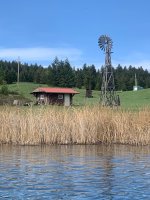
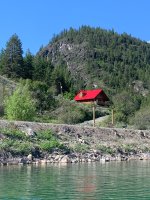
Put it in his field of vision, not on his head: We have a tendency to throw right at the fish, or try to drag the fly right into it underwater. That's the thinking anyway. Instead, start widening out and consider the entire area he conceivably sees. You're appealing to a predator that prefers to ambush or give chase vs. having prey land in its lap. The concept seems a little abstract but the idea behind it works.
Mooney's memorable moment - Steve was presenting in about five feet of depth over vegetation, his fly toward the top of the water column. This giant swept up from bottom to whack the fly an armslength from his rod.
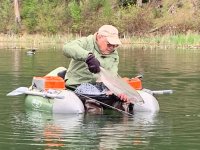
Duration of the fight: The simplest of logic, here you just want the happy medium, that's it. For larger fish, this starts to really matter. Make a play for the net in haste and risk the run to freedom in that moment of truth. On the other hand, too timid for too long either tires the fish needlessly or allows it unnecessary time to shake off. In practical terms, as soon as I observe a slight change in behavior to signal fatigue, I start getting assertive.
Trouble with the trees: A recent favorite, whenever throwing a little too tight to shore, instead of intuitively pulling a snagged fly back like a hookset try allowing some slack and gently wiggle the rod from side to side. It has the effect of pushing your fly back out in the direction it came from vs. pulling it further into the obstacle. Note, it works better with a floating line but try it either way.
Obstacles vs. opportunities - Here I see a lot of both. And on this day, more time in the zone meant big rewards, as a lot of hungry bass couldn't keep their big mouths shut.

The high road and you: I'll end with some life experience here. I've never known anything good to come from mixing it up over a disagreement on the water. My advice, always be respectful and "walk away" from a potential quarrel if you have to. Besides the risk of someone geting hurt or just having a sour outing, this stuff can easily throw you off your game and have you missing opportunities.
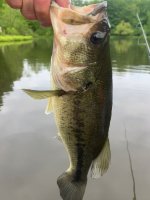
Result of a cool head - The decision to "walk away" from two kayakers who destroyed a honey hole in the shallows had me where I needed to be moments later. No regrets turning the other cheek as I held this one up for a pic.
Try up high out in the middle: When risers number greater than one or two, but less than a bunch, give this a shot. The beauty here is floating or sinking line works. I'm staying with the same setup, Type V full sink and whatever I am already throwing. It's like any other cast/retrieve, just without the count. Soon as it hits the water, I'm stripping back.
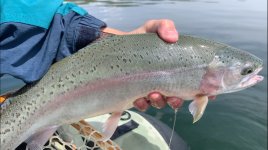
Sizable trout are rare where I live - A few days ago this one exploded on my fly within inches of the surface.
Tight to shore means tight to shore: Comes from general intuition and countless hours working the weeds. To be clear, it means within one foot of vegetation, rocks or whatever makes up the line. A reasonable amount of hand/eye and some practice will have you pitching like a pro. To add, my best strikes and many of the larger fish made the grab in a foot or two of water, right when the fly landed. More logic suggests having the fly already underway and passing overhead for fish further out (often laying in the vegetation looking up).
Whether weeds or rock structure, work on softly dropping your fly within a foot of the line.
Put it in his field of vision, not on his head: We have a tendency to throw right at the fish, or try to drag the fly right into it underwater. That's the thinking anyway. Instead, start widening out and consider the entire area he conceivably sees. You're appealing to a predator that prefers to ambush or give chase vs. having prey land in its lap. The concept seems a little abstract but the idea behind it works.
Mooney's memorable moment - Steve was presenting in about five feet of depth over vegetation, his fly toward the top of the water column. This giant swept up from bottom to whack the fly an armslength from his rod.
Duration of the fight: The simplest of logic, here you just want the happy medium, that's it. For larger fish, this starts to really matter. Make a play for the net in haste and risk the run to freedom in that moment of truth. On the other hand, too timid for too long either tires the fish needlessly or allows it unnecessary time to shake off. In practical terms, as soon as I observe a slight change in behavior to signal fatigue, I start getting assertive.
Trouble with the trees: A recent favorite, whenever throwing a little too tight to shore, instead of intuitively pulling a snagged fly back like a hookset try allowing some slack and gently wiggle the rod from side to side. It has the effect of pushing your fly back out in the direction it came from vs. pulling it further into the obstacle. Note, it works better with a floating line but try it either way.
Obstacles vs. opportunities - Here I see a lot of both. And on this day, more time in the zone meant big rewards, as a lot of hungry bass couldn't keep their big mouths shut.
The high road and you: I'll end with some life experience here. I've never known anything good to come from mixing it up over a disagreement on the water. My advice, always be respectful and "walk away" from a potential quarrel if you have to. Besides the risk of someone geting hurt or just having a sour outing, this stuff can easily throw you off your game and have you missing opportunities.
Result of a cool head - The decision to "walk away" from two kayakers who destroyed a honey hole in the shallows had me where I needed to be moments later. No regrets turning the other cheek as I held this one up for a pic.
Last edited:


