
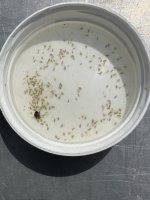
Are these Daphnia:

Follow along with the video below to see how to install our site as a web app on your home screen.
Note: This feature may not be available in some browsers.


There are not as many species of daphnia as there chironimidae, but they do differ about the same. Different colors do exist.Follow up question: If Rod and Dean are correct then I'd like to know if water fleas/daphnia come in different sizes (sub species? - I can't tell for sure what size the daphnia are in Ron's photograph). I tend to think of daphnia as more orangish in color. But WDIK?
Yeah........ I should have added something to the photo to show scale. FWIW, the white "dish" is the lid from a plastic mayo "jar."......Follow up question: If Rod and Dean are correct then I'd like to know if water fleas/daphnia come in different sizes (sub species? - I can't tell for sure what size the daphnia are in Ron's photograph). I tend to think of daphnia as more orangish in color. But WDIK?


Super interesting! Thank you for posting that. Learned something new.On a side note, daphnia should not be ignored. I’ve heard people complain about finding daphnia in throat samples, thinking that the fishing will be a bust. If the fish are on daphnia, it is likely that the daphnia is all that is available.
They will eat other offerings, but you have to find where the fish are targeting the daphnia. Daphnia will often times populate areas of a lake where we don’t normally fish. We mostly fish the Littoral zone of a lake (where light is able to reach the bottom of a lake and support primary producers). Daphnia on the other hand will live comfortably in the pelagic/open water zone or even into the Profundal zone of a lake (below light penetration).
Daphnia will move up and down in the pelagic zone as light penetration changes throughout the day. They are photo sensitive and will move deeper with more light penetration. This the shallow early, deeper later rule of thought. Sometimes though this isn’t true.
The first time I experienced a visible daphnia concentration was on Pass lake in February. @Nick Clayton and I were fishing a deep area within the littoral zone at the far end of the lake most of the day with some success. He needed to leave early so I rowed him back to the launch. Wind was fairly normal, but pushing up against the launch. We could see what looked like an algae bloom next to shore as we approached. We were with another fisherman who was in a float tube and closer to the water who asked, “What are all these little bugs?” Upon closer inspection I noticed that the algae was a massive cluster of daphnia right at the surface. The entire cluster was about 15’ off the shore, about 10’ across, 4’ deep and it stretch about 100 yards down the shoreline.
I dropped Nick off, rowed back out, anchored and dropped a micro leech 3’ under an indicator right into the cluster. I landed 5 bows before Nick left the parking lot. I kept working the cluster all the way down the shoreline, picking up several more fish until I too needed to leave. I used the same pattern the entire time, but I don’t think the pattern mattered at all, those fish were hungry and presented with a larger meal, they were happy to take it.
Through more times I’ve found visual clusters of daphnia, and all three times fish were concentrated on the clusters. @troutpocket and I found two areas of a lake earlier this month and both areas were by far the most productive areas of the lake.
