The original knife thread.

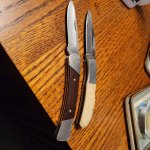
This is a knife I found while cleaning out my in-laws. I’m guessing it came down family lines, most likely from the mid-west. The blade has Marbles, Gladstone, Michigan on the blade. Anyone familiar with it?
Not my area of expertise, but I believe it’s a pretty big deal.
 
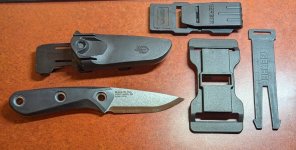
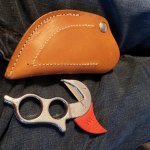
I just got a new to me knife from the auction site. It's a Gerber with an interesting modular sheath system that allows it to be carried vertically or horizontally, with the handle up, down, left or right.

The blade needs a little TLC, but I like doing that. I'd be interested in learning more about this knife.
PXL_20251209_020233799.jpg

Edit: Google Lens says it is a Gerber "Principle."
 
Last edited:
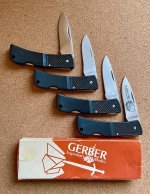
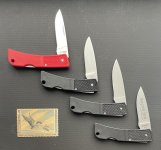
Cheap plastic gas station knives or one of the most revolutionary developments in modern knife making? I believe the latter, but I'm biased. These four knives represent the very earliest of the 'plastic' Gerber LST's. The top two knives made their debut in the 1982 catalog. They were sold along side the previously posted micarta 'classic' models, which would remain in the catalog till 1985 depending on the color. The micarta FS models were put to bed in 1982. These knives were made of Rynite, a Dupont glass filled polyester polymer. The blades on the top two knives are identified as earliest, due to the old block style tang stamp and the transition grind blade. The bottom two have the transition grind blade, but use the later stylistic tang stamp. The Rynite handled LST's were made till 1985. Millions of these knives were produced and there were many million more copies and wannabe's from just about every major knife producer at the time and to this day. More nerd stuff below.

tempImagemoYcc9.jpg
So, what's the big deal? It's the first, one piece, injection molded design in a pocket knife. Allegedly, it has just six pieces, light as air and the actions were buttery smooth. They were strong too. Blackie Collins designed a number of great knives for Gerber, but the LST remains a collaborative effort. Pete Gerber wanted his FSI in a lightweight package and Blackie came to him in 1980 with the idea to go with injection molding. It was a hit. While it may be regarded as a cheap knife today, they didn't cut any corners in the beginning. The blades were still cryo treated 420hc steel. They had a program to match the lock catch to the blade from first cut/machining to final assembly. This assured that the knives would be smooth opening with a tight lock up. The bronze impregnated washers are nearly indestructible and the blade is held in place with a splined axis pin that won't loosen up unless you use it as a pry tool, which is no bueno. I carry one of these as my daily.
 
I just got a new to me knife from the auction site. It's a Gerber with an interesting modular sheath system that allows it to be carried vertically or horizontally, with the handle up, down, left or right.

The blade needs a little TLC, but I like doing that. I'd be interested in leading more about this knife.
View attachment 174279

Edit: Google Lens says it is a Gerber "Principle."
I don't know much about modern Gerber's, but I like that blade. I like the fact that it's still USA made too. Keep us posted.
 
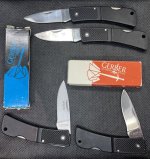
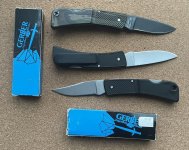
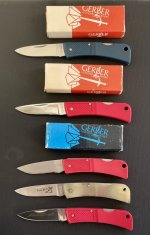
In 1985, Gerber switched from Dupont Rynite to Zytel. Zytel is is a glass filled nylon vs. the Polyester of the Rynite. Of the standard five different sizes of the LST over the years, this original size is known as the 400 model. The orange box is the earlier version, sometime around the Fiskars acquisition and before, while the blue box ran from the late 80s into the 90s. All of these knives have the deep plunge grind vs. the earlier models posted above. They all have the stylized Gerber stamp and they all have the nail nick. Something that will go away in future models. High polished blades will also go away. The Hoffritz blade is the tumbled or brushed blade on the left, signifying the departure of polished blades. These are some of the best built LST knives in the Gerber chronology, as far as I'm concerned.

tempImagez4AdZL.jpg
 

Attachments

  • tempImageiHtdAK.jpg
    tempImageiHtdAK.jpg
    774.2 KB · Views: 2
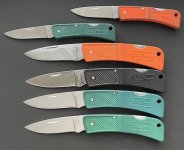
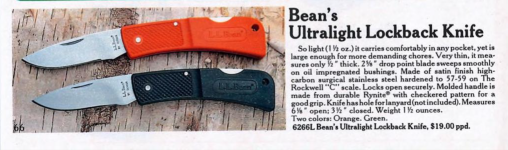
One of the joys and frustrations of being a diehard Gerber collector is that they throw a lot of curveballs at you. This lot of LL Bean LST's (400 size) and Ultralight LST's (300 size) is pretty rare. Not impossible, but when they show up, I can't help myself. These are all different. Not just in color, but in blade styles, polished vs. bead blasted, tang stamps, etc. Gerber LST's in any color but black always brings a premium. Some more than others and finding them not stained and soiled is really hard. The mystery here is that the forest green color was never in the catalogs. I've only seen them as LL Bean knives. The orange, is one of the more desirable colors to find because they were among the first 'catalogued' colors other than black, and they had a short existence, being made only from 86 to 88 according to some sources. The mystery deepens when you consider that the LL Bean catalog shot below was from 1984. The transitional grind in the large orange knife was no longer available by 1985, so this would make sense. Nerd on.........

tempImageI0djXf.jpg

1984 LL Bean Cat .png
 
Four more Gerber LST 400s. The top orange knife has the earlier polished blade. It was my dad's, and was probably made in the early part of 86. He lost it for a number of years, but then found it in his sleeping bag. :sneaky: The next orange knife has the later bead blasted blade. This knife along with the next two are new. The camo is a first generation camo. Gerber experimented with three (technically four) different kinds of camo. Collectors refer to this one as transparent camo. Well, because it is. The problem with the camo in the first generation is that they fade quickly. So, it's hard to find a good one. These knives were made from 86 - 91. The red LST is the most common of the color knives. The red knives were made from 1988 - 96. In this knife you can see where the bean counters started calling down to the shop floor and complaining. The nail nick is now gone and in the second picture, you can see that they stopped worrying about the blade matching the lock. Also, they no longer finish the mold trim as noted on the back of the knife. The tang stamps in this era have 400 under the Gerber stamp.
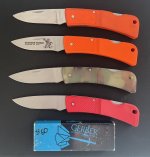
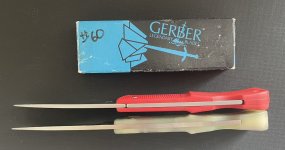
tempImagey35jF8.jpg
tempImageXfkcvO.jpg
 
Gerber 400s - We're well within the 90s here, which is when most of the interesting (IMHO) LST's start to fade away. There are exceptions of course. The Realtree camo knife with the black blade was Gerber's second attempt at a camo handle. The camo didn't wear well, which may explain why these were only made from 92 to 93. Or, it may be that Fiskar's started turning the screws on Gerber and looking to cut costs. The second knife down is a standard 400, but with Gerber's attempt to catch the trend of knives with pocket clips. Effective, but not well executed in my opinion. All three of these knives came with clips. The bottom knife is one of the few blade differences from Gerber, along side the black blades (found on camo and red handled knives only - uncommon), and a partial serrated blade (uncommon). The clip blade was available from 91 through 96 and had some fans, but not enough to keep it in the catalogs. It also is harder to open as you don't have enough blade to grapple on to, and Gerber had already done away with the nail nick.

tempImagemOWEU3.jpg
 
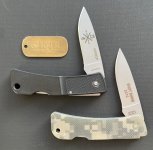
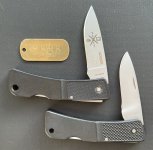
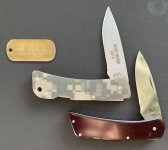
Wrapping up my "400" size LST's (for now). The top knife is a serialized limited edition commemorating Gerber's 75th year, which I believe puts this knife to 2014. The digicam, slab sided knife below is obviously from 2010, but I've only seen these with the Shot Show logo, which may imply that was what they were made for. The brass tag is actually an import tag. Something that was required by the country of Japan for every knife imported. I've seen these for Buck as well. More nerd stuff below.

tempImagenVmLak.jpg

This is a comparison shot of the original Rynite LST from 1982 with the commemorative from 2014. The quality difference is ridiculous. The original knife is a gem in hand and in action. The 2014 feels more like a gas station knife. So many corners were cut, but this was probably the best they could do to keep the price low while still keeping the manufacturing in the USA.
tempImageB7hhcu.jpg
Comparing the slab sided digicam to the original slab sided Micarta from the 81/82 era. In addition to digicam, These Shot Show knives were also made in blaze orange, pink and blue (that I know of).
tempImagexfnvk5.jpg
 
Replicant. I have this buck 500 I am going to liquidate from my collection. It has never been used. Where is the best place to sell it? I will put a picture up of the knife when I get home.

20251214_184447.jpg
 
Replicant. I have this buck 500 I am going to liquidate from my collection. It has never been used. Where is the best place to sell it? I will put a picture up of the knife when I get home.

View attachment 174890
Your best exposure is eBay. If you have an account, I can offer some guidance on how to list. I would avoid FB marketplace and Craigslist, but I wouldn't rule it out altogether. Collector forums would also be ideal, but usually they require membership and participation, etc. So, not easy. Establishing a value could be tricky. A similar knife (just the knife, no box, papers or sheath), sold for $275 recently on eBay. On the other hand, there is one listed as used, with box, sheath, etc listed at $249 with no one watching, so it might be a fickle market. Lovely knife by the way.
 
BTW, $20.00 at an estate sale 9 years ago. I was going to use it for hunting. It is just to pretty for that. I will keep sharpening my old buck folder.
 
These are my preferred hunting knives. Kershaw 4100 whiskey gap 2 1/2 blade
Buck 503 prince 2 5/8 blade.
The buck is my main. 420hc steel sharpens fast and will gut and skin an elk as long as I stay away from the hair. I have harvested 54 bulls and the Buck has done probably 80 percent of them. BTW, the blade is no longer 2 5/8. Closer a strong 2 1/2 now from years of sharpening. 20251217_183209.jpgAs a side note. The buck could be 440c steel since it has a micarta handle.
 
Last edited:
Going down in size is the near equal in popularity, 300 series Gerber Ultralight LST. Weighing just a hair over a half an ounce, this is a surprisingly useful blade for what it is. According to documentation, the 300 Ultralight was released in 1986. Like the 400s, the color models are always in demand. From top to bottom is the earliest to later production. The same could be said for quality. The red knife was made from 86 to 93, and this one is on the early side with the polished blade and nail nick. The next one down has the stamped 300, and no nail nick, putting this one firmly in the 90s. The third knife is still stamped, but there are little details where the quality begins to drop off. Finally, the last knife just doesn't scream refined elegance when it's an etched blade advertising antibiotic medication for bovine and swine. This knife was probably produced at the end of the 300 line, which by some estimates was around 2013. For better or worse, Gerber didn't raise prices on the LST's, so on one hand they represented good value for a USA produced knife, while on the other hand, they created their own competition with every other knife producer coming out with something similar, often not as good, or sometimes better (Spyderco).
tempImageK3Kr6h.jpg
 
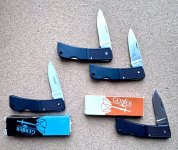
You can buy black 300s for around $10 bucks every day, all day. Even when they have been out of production for over a decade. Millions were made. So, color is where it's at. The top two knives, blue and red are early 86/87 ish as notable by their polished blades, nail nick and orange box. The blue box, red knife with the matte finish blade is a post Fiskar's acquisition knife. These were late 80s through 92 only. For some reason, blue is a very uncommon handle to find and was only available in the 300 model. The camo 300 is not a catalog issue knife. In fact, this is just one of two that I have ever seen. I know the man that owns the other, but he has the "Jake" in 400 size to go with it. Likely a special order. Finally, not unlike the LL Bean knives listed before, Eddie Bauer was an early adopter of these Gerber knives. EB knives can be found on other Gerber hunting knives as well. Youngster's today may not know that Eddie Bauer was a legit sporting goods purveyor at one time. They even had a gun department. I remember looking at the rows of Browning Superposed doubles in their Seattle store when I was a kid.

tempImage12jbkc.jpg
 
Back
Top