The original knife thread.

I don't think it has passed yet. WA Legislature still list's it as illegal.

https://app.leg.wa.gov/RCW/default.aspx?cite=9.41.250
I think you're correct? Legal websites are clear as mud.
I guess if the owner shows up and is someone legally allowed to have it, I'll hand it over.
Otherwise, what? Take it to a police station?
I certainly wasn't leaving it on the ground for some kid to find!
 
I think you're correct? Legal websites are clear as mud.
"Legal websites are clear as Washington fishing regs . . . "

Fixed it for you ;)
 
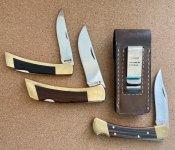
Nice knives. While that Boker has seen a lot of love, I find it to be interesting. Those canted and grooved bolsters and the "Honey and Molasses" celluloid scale pinned flush with nickel silver pins is a sign of high quality. Schrade and Camillus made knives for LL Bean for a long while. That Case Jack in blue is pretty slick. Looks like a doctor's knife, but I'm only guessing.
Thanks for the insight. I was wondering about the scale on the Boler, I thought maybe it was some type of horn as @Zak had said. But celluloid.. I wonder if that would that help to pin down when it may have been made?

Also, someone asked about the old Boy Scout knives. I also have my old Cub Scout knife around here somewhere. If I can find it I’ll post a photo of it too.
 
Thanks for the insight. I was wondering about the scale on the Boler, I thought maybe it was some type of horn as @Zak had said. But celluloid.. I wonder if that would that help to pin down when it may have been made?

Also, someone asked about the old Boy Scout knives. I also have my old Cub Scout knife around here somewhere. If I can find it I’ll post a photo of it too.
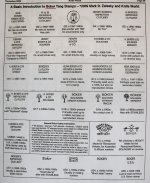
The most common tang stamp for USA made Boker's is at the bottom right. I can't see yours, but also consider that the scales look more like celluloid that didn't see much use after the 40s. With that said, it could be some other synthetic material, but unlikely to be Delrin, which was introduced in the 60s. Again, I'm just taking a stab at this, so I could be completely off.

IMG_0001 (1).JPG
 
The most common tang stamp for USA made Boker's is at the bottom right. I can't see yours, but also consider that the scales look more like celluloid that didn't see much use after the 40s. With that said, it could be some other synthetic material, but unlikely to be Delrin, which was introduced in the 60s. Again, I'm just taking a stab at this, so I could be completely off.

View attachment 168757
Great info'! Thanks for showing this!

The stamp on my knife is the same as the second one from the lower right... Block style all caps; "BOKER". It's on all three blades.
 
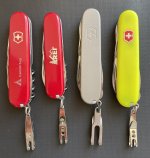
Pretty basic Swiss Army Knives - All by Victorinox. I believe the first knife I ever owned was a SAK (swiss army knife). I remember
carrying it when going on a field trip to MOHAI when I was in pre-school. I was disappointed that my best friend (a girl!) wasn't coming, so I sat in the back of the bus by myself moping and of course playing with my knife. A chaperone saw me and moved back to sit next to me. He saw the knife and proceeded to.............. pull his Swiss Army Knife out of his pocket to show me. The very idea of any of this happening today would shock the younger generation. Oh well.


tempImageTG6RUq.jpgtempImageFTc1Jy.jpg
 
Last edited:
There are some cool knives out there. However, I think I need to blacklist Montana Knife Company from all my devices. It's getting awfully expensive...
 
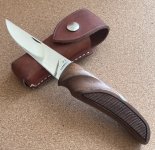
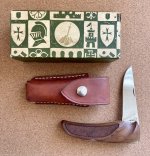
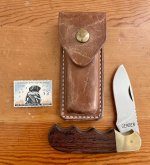
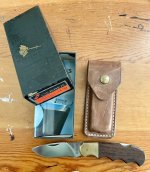
Gerber folding hunter in checkered walnut - Circa 66 - 72, 73,74 ish... These are uncommon and highly sought after. Rare in new, unused condition with box, sheath and papers. Most believe that it was the first folding knife that Gerber ever made. The problem is that there is rumor (from Gerber) that they produced the "Coho" model as their first folding knife in 1966. I've never seen any reference to this "Coho"(the armorhide fixed blade fillet of the same name came later), but the folding hunter may be the "Coho". It's been rumored that the FH for folding hunter was actually the initials for "Francis Ham Gerber", the designer of this knife. This kind of stuff is just a hint of the ambiguity of Gerber production information and history. Something I have been struggling with as a collector of Gerber knives for over forty years. I'm not alone in this sentiment. These came in a standard of six variations. Delrin or nylon handled at the lowest price. Next up was a smooth handled walnut at the medium price, then the checkered handled walnut as shown below. You then had your choice of stainless blade or HS (High speed steel) blade. Some times you will find them with a Gerber sharpening steel in a sheath that accommodates both the knife and the steel. Finally, there may have been an ebony version made in the final two years of production. I haven't seen one yet. Annnnd, technically there were others, but I'll get into those later.

tempImageHEUqk7.jpg
tempImageVImFqa.jpg
 
Gerber folding hunter in checkered walnut - Circa 66 - 72, 73,74 ish... These are uncommon and highly sought after. Rare in new, unused condition with box, sheath and papers. Most believe that it was the first folding knife that Gerber ever made. The problem is that there is rumor (from Gerber) that they produced the "Coho" model as their first folding knife in 1966. I've never seen any reference to this "Coho"(the armorhide fixed blade fillet of the same name came later), but the folding hunter may be the "Coho". It's been rumored that the FH for folding hunter was actually the initials for "Francis Ham Gerber", the designer of this knife. This kind of stuff is just a hint of the ambiguity of Gerber production information and history. Something I have been struggling with as a collector of Gerber knives for over forty years. I'm not alone in this sentiment. These came in a standard of six variations. Delrin or nylon handled at the lowest price. Next up was a smooth handled walnut at the medium price, then the checkered handled walnut as shown below. You then had your choice of stainless blade or HS (High speed steel) blade. Some times you will find them with a Gerber sharpening steel in a sheath that accommodates both the knife and the steel. Finally, there may have been an ebony version made in the final two years of production. I haven't seen one yet. Annnnd, technically there were others, but I'll get into those later.

View attachment 170475

that's a beaut... Gerber knives seemed to take a superior edge compared to others during that period
 
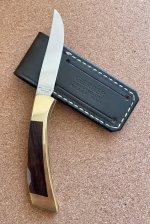
The aforementioned folding hunter was not the rousing success that Gerber hoped it would be. Possibly they saw Buck's success with the 110 and Puma with the 'Game Warden' and wanted to get in on that. So, while they had been making their knives in house since 45 (I think), they reached across the pond to have their first "Sportsman" series made in Solingen Germany. These German versions of the popular Sportsman series were only made for one year, 1972. While they proved to be popular, they're difficult to find these days. Especially mint and unused. This knife retailed for $18.50 in 1972. A little over $140 in today's dollars. A sheath, or what Gerber always referred to as a 'scabbard' was extra. That would have knocked you back $2.50. The scabbard shown is an early Gerber scabbard and correct to the model, but not to the era. The original Solingen era scabbards are probably 100 times rarer than the knife. I absolutely love this knife.

tempImagezTpsvB.jpg
tempImage4nsKyS.jpg
 
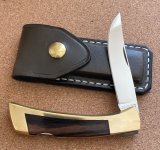
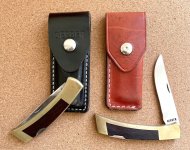
With the success of the 1972 Solingen made Folding Sportsman behind them. Gerber decided to bring production in house. Designated the Folding Sportsman II (2), this model is dimensionally similar to the original Folding Sportsman, but definitely not the same. This model was the longest production of any of the brass body Folding Sportsman models or variants and was made from 1973 through 1997. With exception to a change of tang stamp during the 80s, the construction of the knife appeared to remain the same throughout. The scabbard (sheath) on the other hand, went through many changes. The scabbard on the right is a 70s era, where the one on the left came much later. You could also get them in nylon. Again, because the scabbard's were optional, they tend to be harder to find.

tempImageN44b0b.jpg
 
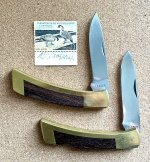
Less common than the previously posted 'trailing point' blades is this pair of Folding Sportsman IId knives. The d is for drop point blade and these were introduced in 76 (three years after the introduction of the trailing point version) and stayed in production till 94 (three years before all folding sportsman models were ceased). The only major difference between these two is the grind plunge and later tang stamp (mid 80s) on the top knife vs. the transitional grind and the block style font on the earlier bottom knife.

tempImagetq881L.jpg
 
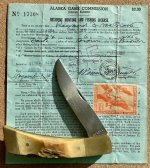
Here is a pretty rough example of a Gerber Folding Sportsman II with stag inlays. I believe these were made from 77 thru 82, but with Gerber, there were always exceptions. More, potentially boring detail below.

tempImage58avtG.jpg

While the vast majority of Folding Sportsman models came with Macassar Ebony inlays, there were some interesting variants that I don't have........... yet! There was a Sportsman II that had a special Vascowear blade. Pretty high tech alloy for the time. These had black micarta inlays. I was busy negotiating for one, but then the tariffs hit. There were limited editions that had beautiful Jade inlays and Oregon agate inlays. These could also be found, fully engraved. The stag shown above was a special edition. There were sets of all three sizes with varying inlays and engraving. Commemorative models. Red bone inlays (very beautiful) and some that I've never seen in the catalogs, like smooth stag (possibly bone) and black palm. Of course there are plenty of sportsman models with corporate logos, promotions and service awards. These can be a hinder to value most of the time, but there are always exceptions.
 
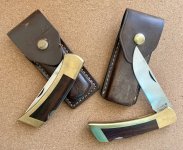
A pair of the largest of the Folding Sportsman series. The FSIII - And they are big. The sheath on the left is the more common, later version where the sheath on the right is alleged to be a first production year only for this knife. I like the handy dandy clip on the back. I show a comparison photo on the bottom with the FSII and the Buck 110. Interesting to me is that the Buck 110 blade is essentially the same length of the FSII, but with a much larger and longer handle. The FSIII is a monster compared to the 110. The FSIII was produced from 75 to 95 and had an overall open length of 9.5".

tempImage8n8LOP.jpg
tempImageC7Db1h.jpg
 
Technically in the same category, this is the Gerber Magnum Folding Hunter. At the time, Al Mar was head of Gerber's design team and this knife is attributed to him. These were made from 75 thru 87. The early ones had pins in the handles and during the first year, you could get one with natural stag handles or smooth stag handles.

tempImageAMAqga.jpg
tempImagecPzLfq.jpg
 
Technically in the same category, this is the Gerber Magnum Folding Hunter. At the time, Al Mar was head of Gerber's design team and this knife is attributed to him. These were made from 75 thru 87. The early ones had pins in the handles and during the first year, you could get one with natural stag handles or smooth stag handles.

View attachment 170916
View attachment 170917
I dig the sword/commando knife stamped into the sheath.
 
A pair of the largest of the Folding Sportsman series. The FSIII - And they are big. The sheath on the left is the more common, later version where the sheath on the right is alleged to be a first production year only for this knife. I like the handy dandy clip on the back. I show a comparison photo on the bottom with the FSII and the Buck 110. Interesting to me is that the Buck 110 blade is essentially the same length of the FSII, but with a much larger and longer handle. The FSIII is a monster compared to the 110. The FSIII was produced from 75 to 95 and had an overall open length of 9.5".

View attachment 170864
View attachment 170865
i had a folding sportsman for years. my parents gave us boys the knives. mine had a severe angle to the blade (whatever you call that), and it was very difficult to get or keep sharp. it was put aside, and i dont know where the heck it is.
 
i had a folding sportsman for years. my parents gave us boys the knives. mine had a severe angle to the blade (whatever you call that), and it was very difficult to get or keep sharp. it was put aside, and i dont know where the heck it is.
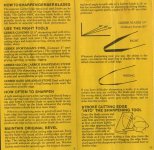
Most pocket/field knives had/have around a 20 to 25 degree angle to them. My Gatco sharpening system defaults to pocket/hunting knives at 25 degrees. Gerber usually provided paperwork with their knives stating that they need to be sharpened at a 15 degree angle. This is/was a major complaint about Gerber knives, but they did everything with intention. You might have noticed the soft opening and closing of your sportsman with a pause before closing. This was intentional. Pete Gerber stated that he didn't like the loud snap of a knife being opened and closed (e.g. Buck). This required extra work, thus the expense.

I just found a copy of their instructions in my file.

img192.jpg
 
Back
Top