The original knife thread.

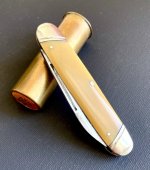
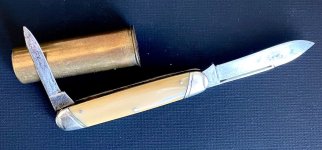
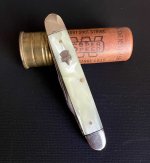
A pair of Iroquois pen knives. Iroquois was a house brand or sub brand of Utica (Kutmaster fame), but most literature states that the brand only existed from 1930 to 1940. Most likely a depression era business move. The lower knife is nicer in quality and is probably earlier.


View attachment 159568
Do you think pen knives are called that because they used to cut/sharpen quills for pens?
 
Yes. It’s a holdover from the previous century. They were essentially gentlemen knives. It’s essentially a pattern name that stuck around. Like stockman or Texas toothpick and so on.
 
The devil is in the details on this pre 1937 Utica. A gentlemen's knife with spear point master and a pen blade. Both blades have half stops. The slanted, pinched and grooved bolster's add a little flourish. The natural celluloid scales that resemble smooth bone are pinned flush. By the time the 40s rolled along Utica still made great knives but they were more utilitarian and simple.

tempImageZNp8iB.jpg

tempImage7w7clN.jpg
 
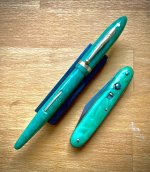
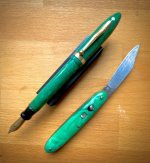
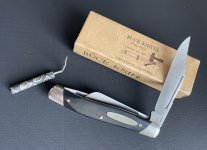
Edgemaster switchblade 1936-1956 - These things are crudely made and I would equate the quality to today's 'gas station' knife. Yet, they command big prices. I let this one go at auction recently (in Oregon as I can't sell it in WA), and was surprised to see it go north of $100. Nice one's can reach $300. The jade celluloid scales are not the same as the 30s era Sheaffer's (much higher quality). The pen is a "Balance" model, but this one in particular is a telephone dialer ;)

zAcJdvE.jpeg
wdeTede.jpeg
 
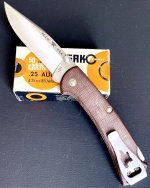
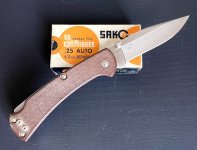
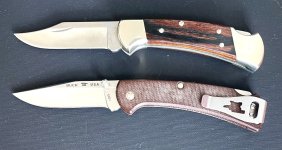
Here is a knife that I carry frequently. The name is a bit of a mouthful. It's a Buck 112 Slim Ranger Pro in "Green" Micarta (Ya, I know it looks brown). Circa 2020, this was a short lived model. Offered in the 110 as well, they came in green and brown. As you can see, the green turned brown over time. The more recent "Slim Pro" offerings switched over to G10 scales and went back to a longer pocket clip. I actually prefer the shorter pocket clip and the smaller size of the 112 vs the larger 110. The S30V blade is a joy to use and easy to maintain an edge. If I have any complaints, it's that blade is a bit stiff to open. Shown with its older brother (I've posted before).

tempImageFWut6i.jpg
tempImageVBZVd6.jpg
tempImageroHpxW.jpg
 
Here is a knife that I carry frequently. The name is a bit of a mouthful. It's a Buck 112 Slim Ranger Pro in "Green" Micarta (Ya, I know it looks brown). Circa 2020, this was a short lived model. Offered in the 110 as well, they came in green and brown. As you can see, the green turned brown over time. The more recent "Slim Pro" offerings switched over to G10 scales and went back to a longer pocket clip. I actually prefer the shorter pocket clip and the smaller size of the 112 vs the larger 110. The S30V blade is a joy to use and easy to maintain an edge. If I have any complaints, it's that blade is a bit stiff to open. Shown with its older brother (I've posted before).

View attachment 160640
View attachment 160641
View attachment 160642

I carry this same knife!
 
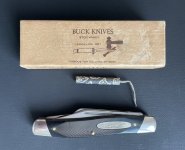
Buck knives introduced their first stockman pattern in 1966 (allegedly), but they didn't actually make them in house until around 1985 (allegedly). This knife was made somewhere between 1967 and 1972. The large, three rivet, Valox scales and its (Achilles heel) "keyhole" assembly makes this one a Schrade contracted knife.

tempImage920MsK.jpg
tempImageOl2BmV.jpg
 
Buck knives introduced their first stockman pattern in 1966 (allegedly), but they didn't actually make them in house until around 1985 (allegedly). This knife was made somewhere between 1967 and 1972. The large, three rivet, Valox scales and its (Achilles heel) "keyhole" assembly makes this one a Schrade contracted knife.

View attachment 160828
View attachment 160829
Black cats and bottle rockets!
 
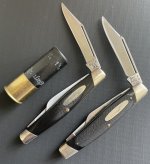
Buck knives didn't renew their contract with Schrade after 1970. They had a pretty ironclad warranty and found that Schrade was not meeting their standards, which caused a backlog of repair and replacement work. Keep in mind that a Buck branded stockman (made by Schrade) went for a lot more money than the Old Timer did. So, they reached out to Camillus and started a long relationship with what many '300 series' collector's deem the best of the era. The bottom knife is a first year 1971 Camillus with the small, flush rivets on the end of the scales and (not shown) an extra brass liner. They still hadn't stamped the model number on the blade. From 71 to 74 there were lots of little details that were going on, and one could actually collect several of the variants from 71 to 74, all of the same pattern but with a bunch of little changes. The top knife was made from 75 to 85 and while it doesn't have the small rivets, it is mostly identifiable by the fact that 301 is stamped on the obverse tang, finally noting the model number. Welcome to knife nerd Hell.


tempImagejoGeHU.jpg
 
I have a small buck lock back pocket knife I have had for 20+ years. About a year ago I was reclined in my Lazy boy and it slid out of my pocket and down the side of the cushion. It is somewhere inside the chair but I can't find it. I even turned the whole thing upside down. Frustrating
 
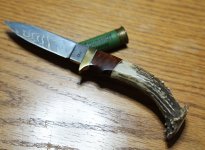
Forgot this one. In a scabbard on the Huckleberry rig hanging in the gun room. Made by a fella I worked with for years. I found the shed.


DSC00827.JPG
 
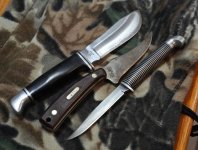
3 more oldies. Buck is at least 50 years old; Sharpfinger & Western are over 60. All saw a lot of use.DSC00836.JPG
 
Back
Top