NFR Swordfish

Non-fishing related
Great memories! No Name was my go to lunch place while in Boston for work, non-pretentious, large wood tables, filled with locals, right at the pier, near the boats, fish offloading nearby. Never tried their swordfish, their New England style fish chowder was the best, generous lobster rolls, plentyfull scallops, yumm. To pay you just walked to the register downstairs and just told them what you ate and payed accordingly, trust system. Sadly, I just read that they closed in December 2019 after more than 100 years around, from what I read due in part to the rapid gentrification of the Seaport district, what a loss.
We might have crossed paths there without knowing it due to the same eating habits. I worked about 5 miles from their front door and would meet a friend there at least three times a month, usually on Thursday. Friday was mayhem there so Thursday was “app’t with a customer” day. Never had a bad meal there. One of the better memories of working on the “Noarth Showuh”
 
  • Love
Reactions: VMP
There is only one species of swordfish globally: the broadbill swordfish (Xiphias gladius). It is the sole living member of the Xiphiidae family. While they are marketed under different regional names, every swordfish caught commercially belongs to this single highly migratory species.

Easyfish Group


Broadbill Swordfish (Xiphias gladius), AI generated

Broadbill Swordfish (Xiphias gladius). Source: Pelagic Gear
 
Because the broadbill's rostrum is made of highly dense, solid bone with tapered, smooth edges, it naturally lends itself to being mounted into a hilt.

Antique Sailor-Made Swordfish Bill, AI generated

Antique Sailor-Made Swordfish Bill. Source: Rafael Osona Auctions

Sailor-Made Souvenirs and Weapons​

During the 18th and 19th centuries, it was common practice for sailors to harvest the bill from a caught swordfish, carefully clean and cure the bone, and fashion it into a decorative sword.

They would often craft custom hilts, handguards, and pommels using materials they had onboard—such as carved wood, brass, wrapped leather, or even woven rigging twine. While many of these were created as maritime souvenirs or folk art to bring back home, the bone is dense enough that they could inflict serious damage if used defensively.

Decoratively Hilted Swordfish Rostrum, AI generated

Decoratively Hilted Swordfish Rostrum. Source: eBay
 
Years ago I had access to as may of these "swords" as I wanted. I also had access to actual "marlinspikes".
Most saltwater fisherman know what a "marlinspike" is....a tool that is used in the art of marlinspike seamanship (knot tying).....normally made of stainless steel today ...but long ago they were originally made from the bill of a Marlin.
Years ago, I gave my great uncle one of these with a polished turquoise "butt" attached with a silver band.
These fish have some dang cool noses.
 
Last edited:
The dense, bony structure and natural, gradual taper of a bill made it an exceptionally strong material for separating the thick strands of hemp or manila rope when splicing lines or untying hardened knots.

Here are a few examples of what these biological tools looked like:

Antique sailor-carved marlin spike, AI generated

Antique sailor-carved marlin spike. Source: eBay
Because these were custom-made by the sailors themselves (a form of maritime folk art known as scrimshaw or sailor's work), the handles were often personalized. Some were intricately carved with grooves for better grip, while others were tightly wrapped with tarred twine or leather to create a comfortable handle.

Cord-wrapped bill with a custom sheath, AI generated


Cord-wrapped bill with a custom sheath. Source: Etsy
An interesting piece of nautical history: You might assume the tool was named after the fish, but it is actually the other way around. The tool was originally called a "marling spike" (from the practice of "marling" or binding ropes together). When sailors encountered large, bill-nosed fish, they thought the animal's snout looked exactly like their rigging tool, so they named the fish the "marlin."
 
The dense, bony structure and natural, gradual taper of a bill made it an exceptionally strong material for separating the thick strands of hemp or manila rope when splicing lines or untying hardened knots.

Here are a few examples of what these biological tools looked like:

Antique sailor-carved marlin spike, AI generated

Antique sailor-carved marlin spike. Source: eBay
Because these were custom-made by the sailors themselves (a form of maritime folk art known as scrimshaw or sailor's work), the handles were often personalized. Some were intricately carved with grooves for better grip, while others were tightly wrapped with tarred twine or leather to create a comfortable handle.

Cord-wrapped bill with a custom sheath, AI generated


Cord-wrapped bill with a custom sheath. Source: Etsy
An interesting piece of nautical history: You might assume the tool was named after the fish, but it is actually the other way around. The tool was originally called a "marling spike" (from the practice of "marling" or binding ropes together). When sailors encountered large, bill-nosed fish, they thought the animal's snout looked exactly like their rigging tool, so they named the fish the "marlin."
This is very cool! Thanks for sharing this info on these nosey fish!
 
Dang.. I thought I was just jawing about flammable wood, destructive animals, and good tasting fish with cool noses. I don't know nothing about "hyper fixations", or defecting gold....But I will accept your post as a complement.
 
The first sentence I typed in this thread is "This is one of my favorite fish to eat."
For me, any Swordfish sold at any American market can be quite a treat.
My culinary advice....Soak the fish in Italian Salad Dressing, from two hours to over night. (Bernstiens is the best)...
Cook it on a smokey grill ....with hickory chips.
Serve with mashed potatoes....this is key!
Canned green beans adds a nice touch.
And while you are eating this delicious meal.....think of this magnificent creature and the way that it lived....Deep in the ocean with a bad ass sword.
 
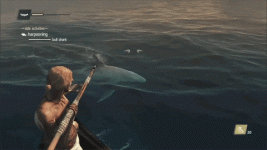
That harpoon, made of fatwood, tipped with a Marlin snout, and bound with otter entrails, pretty much covers the entire thread.

Next !!!
 
Back
Top