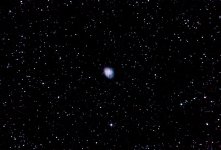
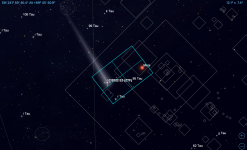
Well, the clouds rolled in, with rain and thunderstorms (73 F outside); as a result, the image acquisition team is taking some much deserved nights off and the data crunchers have taken over the observatory to crunch the massive amounts of data recently collected. After crunching the data, the team announces the we have not discovered anything new. It turns out all that stuff in the sky has been there for quite a while and has previously been discovered, catalogued, and described, as we have noted throughout our posts. But, like good scientists, we do take satisfaction in verifying those who went before us, that stuff is indeed up there. With that, other discoveries the Canuck Observatory have not made in 2022:
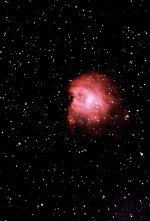
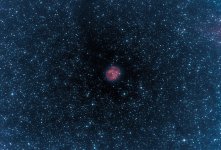
The Cocoon Nebula (IC 5146) is a bright emission nebula in the constellation Cygnus. Although it has a visual magnitude of 7.2, its light is spread out over approximately 12 arc minutes (about 15 light years) and it sits in a relatively "dusty"part of the sky, which perhaps explains why it was not discovered until 1899 by Thomas Epsin. The dark nebula IC 5146, surrounds the cocoon and projects a westward (upwards in the image below) trail, as if the Cocoon eaten cut a path through the stars.
The Cocoon Nebula (IC 5156): 35 x 300 second light exposures; 25 x 300 dark exposures; OIII/H-alpha duo-narrowband filter:
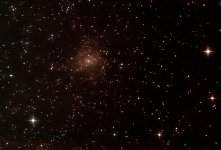
The Hidden Galaxy (IC 342) is a spiral galaxy in the constellation Camelopardalis first discovered by WF Denning in 1895. The galaxy owes its popular name, the Hidden Galaxy, due to its visual difficulty to detect; sitting only 10.5 degrees from the galactic equator, it is obscured by the interstellar matter of the Milky Way. In the below image, I did a fair amount of "star removal" in order to bring out the galaxy.
The Hidden Galaxy (IC 342): 19 x 240 second light exposures (ran into some issues with high thin clouds, limiting the useful number of exposures); 25 x 240 dark exposures; multispectrum broadband filter:
The Iris Nebula (NGC 7023) is a reflection nebula in the constellation Cepheus discovered by William Herschel in 1794. The Iris i lit up by an open star cluster, spans about 6 light years across, and is approximately 1300 light years distant.
The Iris Nebula (NGC 7023): 40 x 300 second light exposures; 30 x 300 second dark exposures; OIII/H-alpha duo-narrowband filter:
Cheers to all, and have a wonderful New Year!!




 ).
).