So, over the last 2 weeks we had a couple of "cold" snaps, where temperatures went to the high 20's and were skies relatively clear with lower humidity (we're in the 70's now with high humidity and cloudy). As a result, the Canuck Observatory, home of the Not Terribly Large Telescope (NTLT), as opposed to the VLT (
https://www.eso.org/public/usa/teles-instr/paranal-observatory/vlt/) went into action, capturing several targets over several nights:
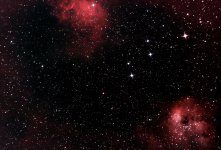
The Flaming Star (IC 405) and Tadpole nebulae (IC 410), are a pair of emission nebulae in the constellation Auriga. The Flaming Star nebula is illuminated by the variable star AE Aurigae and the Tadpole nebula by an open-cluster of stars. The Tadpole is is approximately 12,000 light-years away, and is over 100 light-years across. Formed in the interstellar cloud a mere 4 million years ago, the radiation from these hot stars pushes the gas away from them and creates dark "tadpoles" trailing away from the nebula's central regions (not sure I see it, maybe I need a VLT). The Flaming Star nebula is approximately 15,000 light years distant and about 5 light years across.
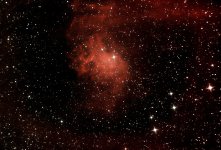
Flaming Star (IC 405; center top) and Tadpole nebulae (IC 410; right bottom): 30 x 240 second light exposures, 30 Darks, OIII/H-alpha duo-narrowband filter (tried getting them in a single field of view, but it appears I may have cut off, so tried just the Flaming star over subsequent nights, see below) :
View attachment 44164
Flaming Star (slightly cropped):
View attachment 44167
NGC 7380 is an open cluster of stars in the constellation Cepheus. The surrounding emission nebulosity is known commonly referred to as the Wizard Nebula, which spans an angle of 25
′. NGC 7380 was discovered by
Caroline Herschel in 1787; her brother William Herschel included it in his catalog, labelling it H VIII.77. The nebula is known as S 142 in the 1959
Sharpless catalog (Sh2-142).
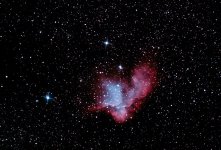
NGC 7380 and the Wizard nebula (SH 2-142): 40 x 300 second light exposures, 30 darks, OIII/H-alpha duo-narrowband filter:
View attachment 44168
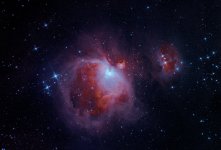
Finally, I had a few extra hours, so turned to Orion, which I have posted previously, but it is such a magnificent target. This time I had the narrow-band filters. Orion is so bright, I used only 60 second exposures and still risk blowing out the central core. I also took some "artistic" liberties, playing a little more with the temperature, hue, and saturation levels than usual:
View attachment 44169
Information from Skysafari 6 Pro and yes, Wikipedia.
Cheers