Second try at this target; first effort I blew out the central core, overexposed at 240 second exposures, so it's a pretty bright little target:
M27, commonly referred to as the Dumbbell Nebula, like the Helix Nebula (
#99 ), is a planetary-type nebula in the constellation Vulpecula (Little Fox) and the first of this type to be discovered, by, you guessed it by the M-designation, Charles Messier. Messier described it in 1764 as an oval nebula without stars. Some 20 years later in 1784, William Herschel came up with the name "Planetary Nebula", because he thought these formations resembled his newly discovered planet, Uranus. The visual magnitude of M27 is 7.4, actually not as bright in magnitude as the Helix Nebula (7.3); however, the Dumbbell has higher surface brightness due to its smaller size (thus the shorter exposure needed).
How far is the Dumbbell from us, you ask. Well, as with most planetary nebulae it's a bit of an unknown; current estimates range from 490 to 3500 light years. Using its angular rate of expansion, the Dumbbell has been estimated to have an age of no more than 14,600 years (Moreno-Corral
et al. 1992).
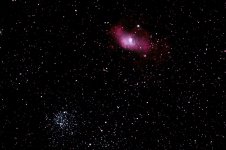
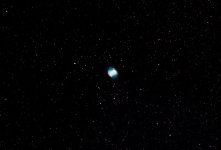
The Dumbbell Nebula, 100 x 120 second light exposures, 50 darks, OIII/H-alpha duo-narrowband filter, essentially no cropping:
Facts brought to you by SkySafari 6 Pro.
Cheers


?