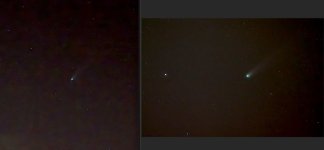

It was a busy night at the Observatory on Sunday night/Monday morning before sunrise. The hope was to acquire 3 separate targets through the night. Having been on furlough for the better part of a year and a half, the plan was to go after well-known deep-space objects (DSOs) to refresh and hone skills.
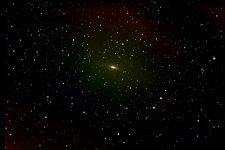
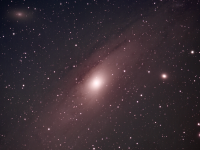
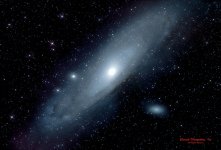
The Galaxy Hunters were the first group to come in, with orders from the top brass to target M 31, the Andromeda Galaxy, which oddly enough, is found in the constellation Andromeda, not the constellation M 31. At approximately 2.54 million light years distant, M 31 is one of the farthest objects visible to the naked eye, appearing as a faint smudge of light to the west of the "W" Cassiopeia. By a strange coincidence, M 31 is the 31st entry in Messier's catalogue (this sort of coincidence seems to happen very regularly, see the next target further below).
Observations by the Spitzer Space Telescope in 2006 revealed that M 31 contains roughly one trillion stars, several times the number in our own galaxy (about 300 to 400 billion). The estimated luminosity of M 31, some 26 billion Suns, is about 25% higher than the Milky Way's; however, the rate of star formation in the Milky Way is much higher, with M 31 producing about 1 solar mass per year, compared with 3 to 5 solar masses for the Milky Way. Likewise, the rate of supernovae in M 31 is about half that of the Milky Way. Until now, only one supernova has been recorded in M 31, in 1885, and imaginatively designated S Andromedae.
M 31 (Andromeda): 55 X 180 second light exposures; 50 X 180 second dark exposures, multispectrum broadband filter:
Next up was M 45, the 45th entry in Messier's catalogue (see above M 31 information for a similar coincidence). M 45 is also popularly referred to as Pleiades, the seven sisters, and the Subaru cluster (Note, Subaru is also the name of a Japanese auto manufacturer, which uses a 7-star cluster as their logo - we are not sure which came first, but the crack research staff at the Observatory is scouring historical verify the originator). Going forward, to avoid confusion, we shall refer to them as Pleiades.
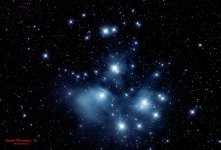
The Pleiades is an open-star cluster in the constellation Taurus approximately 440 light years distant. There are over 1,000 confirmed members in the cluster, with a total mass estimated at about 800 Suns. The stars in the Pleiades are thought to have formed together around 100 million years ago; its brightest members are all hot, young, blue-white class B giants and subgiants, with absolute magnitudes from about -1.5 to -2.5.
In the Norther hemisphere, the Pleiades is easily seen by the naked eye in the winter months, summer months in the southern hemisphere. Because of its prominence in the night sky, Pleiades has been the subject of much classical mythology. In Hindu mythology, the Pleiades are much revered and referred to as Krittika, the six mothers of the war god Skanda, who developed six faces. The earliest Greek references to the Pleiades were by Homer in the Iliad and Odyssey, around 750 and 720 B.C., and by Hesiod, about 700 B.C. The nine brightest stars of the Pleiades are named for the Seven Sisters of Greek mythology: Sterope, Merope, Electra, Maia, Taygeta, Celaeno, and Alcyone, along with their father Atlas and mother Pleione. As daughters of Atlas, the Hyades were sisters of the Pleiades. The Pleiades are also mentioned in many other and diverse cultures, including the Maori (who call them "Matariki") and Australian Aborigines, the Chinese, the Mayans (who called them "Tzab-ek"), the Aztecs ("Tianquiztli"), and the Sioux and Cherokee of North America.
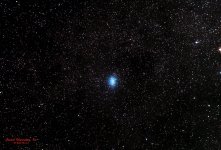
M 45 (the Pleiades/The Seven Sisters/Subaru/Matariki/Tzab-ek/Tianquiztli ...): 55 X 120 second light exposures; 50 X 120 dark exposures, multi spectrum broadband filter:
Labelled:
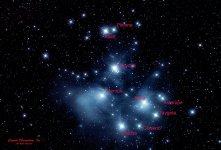
Thanks to SkySafari 6 Pro for providing the information.
The Imaging group are waiting for computer time to process the third target, hopefully we will be able to post tomorrow.
Cheers from the crew at the Canuck Observatory.
The Galaxy Hunters were the first group to come in, with orders from the top brass to target M 31, the Andromeda Galaxy, which oddly enough, is found in the constellation Andromeda, not the constellation M 31. At approximately 2.54 million light years distant, M 31 is one of the farthest objects visible to the naked eye, appearing as a faint smudge of light to the west of the "W" Cassiopeia. By a strange coincidence, M 31 is the 31st entry in Messier's catalogue (this sort of coincidence seems to happen very regularly, see the next target further below).
Observations by the Spitzer Space Telescope in 2006 revealed that M 31 contains roughly one trillion stars, several times the number in our own galaxy (about 300 to 400 billion). The estimated luminosity of M 31, some 26 billion Suns, is about 25% higher than the Milky Way's; however, the rate of star formation in the Milky Way is much higher, with M 31 producing about 1 solar mass per year, compared with 3 to 5 solar masses for the Milky Way. Likewise, the rate of supernovae in M 31 is about half that of the Milky Way. Until now, only one supernova has been recorded in M 31, in 1885, and imaginatively designated S Andromedae.
M 31 (Andromeda): 55 X 180 second light exposures; 50 X 180 second dark exposures, multispectrum broadband filter:
Next up was M 45, the 45th entry in Messier's catalogue (see above M 31 information for a similar coincidence). M 45 is also popularly referred to as Pleiades, the seven sisters, and the Subaru cluster (Note, Subaru is also the name of a Japanese auto manufacturer, which uses a 7-star cluster as their logo - we are not sure which came first, but the crack research staff at the Observatory is scouring historical verify the originator). Going forward, to avoid confusion, we shall refer to them as Pleiades.
The Pleiades is an open-star cluster in the constellation Taurus approximately 440 light years distant. There are over 1,000 confirmed members in the cluster, with a total mass estimated at about 800 Suns. The stars in the Pleiades are thought to have formed together around 100 million years ago; its brightest members are all hot, young, blue-white class B giants and subgiants, with absolute magnitudes from about -1.5 to -2.5.
In the Norther hemisphere, the Pleiades is easily seen by the naked eye in the winter months, summer months in the southern hemisphere. Because of its prominence in the night sky, Pleiades has been the subject of much classical mythology. In Hindu mythology, the Pleiades are much revered and referred to as Krittika, the six mothers of the war god Skanda, who developed six faces. The earliest Greek references to the Pleiades were by Homer in the Iliad and Odyssey, around 750 and 720 B.C., and by Hesiod, about 700 B.C. The nine brightest stars of the Pleiades are named for the Seven Sisters of Greek mythology: Sterope, Merope, Electra, Maia, Taygeta, Celaeno, and Alcyone, along with their father Atlas and mother Pleione. As daughters of Atlas, the Hyades were sisters of the Pleiades. The Pleiades are also mentioned in many other and diverse cultures, including the Maori (who call them "Matariki") and Australian Aborigines, the Chinese, the Mayans (who called them "Tzab-ek"), the Aztecs ("Tianquiztli"), and the Sioux and Cherokee of North America.
M 45 (the Pleiades/The Seven Sisters/Subaru/Matariki/Tzab-ek/Tianquiztli ...): 55 X 120 second light exposures; 50 X 120 dark exposures, multi spectrum broadband filter:
Labelled:
Thanks to SkySafari 6 Pro for providing the information.
The Imaging group are waiting for computer time to process the third target, hopefully we will be able to post tomorrow.
Cheers from the crew at the Canuck Observatory.