Stuff in the Sky

Kinda surprised nobody has posted photos of the recent Blood Moon lunar eclipse.

The moon was too low over the horizon here in Central Italy when the eclipse started, so I was only able to get photos of the exit, and no Blood Moon either, so I want my money back.

Lacking a scope I used my phone (a Samsung S24 Ultra) to take the photos, so I apologize in advance for the crappy images. If anything, they are a clear demo of the limits of taking moon shots with a phone, even if Samsung throws a bucket-load of AI at them.

AP1GczMUV8e-DvTIj2I9vvG_tiR0zWsVqY1CjLWY4s2WIRIp2TAK-rFmr1BaH7qy9FG2hJdciwdPc_QhkRjd5I-xFTp_Oi8cLJ1vl_pPs11ZclYGdslmiv0OAHphJp874UaCZNR9mO1u895yk--o5yuiMv7h=w817-h911-s-no

AP1GczNanjJeGRiHLnDn6g925OiSbnOxW2b-RQaQofhgzQm5R7SD00LbHFx-wdLQLxEEbHSP7w2e3FU8hTzsM8XuW0aLtx-1Ln1Evuns9ekJhZcH3Fudi62vo-XJZsKKe-u-RHn6nsUehtUL9qTkwUAukvwC=w824-h911-s-no

AP1GczNocKJ5wgSGvwch3N_wFKoWDXe7nbNn2WGB4I7ruE5huLmtTHvfk0OgANotdOIzZc_WoNQHaPKll3ZWpqOJvM8cF-MQH_7I0OjEVgI9GXTiHcYPRtsboEuL6Vet5wxB427i6inayaAAGWtCoZzqEpGd=w860-h911-s-no

AP1GczOgJdDUdBsxkaaCBwQNumMbrecC-FvCjoCGCho8J0C5Y4sjT5-4bDPV7W4jjc-qlOHcE3FEx67Q1NrZnn9KSGx7sG9IT4jcXdRxefWq7khlgOkHX4KqgPzpUVKxV5W9f-jtqxmNSwQaptDAW2PnoZDo=w891-h911-s-no


Kenneth
 
Kinda surprised nobody has posted photos of the recent Blood Moon lunar eclipse.

The moon was too low over the horizon here in Central Italy when the eclipse started, so I was only able to get photos of the exit, and no Blood Moon either, so I want my money back.

Lacking a scope I used my phone (a Samsung S24 Ultra) to take the photos, so I apologize in advance for the crappy images. If anything, they are a clear demo of the limits of taking moon shots with a phone, even if Samsung throws a bucket-load of AI at them.

AP1GczMUV8e-DvTIj2I9vvG_tiR0zWsVqY1CjLWY4s2WIRIp2TAK-rFmr1BaH7qy9FG2hJdciwdPc_QhkRjd5I-xFTp_Oi8cLJ1vl_pPs11ZclYGdslmiv0OAHphJp874UaCZNR9mO1u895yk--o5yuiMv7h=w817-h911-s-no

AP1GczNanjJeGRiHLnDn6g925OiSbnOxW2b-RQaQofhgzQm5R7SD00LbHFx-wdLQLxEEbHSP7w2e3FU8hTzsM8XuW0aLtx-1Ln1Evuns9ekJhZcH3Fudi62vo-XJZsKKe-u-RHn6nsUehtUL9qTkwUAukvwC=w824-h911-s-no

AP1GczNocKJ5wgSGvwch3N_wFKoWDXe7nbNn2WGB4I7ruE5huLmtTHvfk0OgANotdOIzZc_WoNQHaPKll3ZWpqOJvM8cF-MQH_7I0OjEVgI9GXTiHcYPRtsboEuL6Vet5wxB427i6inayaAAGWtCoZzqEpGd=w860-h911-s-no

AP1GczOgJdDUdBsxkaaCBwQNumMbrecC-FvCjoCGCho8J0C5Y4sjT5-4bDPV7W4jjc-qlOHcE3FEx67Q1NrZnn9KSGx7sG9IT4jcXdRxefWq7khlgOkHX4KqgPzpUVKxV5W9f-jtqxmNSwQaptDAW2PnoZDo=w891-h911-s-no


Kenneth
No eclipse here in North America, was a nice and very bright full moon though.
 
@Canuck from Kansas,

By chance did you catch the ISS last night?

Nope, but wasn't really looking for it - have seen it several times - always interesting though, too high to be a plane (and no blinking navigation lights), too slow to be a meteor, and too steady a straight of a path to be a UFO.

cheers
 
Comet Alert: No, this is not an update on C/2025 A6 (Comet Lemon), it is in fact another new comet discovered earlier this month. Comet 2025 R2 SWAN, was discovered by Ukrainian amateur astronomer Vladimir Bezugly. It has apparently been hiding behind the sun for some time, eluding earlier detection. C/2025 R2 SWAN is still largely obscured by sunlight, but is predicted to be more viewer friendly in October and possibly visible to the neck-ed eye with a hoped-for magnitude of +4.


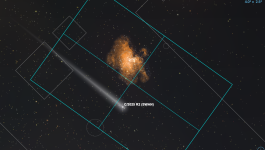
Like C/2025 A6 Lemon, Comet R2 SWAN is predicted to present a wonderful astrophotography opportunity, with the Eagle Nebula (M 16) in the same photographic field with a scope or telephoto lens (about 400 mm) n the evening of 17 October:

Screenshot 2025-09-18 at 11.23.27 AM.png

Projection from SkySafari 6 Pro.

Cheers to Clear Skies
 
Comet Alert: No, this is not an update on C/2025 A6 (Comet Lemon), it is in fact another new comet discovered earlier this month. Comet 2025 R2 SWAN, was discovered by Ukrainian amateur astronomer Vladimir Bezugly. It has apparently been hiding behind the sun for some time, eluding earlier detection. C/2025 R2 SWAN is still largely obscured by sunlight, but is predicted to be more viewer friendly in October and possibly visible to the neck-ed eye with a hoped-for magnitude of +4.


Like C/2025 A6 Lemon, Comet R2 SWAN is predicted to present a wonderful astrophotography opportunity, with the Eagle Nebula (M 16) in the same photographic field with a scope or telephoto lens (about 400 mm) n the evening of 17 October:

View attachment 167124

Projection from SkySafari 6 Pro.

Cheers to Clear Skies

Pretty impressive tail

 
It's a wonder he had any clear sky in Ukraine to even open the dome. Usually it's filled with drones. (Me being a wise guy)

Is the ALSACE array the one where you have to have a PhD to even stay in their hotel ?
 
It's a wonder he had any clear sky in Ukraine to even open the dome. Usually it's filled with drones. (Me being a wise guy)

Is the ALSACE array the one where you have to have a PhD to even stay in their hotel ?
Not sure what that array is, never heard of it and cannot find anything on the interwebs; the ALMA array (Atacama Large Millimeter/submillimeter Array) in Chile?
 
Not sure what that array is, never heard of it and cannot find anything on the interwebs; the ALMA array (Atacama Large Millimeter/submillimeter Array) in Chile?
I believe that's the one. Sits around 12-13000 feet. It's been on TV a few times. Notorious for what I'd mentioned in my earlier post.
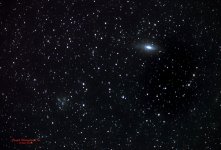
 
Well, in anticipation of the forthcoming month of comets, the Zenithstar 80 was recommissioned, some observatory staff called back from furlough, and an imaging session scheduled. Was quite surprised how smoothly everything seemed to work.

The Galaxy Group came in for the first shift. They locked onto NGC 7331, a spiral galaxy in the constellation Pegasus discovered by William Herschel in 1784. NGC 7331 is about 50 million light years distant, and approximately 30,000 light years across. It is similar in size and structure to our own Milky Way. A Type Ia supernova (SN 2025 res) was detected on July 14 of this year, likely the result of a white dwarf exploding some 50 million years ago (see a nice image here: https://apod.nasa.gov/apod/ap250731.html).

NGC 7331, 30 x 300 minute exposures, 30 X 300 second dark exposures; multispectrum broadband filter (note the 3 companion galaxies at about 8 o'clock):

NGC7331 - PS - Cropped copy.jpg

The early morning shift the comet hunters took over, pointing the Zenithstar to the Constellation Lynx where they found C/2025 A6 (Lemon). It is currently magnitude 8.1. The imaging team had some difficulty stacking the image, it blew out when using the comet to stack, so they decided to just use stars for stacking, resulting in the the comet core looking elongated. There is also a very faint tail, but bringing it out resulted in too much color cast in the image (we will have to work on the imaging parameters prior to 6 October):

30 x 60 second exposures, 30 x 60 second dark exposures, multispectrum broadband filter:

C:2025 A6 Lemon - PS-2 copy.jpg

Cheers
 
I'm too dumb to understand everything you said, but I love astronomy and astrophysics and appreciate your posts on the subjects!

The Astronomy Picture of the Day from NASA is a favorite of mine with some truly amazing images!
 
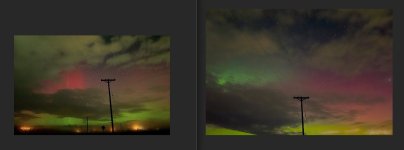
Had an incredible showing of the aurora last night when there was a break in all the clouds. I was out listening to and watching barn owls when I saw the stars were out. I took a test photo north as the numbers for the aurora looked positive (well, negative numbers in some areas are needed for the effect to happen).

AURORA2025SEPTfarm.jpg
 
Back
Top