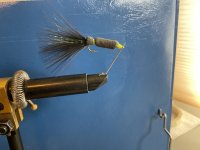

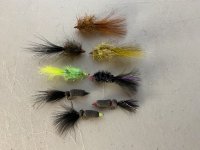
I’ve always been a big fan of fishing leech patterns. It’s seems l could always catch a few, especially if l fished them deep. Problem is I’d lose so many to snags. In the Summer of 2024, I had been trying a dragon fly nymph with a heavy sink line to good effect. It was designed to float above the weeds. So,I thought why not try to tie-up some sort of floating leech that could be presented right down on the deck but not get snagged, somewhat like the dragon nymph. Hence, the evolution of what I call the So. Bay Leech. I’ve been very happy with its performance, so l thought I’d share it with you.
Let me show you how I make one. Though you can use many different materials and techniques as your creativity will allow, this is the one I use most. There’s some photos done in sequence to help you along..
Material List:
Size 6 or 8, 3x long Straight Eye streamer hook.
5 or 7mm Foam Cylinders. Booby Eyes. I get mine from The Fly Shack.
Hareline Folded Palmering Chenille,15mm.
Any type big fuzzy dubbing.
Marabou for the tail.
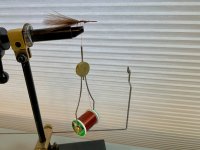
Step one: Tie in the marabou tail, keeping it long and sparse. 1.5 to 2 times the shank length. Leave the thread down on the hook curve.
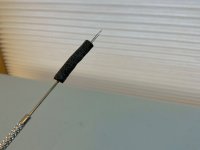
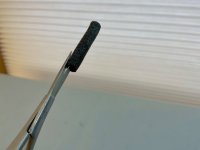
Step two: Drill your bodkin needle through the center of the cylinder to ream it out. After retrieving it, insert your scissors in the hole and cut a small slot. This slot will allow you to slide the cylinder beyond the thread and the curve in the hook.
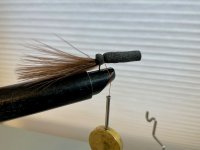
Step three: Spin your cylinder down the hook shaft, allowing the slot to go beyond the curve and the thread, enrobing the tail.
Step four: Tie down the foam leaving the quarter inch behind the curve as is. Leave the thread hanging here.
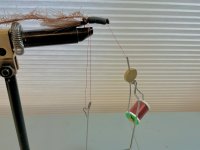
Step five: Tie in your chennile and then make a dubbing loop. Now, securely tie off and cut the thread. You are going to combine the chenille and dubbing material together to make a dubbing brush.
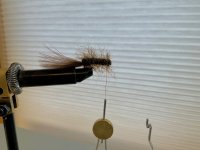
Step six: Move to the front. Make sure you can see a little of the hook eye. Move back a quarter inch and securely tie down the foam leaving a little foam tab. Secure the thread.
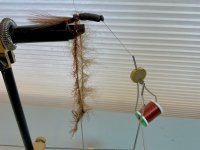
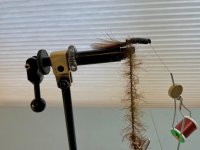
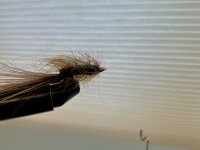
Step seven: Place your dubbing in the loop. Go sparse. Give it a few spins to grip the dubbing. Wrap the free end of the chenille around the spinning tool. Spin both materials together brushing it occasionally to fluff it out. Now, Palmer the brush up the cylinder, first using a full turn around the rear ends foam trench. Use a lite touch as to not compress the foam. Four turns is enough. Give it one full turn around the foam trench in the front and then tie down and cut off the brush. Secure the left-over foam tab with your thread and make a head.
Fishing Technique:
I use a short leader, only 5 or 6 feet at most. 8# floro is my choice. I also use a Type 7/8 sinking line.The short leader allows you to control the depth of your fly when using a heavy sink line while using the countdown technique. The fly will stay a bit higher than your line while retrieving. With a bead head leech when you pause between strips, the fly will sink down making for that great jig action. Conversely, the pause between strips with the floating leech will cause it to rise, also with some jig action. Because it will float above the line, you can take it to the bottom and not be as concerned that it will snag.
My most productive approach is to let the line go all the way to the deck and settle. The leech will be floating above. As you start stripping, the fly will move forward and down. As you pause it floats slowly back up. It’s all happening down where the fish like to hang out. Try various returns. Quick short strips with a two or three second pause works well. Sometimes slow and steady is the way to go. Just remember, you need a little pause to get the fly to jig.
Try using the classic countdown technique to fish it at different depths, as it is also effective presenting it this way. Let your line control the depth.
Let me show you how I make one. Though you can use many different materials and techniques as your creativity will allow, this is the one I use most. There’s some photos done in sequence to help you along..
Material List:
Size 6 or 8, 3x long Straight Eye streamer hook.
5 or 7mm Foam Cylinders. Booby Eyes. I get mine from The Fly Shack.
Hareline Folded Palmering Chenille,15mm.
Any type big fuzzy dubbing.
Marabou for the tail.
Step one: Tie in the marabou tail, keeping it long and sparse. 1.5 to 2 times the shank length. Leave the thread down on the hook curve.
Step two: Drill your bodkin needle through the center of the cylinder to ream it out. After retrieving it, insert your scissors in the hole and cut a small slot. This slot will allow you to slide the cylinder beyond the thread and the curve in the hook.
Step three: Spin your cylinder down the hook shaft, allowing the slot to go beyond the curve and the thread, enrobing the tail.
Step four: Tie down the foam leaving the quarter inch behind the curve as is. Leave the thread hanging here.
Step five: Tie in your chennile and then make a dubbing loop. Now, securely tie off and cut the thread. You are going to combine the chenille and dubbing material together to make a dubbing brush.
Step six: Move to the front. Make sure you can see a little of the hook eye. Move back a quarter inch and securely tie down the foam leaving a little foam tab. Secure the thread.
Step seven: Place your dubbing in the loop. Go sparse. Give it a few spins to grip the dubbing. Wrap the free end of the chenille around the spinning tool. Spin both materials together brushing it occasionally to fluff it out. Now, Palmer the brush up the cylinder, first using a full turn around the rear ends foam trench. Use a lite touch as to not compress the foam. Four turns is enough. Give it one full turn around the foam trench in the front and then tie down and cut off the brush. Secure the left-over foam tab with your thread and make a head.
Fishing Technique:
I use a short leader, only 5 or 6 feet at most. 8# floro is my choice. I also use a Type 7/8 sinking line.The short leader allows you to control the depth of your fly when using a heavy sink line while using the countdown technique. The fly will stay a bit higher than your line while retrieving. With a bead head leech when you pause between strips, the fly will sink down making for that great jig action. Conversely, the pause between strips with the floating leech will cause it to rise, also with some jig action. Because it will float above the line, you can take it to the bottom and not be as concerned that it will snag.
My most productive approach is to let the line go all the way to the deck and settle. The leech will be floating above. As you start stripping, the fly will move forward and down. As you pause it floats slowly back up. It’s all happening down where the fish like to hang out. Try various returns. Quick short strips with a two or three second pause works well. Sometimes slow and steady is the way to go. Just remember, you need a little pause to get the fly to jig.
Try using the classic countdown technique to fish it at different depths, as it is also effective presenting it this way. Let your line control the depth.
Attachments
-
 IMG_0066.jpeg780.5 KB · Views: 147
 -
 IMG_0067.jpeg398.3 KB · Views: 98
 -
 IMG_0069.jpeg379.4 KB · Views: 91
 -
 IMG_0072.jpeg484.1 KB · Views: 95
 -
 IMG_0073.jpeg513.6 KB · Views: 94
 -
 IMG_0074.jpeg575.8 KB · Views: 96
 -
 IMG_0075.jpeg542.7 KB · Views: 97
 -
 IMG_0076.jpeg515 KB · Views: 103
 -
 IMG_0077.jpeg460.2 KB · Views: 143
 -
 IMG_0078.jpeg710.4 KB · Views: 156