Slow Day Fly Progression

Wetswinger

Beneath the surface of the mud, there’s more mud.
Forum Supporter
For me, yesterday was a slog. I had a lot of time to contemplate what hell I was doing. Whatever it was, it wasn’t working. I usually start on a sinking line with dragon nymphs and/or leeches. I’ve found they prefer a certain presentation of the day, so I try a different speed and rhythm of retrieval until I find what they’ll take. With leech I go, brown, olive, black, then when l get desperate chartreuse. I always get one with chartreuse, just not yesterday..

Then I turn to dry line, naked line fishing. I use two flies. A chromie in the middle, always, then l start with a bloodworm on point. Then it’s a progression, chromie, zebra, blob. Do you all use throat pumps? I’ve struggled with that so I’ve stopped.

Move location, start again. Of course, when l had to get home l started getting some action, all on a chromie naked line style.

So I’ve wondered. What progression do other folks use when they get to their favorite fishing hole.?
 
I'm kind of new to lakes, but I always start with a sinking line and run through a selection of leeches and bait fish patterns. I'll switch to an indicator after a while, but I can't stick with that if I go more than 10 minutes without action.
Yesterday, I tried a naked floating line with a couple of small beaded nymphs, about 3 feet from each other, and used a slowish finger retrieve. 3 fish in short order!
So, I guess I'll be doing that a lot, now.🤷🏽
 
Sometimes it’s just slow. Weather changes/cold fronts, too much or little wind. This time of year there could be an over abundance of natural food sources making it harder to convince a fish to eat our stuff instead.

I’m usually focused on finding fish. Then figuring out what might catch them. If you know you found them and none of the usual approaches are working it’s time to get creative or pick a proven excuse! Moon phase, glass worms, others hotspotting the place, how you hold your mouth, etc.
 
I luv to troll damsel nymphs on sinking lines. Usually a two fly setup to start; one medium olive and one dark olive. For some reason one color will do better than the other that day. I start with s-curve trolling track to help identify the depth of where the fish are holding. Once the color is figured out, I just use that one fly.

If that does not work, I then fish near the line of lily pads by letting out 50'+ of line while trolling very slowly. Once all out, then I stop trolling, wait a bit to allow the line to sink, then retrieve the line varying speed and always adding twitches along the way. I swear fish are following it, and the twitch gets them excited.

If that is not working, next spot. Since I live of a lake, I know several spots that are usually dependable.

If that does not work, straight down the middle of the lake with a fast troll. I then decide if I want to stop fishing or do the Hail Mary. If the later, usually a two worm rig on a floating line nearer to shore or just off the lily pads.
 
Usually start with a type four and an olive Hale Bopp. LONG leader. Move around the lake looking at the depth finder to locale any hits. Keep an eye on the water beside me (shucks) and around for rises.
Yesterday ended up in 13 FOW with rises all around, and emerging 'mids. Set up both anchors. Since I saw hatch action dispensed with the blood worm and put on #14 black on black red butt snocone, and above that sliver over black snocone, both tied with wing buds.
Didn't move for two hours and cycled fish as fast as could release and reset. Bobber stopper helpful. Arms tired.
Then the rain came and only stopped when it turned to hail...... Fishing remained red hot. Until the sun came out, and it stopped cold. Since I was also a wee bit cold called it a day.
This time of year would usually start with blood worm on point, silver over black. When a decent size fish is in, throat pump and try to match. Without a fish, or if daphnia pumped, go smaller black, (up to #22), add some red, chromy, lime green, or if all else fails a blob.
This in March. April May and beyond balanced leeches and emergers come into play. And if callibaetis or midges on top, emergers and dry fly.
 
It’s dependent on lake, weather, and time of year for me.

At my favorite local lake I’m going to show up with an indicator rod rigged with chironomids on point and a sliding dropper. Unless I see surface action I probably won’t change because it’s usually just a matter of waiting until the bite eventually turns on. The exception would be a perfectly calm and sunny day when nothing is biting…then I might try casting or trolling a booby fly. Some days are tough. Earlier this year I fished back-to-back days on the same lake…Day 1 was calm and sunny and I caught 4 fish all day (the fish I pumped was stuffed with chironomids)…Day 2 was the perfect light chop all day and I caught 32. Most days are somewhere in between.

My favorite mid-summer lakes progress from early morning leeches/scuds, mid-morning chironomids, lunchtime mayfly/caddis nymphs, afternoon mayfly/caddis dries, and once the hatches end it’s back to leeches. The same lakes in the fall are mostly leeches/scuds all day long.
 
When it’s slow I’ll usually do a throat sample and find size 40 chironomids.
I will then tie this on a fast sinking line and match the hatch (not😁)-
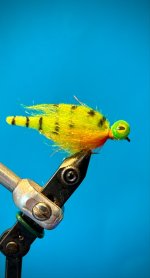
View attachment 145991
Usually works…
Exactly. When matching the hatch gets tough just throw something ugly. That fly looks like a monstrosity that @Bambooflyguy throws. It also looks like a damn goldfinch or something. 😁
 
Mop flies!
 
I would add that as long as you're trying different flies because you're not getting fish, also try different areas if you can--shallower areas, deeper areas, rocks vs weeds, steeper shores vs shoals, parallel vs perpendicular retrieves, etc. In fact I'd probably be more inclined to do that than I would be to move off say a leach pattern. Obviously can be tough to cover all that if you're limited to a tube, the lake is large, etc.
 
Back
Top