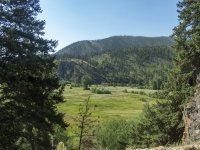
“Silex Creek”, 10 to 14 July 2024. Part 1 of 2. After “The River of Garnet Sands”, we headed east into Montana to fish “Silex Creek”.
Friends of ours had purchased a summer cabin on the creek and have been very generous as allowing friends and family to visit. In fact, this would be a reunion of sorts of the Patagonia crew from March (plus a few other family members). We restocked up on the essentials: beer, food, ice, Montana fishing licenses, a bottle of bourbon, and drove farther east.
Friday evening. After an early dinner on Friday, four of us headed out for an evening of fishing. River flows were only 60% of their seasonal average and daytime temperatures were over 90oF. Wading would be easier than normal. But we were concerned about the impact of high stream temperatures on trout recovery. In fact, Montana had just instituted “hoot owl” restrictions (that is, closing fishing in the afternoon) on some rivers, but not “Silex Creek” to reduce stress on the trout. We recorded morning temperatures in the low 60s and afternoon temperatures in the high 60’s, So we needed to ensure that the fish were revived after hooking, but we felt that we would could still fish ethically.
For that evening, we had a specific location in mind, let’s call it “the Blowdown”.
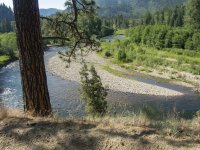
It is a very popular spot, and we were fortunate that it was available that evening. Not only is “the Blowdown” popular because of the quality of the fishing there, but it is also large enough to fish four anglers. The other two anglers went downstream and Mike and I went upstream. Our target was the top pool of this section.
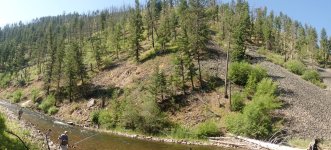
This run is several hundred feet long. The entering rapid bends into the top of the run from the left and the wide run itself is relatively straight. Flow is fast at the top, especially along the edge against the scree slope (right side when looking upstream = “river left”). Flow slows substantially by about the halfway mark. From prior experience, I know that a shallow spine extends up the middle of the run from the tailout. This makes the upstream wading easier to reach the prime fishing position; last summer’s wading was a bit dicier in this section. Flow is faster and deeper on the right half (river left) of the run, but there are enough boulders strewn through this section create current breaks for fish to hide out of the current. It is also deeper up to the shoreline which had overhanging shrubs and then grass-lined bank. The left half (river right) is more uniform, shallower, slower flow, and holds fewer fish. From the spine, the either bank is within my casting range.
I have fished this run several times previously. Guided by my prior experiences and Tim’s recommendations, I settled in just below the halfway point. This halfway point is the perfect balance of enough flow to bring a steady supply of insects but without the fish having to expend too much energy for their supper. Initially, I actually waded off the mid-run ridge into the deeper water closer to the bank to present more upstream casts (vs. cast more perpendicular to the flow). There were a number of caddis flies flying around and a few ovipositing. I also saw the occasional yellow Sally stonefly and a few pale morning duns. As the evening progressed, the hatch density increased, but it never was a massive blanket hatch (a consequence of the high temperatures?). And my fly of choice? A cdc caddis.
Initially, I was simply blind casting – dropping casts into current seams, foam lines, or quiet pockets and hoping someone was looking up. I was rewarded with a few small cutthroats and an 8” rainbow. I waded back to the spine and set up a bit further upstream. The surface action began to increase. I sprayed my casts toward the far bank between 30o upstream to 30o downstream of my position. It is great to cast to rising fish (versus prospecting). The early risers were smaller fish, but the fish quality improved as the evening progressed. You have a feeling of anticipation as your fly drifts over where you last saw a fish rise. And sometimes the fish rises right where you expect it to be (but more commonly, the fly passes by untouched).
It wasn’t my best night in this stretch. I missed several fish because I let there be too much slack in my leader (complex currents didn’t help). And I struck too soon on two nice fish when I anticipated their rises. But I hooked and landed a nice 13” brown to complete a Silex Creek slam: cutthroat, rainbow, brown.
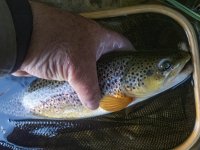
Later in the evening, I dropped a cast into the foam line by a submerged boulder tighter to the bank. A large head emerged from depths to grab the fly and I set the hook. This would be a solid fish for sure. We tussled back and forth in the fast water and I eventually managed to slip this solid 14” cutthroat into the net. I waded across the run the opposite bank to remove the hook and take a few pictures. My camera wasn’t cooperating and the pictures were poor.
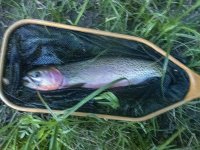
While I was fishing this middle stretch, Mike was up at the head of the pool and having a middling evening. After I released the nice cutt, we decided to head out before full dark. Tom and his nephew were just finishing up when we waded down to where they had been fishing. Tom had had a good night, Jared less so.
Saturday morning. Mike and I headed back out after breakfast. As expected, the “Blowdown” already had two cars in the parking lot. We decided to fish “Logan’s Run”, not far upstream.
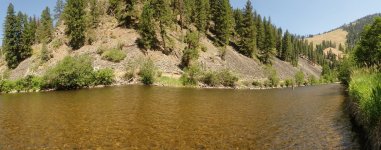
The very top of “Logan’s Run” is “Mike’s Corner”. “Mike’s Corner” marks the last bend as the river makes a 180o turn; this last rapid dumps against a rock wall against the road and creates a deep pool that Mike wanted to nymph. I was going to prospect along the length of “Logan’s Run”. Mike powered his way upstream to the top of the run, while I searched the tailout with my cdc caddis. There were several clouds of caddis over the faster water in the lee of an overhanging shrub and I saw a few caddis dipping onto the surface ovipositing.
I waded out to the middle of the run and began prospecting. I actually did see a few fish rising from the slower, smoother waters of this tailout. There isn’t much structure here but there is always some topographic variety that a fish can use as a refuge from the current. I picked up a few smaller cutts in this section. The fish were certainly keying on ovipositing caddis, from just a few feet downstream of me, a fish just exploded on my caddis pattern as I was retrieving it (but never hooked up). In the clear water, I could see the occasional flash of a fish turning sideways to pick up something underwater or to chase my caddis fly. The highlight of this window, I picked up a nice 11” brown that had been rising sporadically.
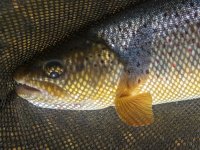
The water upstream of my tailout location looked inviting and I decided to wade / fish my way up. That proved to be a mistake. Most of the flow was too fast/deep to hold fish that would rise to a dry fly. I might have picked up a fish if I hammered pockets of structure along the bank. Mike had picked up a nice fish or two while nymphing at the corner. Mike had nymphed the pool at the top into a froth and there weren’t any fish interested in my cdc caddis after all the disturbance. A lesson relearned: “Never leave fish to find fish.” So, I beat a quick retreat down to the tailout.
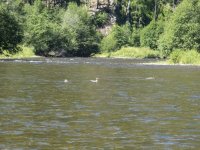
The surface activity had died down as morning transitioned to noon. While I had been away, three other fishers – mergansers had low-holed me. But they were wary and kept tight to the bottom of the tailout.
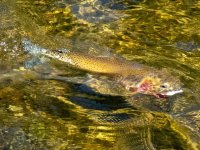
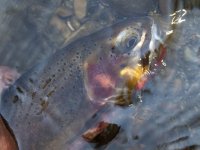
Back in the zone, I missed a nice fish from under the road-side shrub that extended over the edge of the creek and that covered a deeper slot. This fish hadn’t felt the hook, and I managed to move it twice afterwards but then nothing. I turned my attention to a finger of rocks just in front of the shrub. The rock finger created a current refuge in its lee and a foam line passed by the tip. After a few casts to find my range, I dropped a cast right into the foam line and a big cutthroat rose up from the depths to grab it. I set the hook and it was game on. It was a strong fish, but there wasn’t any trouble and I let it tire itself out before sliding it into the net. A few photographs and some quality revival time and it dashed back across the river to the safety of the deep slot.
At that point, we decided that we would call it quits for a late lunch. As we drove back, we saw a moose and her calf trotting across the “The Blowdown” below us.
All in all, a solid visit to “Silex Creek”.
Steve
Friends of ours had purchased a summer cabin on the creek and have been very generous as allowing friends and family to visit. In fact, this would be a reunion of sorts of the Patagonia crew from March (plus a few other family members). We restocked up on the essentials: beer, food, ice, Montana fishing licenses, a bottle of bourbon, and drove farther east.
Friday evening. After an early dinner on Friday, four of us headed out for an evening of fishing. River flows were only 60% of their seasonal average and daytime temperatures were over 90oF. Wading would be easier than normal. But we were concerned about the impact of high stream temperatures on trout recovery. In fact, Montana had just instituted “hoot owl” restrictions (that is, closing fishing in the afternoon) on some rivers, but not “Silex Creek” to reduce stress on the trout. We recorded morning temperatures in the low 60s and afternoon temperatures in the high 60’s, So we needed to ensure that the fish were revived after hooking, but we felt that we would could still fish ethically.
For that evening, we had a specific location in mind, let’s call it “the Blowdown”.
It is a very popular spot, and we were fortunate that it was available that evening. Not only is “the Blowdown” popular because of the quality of the fishing there, but it is also large enough to fish four anglers. The other two anglers went downstream and Mike and I went upstream. Our target was the top pool of this section.
This run is several hundred feet long. The entering rapid bends into the top of the run from the left and the wide run itself is relatively straight. Flow is fast at the top, especially along the edge against the scree slope (right side when looking upstream = “river left”). Flow slows substantially by about the halfway mark. From prior experience, I know that a shallow spine extends up the middle of the run from the tailout. This makes the upstream wading easier to reach the prime fishing position; last summer’s wading was a bit dicier in this section. Flow is faster and deeper on the right half (river left) of the run, but there are enough boulders strewn through this section create current breaks for fish to hide out of the current. It is also deeper up to the shoreline which had overhanging shrubs and then grass-lined bank. The left half (river right) is more uniform, shallower, slower flow, and holds fewer fish. From the spine, the either bank is within my casting range.
I have fished this run several times previously. Guided by my prior experiences and Tim’s recommendations, I settled in just below the halfway point. This halfway point is the perfect balance of enough flow to bring a steady supply of insects but without the fish having to expend too much energy for their supper. Initially, I actually waded off the mid-run ridge into the deeper water closer to the bank to present more upstream casts (vs. cast more perpendicular to the flow). There were a number of caddis flies flying around and a few ovipositing. I also saw the occasional yellow Sally stonefly and a few pale morning duns. As the evening progressed, the hatch density increased, but it never was a massive blanket hatch (a consequence of the high temperatures?). And my fly of choice? A cdc caddis.
Initially, I was simply blind casting – dropping casts into current seams, foam lines, or quiet pockets and hoping someone was looking up. I was rewarded with a few small cutthroats and an 8” rainbow. I waded back to the spine and set up a bit further upstream. The surface action began to increase. I sprayed my casts toward the far bank between 30o upstream to 30o downstream of my position. It is great to cast to rising fish (versus prospecting). The early risers were smaller fish, but the fish quality improved as the evening progressed. You have a feeling of anticipation as your fly drifts over where you last saw a fish rise. And sometimes the fish rises right where you expect it to be (but more commonly, the fly passes by untouched).
It wasn’t my best night in this stretch. I missed several fish because I let there be too much slack in my leader (complex currents didn’t help). And I struck too soon on two nice fish when I anticipated their rises. But I hooked and landed a nice 13” brown to complete a Silex Creek slam: cutthroat, rainbow, brown.
Later in the evening, I dropped a cast into the foam line by a submerged boulder tighter to the bank. A large head emerged from depths to grab the fly and I set the hook. This would be a solid fish for sure. We tussled back and forth in the fast water and I eventually managed to slip this solid 14” cutthroat into the net. I waded across the run the opposite bank to remove the hook and take a few pictures. My camera wasn’t cooperating and the pictures were poor.
While I was fishing this middle stretch, Mike was up at the head of the pool and having a middling evening. After I released the nice cutt, we decided to head out before full dark. Tom and his nephew were just finishing up when we waded down to where they had been fishing. Tom had had a good night, Jared less so.
Saturday morning. Mike and I headed back out after breakfast. As expected, the “Blowdown” already had two cars in the parking lot. We decided to fish “Logan’s Run”, not far upstream.
The very top of “Logan’s Run” is “Mike’s Corner”. “Mike’s Corner” marks the last bend as the river makes a 180o turn; this last rapid dumps against a rock wall against the road and creates a deep pool that Mike wanted to nymph. I was going to prospect along the length of “Logan’s Run”. Mike powered his way upstream to the top of the run, while I searched the tailout with my cdc caddis. There were several clouds of caddis over the faster water in the lee of an overhanging shrub and I saw a few caddis dipping onto the surface ovipositing.
I waded out to the middle of the run and began prospecting. I actually did see a few fish rising from the slower, smoother waters of this tailout. There isn’t much structure here but there is always some topographic variety that a fish can use as a refuge from the current. I picked up a few smaller cutts in this section. The fish were certainly keying on ovipositing caddis, from just a few feet downstream of me, a fish just exploded on my caddis pattern as I was retrieving it (but never hooked up). In the clear water, I could see the occasional flash of a fish turning sideways to pick up something underwater or to chase my caddis fly. The highlight of this window, I picked up a nice 11” brown that had been rising sporadically.
The water upstream of my tailout location looked inviting and I decided to wade / fish my way up. That proved to be a mistake. Most of the flow was too fast/deep to hold fish that would rise to a dry fly. I might have picked up a fish if I hammered pockets of structure along the bank. Mike had picked up a nice fish or two while nymphing at the corner. Mike had nymphed the pool at the top into a froth and there weren’t any fish interested in my cdc caddis after all the disturbance. A lesson relearned: “Never leave fish to find fish.” So, I beat a quick retreat down to the tailout.
The surface activity had died down as morning transitioned to noon. While I had been away, three other fishers – mergansers had low-holed me. But they were wary and kept tight to the bottom of the tailout.
Back in the zone, I missed a nice fish from under the road-side shrub that extended over the edge of the creek and that covered a deeper slot. This fish hadn’t felt the hook, and I managed to move it twice afterwards but then nothing. I turned my attention to a finger of rocks just in front of the shrub. The rock finger created a current refuge in its lee and a foam line passed by the tip. After a few casts to find my range, I dropped a cast right into the foam line and a big cutthroat rose up from the depths to grab it. I set the hook and it was game on. It was a strong fish, but there wasn’t any trouble and I let it tire itself out before sliding it into the net. A few photographs and some quality revival time and it dashed back across the river to the safety of the deep slot.
At that point, we decided that we would call it quits for a late lunch. As we drove back, we saw a moose and her calf trotting across the “The Blowdown” below us.
All in all, a solid visit to “Silex Creek”.
Steve
Last edited: