

speedbird
Life of the Party
Found this gem of a thread reading up on sandlance: https://www.washingtonflyfishing.co...relation-to-fly-fishing-on-puget-sound.35994/
I learned quite a bit. I imagine the beaches shown would do decent for Sea Runs during the spawning period, as well as Resi bycatch. There's beaches on there that leave me optimistic to incidentally running into a blackmouth too. I am very curious as to what happens when the spawning period ends in late February. Downrigger boats seeking to imitate sandlance will consistently fish between 90-150 feet bouncing off the bottom. While this puts fish in the boat, I have believed this is a truism stemming from the days of winter blackmouth fishing where sandlance would burrow themselves in the sand to hibernate before and after spawning. Every so often I see photos on here of coho cut open with sandlance fresh in their bellies, caught off beaches in much shallower water. Additionally, most Chinook bellies I cut open in the summer, even those caught at the bottom, seem to be more keyed in on green-blue label sized herring than they are on sandlance, and have scars that are largely healed. I think last summer while bouncing bottom I only encountered one fish with fresh scars. I speculate the bottom orientation of those fish has more to do with currents pushing schooling fish up against shelves, and the bottom providing a good space to ambush. I have definitely seen this on the fishfinder with smaller fish snapping at the bait balls from behind while larger fish sit at the bottom directly under the ball.
From Selleck et. al (Paywall, but allow access of up to 100 free articles a month), tow net and beach seine surveys show sand lance activity peaking in summer around mid June, and then dropping consistently until they become near 0 between November and February, coincidentally exactly timed with documented spawn time for the species, when they bury. The study mentions this burying behavior briefly, and postulates that a decrease in predatation in that time period is related to a decrease in presence, but it makes no mention or note of the documented behavior of both Chinook and coho who will dig up burried sand lance.
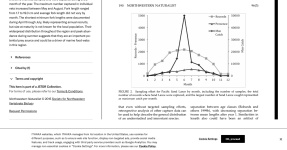
Selleck, J. R., Gibson, C. F., Shull, S., & Gaydos, J. K. (2015). NEARSHORE DISTRIBUTION OF PACIFIC SAND LANCE (AMMODYTES PERSONATUS) IN THE INLAND WATERS OF WASHINGTON STATE. Northwestern Naturalist, 96(3), 185–195. http://www.jstor.org/stable/26382466
Unfortunately, no mention seems to be made of depth ranges. So I consulted Bizzarro et al. (2016) () a study coming out of NOAA, also from the folks at FHL. Pacific Sandlance were beleived to bury at night and remain active during the day, however the study speculates from lab tests that sandlance may also bury during the day to escape predators. The observations of sandlance burying during the day are cautioned as potentially being extreneuous and a function of small sample size, or lab conditions. In terms of depth ranges, they seem to range up to 80m, a very wide range.
In terms of fishing Puget Sound, I assume that sandbars like Posession, Jefferson, and Midchannel are teeming with sandlance as a result of juvenile free swimming fish being pushed into them by strong currents, and choosing to remain burried in that location. I still have many questions for which I have not found studies just yet, (Will do more digging and report back) such as how the species ranges between deep water and near shore, as well as differences in how they behave. I have seen sandlance (Or small, scaled silver elongated baitfish that resemble them) swimming near shore at beaches on whidbey island in a more midwater oriented pattern. Are nearshore fish less likely to engage in daytime burying, or was my observation an anomoly? Assuming the current status quo of sandlance coming out of their burrows during the day is correct, what triggers the digging behavior commonly observed in Chinook and coho? Do sandlance bury in response to the presence of salmon? Could the lower levels of light in deep water sandlance trigger their dinural burying behavior at greater rates than shallower populations?
In a world where a clouser minnow stripped at a fast speed on any beech with a steep dropoff during tide change is enough to catch a coho, this is probably another case of using too much of my brain in an attempt to trick an animal with the brain a size of a pea, but for me half the fun of fishing is understanding not just how I caught a fish, but also why
I learned quite a bit. I imagine the beaches shown would do decent for Sea Runs during the spawning period, as well as Resi bycatch. There's beaches on there that leave me optimistic to incidentally running into a blackmouth too. I am very curious as to what happens when the spawning period ends in late February. Downrigger boats seeking to imitate sandlance will consistently fish between 90-150 feet bouncing off the bottom. While this puts fish in the boat, I have believed this is a truism stemming from the days of winter blackmouth fishing where sandlance would burrow themselves in the sand to hibernate before and after spawning. Every so often I see photos on here of coho cut open with sandlance fresh in their bellies, caught off beaches in much shallower water. Additionally, most Chinook bellies I cut open in the summer, even those caught at the bottom, seem to be more keyed in on green-blue label sized herring than they are on sandlance, and have scars that are largely healed. I think last summer while bouncing bottom I only encountered one fish with fresh scars. I speculate the bottom orientation of those fish has more to do with currents pushing schooling fish up against shelves, and the bottom providing a good space to ambush. I have definitely seen this on the fishfinder with smaller fish snapping at the bait balls from behind while larger fish sit at the bottom directly under the ball.
From Selleck et. al (Paywall, but allow access of up to 100 free articles a month), tow net and beach seine surveys show sand lance activity peaking in summer around mid June, and then dropping consistently until they become near 0 between November and February, coincidentally exactly timed with documented spawn time for the species, when they bury. The study mentions this burying behavior briefly, and postulates that a decrease in predatation in that time period is related to a decrease in presence, but it makes no mention or note of the documented behavior of both Chinook and coho who will dig up burried sand lance.
Selleck, J. R., Gibson, C. F., Shull, S., & Gaydos, J. K. (2015). NEARSHORE DISTRIBUTION OF PACIFIC SAND LANCE (AMMODYTES PERSONATUS) IN THE INLAND WATERS OF WASHINGTON STATE. Northwestern Naturalist, 96(3), 185–195. http://www.jstor.org/stable/26382466
Unfortunately, no mention seems to be made of depth ranges. So I consulted Bizzarro et al. (2016) () a study coming out of NOAA, also from the folks at FHL. Pacific Sandlance were beleived to bury at night and remain active during the day, however the study speculates from lab tests that sandlance may also bury during the day to escape predators. The observations of sandlance burying during the day are cautioned as potentially being extreneuous and a function of small sample size, or lab conditions. In terms of depth ranges, they seem to range up to 80m, a very wide range.
In terms of fishing Puget Sound, I assume that sandbars like Posession, Jefferson, and Midchannel are teeming with sandlance as a result of juvenile free swimming fish being pushed into them by strong currents, and choosing to remain burried in that location. I still have many questions for which I have not found studies just yet, (Will do more digging and report back) such as how the species ranges between deep water and near shore, as well as differences in how they behave. I have seen sandlance (Or small, scaled silver elongated baitfish that resemble them) swimming near shore at beaches on whidbey island in a more midwater oriented pattern. Are nearshore fish less likely to engage in daytime burying, or was my observation an anomoly? Assuming the current status quo of sandlance coming out of their burrows during the day is correct, what triggers the digging behavior commonly observed in Chinook and coho? Do sandlance bury in response to the presence of salmon? Could the lower levels of light in deep water sandlance trigger their dinural burying behavior at greater rates than shallower populations?
In a world where a clouser minnow stripped at a fast speed on any beech with a steep dropoff during tide change is enough to catch a coho, this is probably another case of using too much of my brain in an attempt to trick an animal with the brain a size of a pea, but for me half the fun of fishing is understanding not just how I caught a fish, but also why