
Navigation
Install the app
How to install the app on iOS
Follow along with the video below to see how to install our site as a web app on your home screen.
Note: This feature may not be available in some browsers.
More options
Style variation
You are using an out of date browser. It may not display this or other websites correctly.
You should upgrade or use an alternative browser.
You should upgrade or use an alternative browser.
Russ Peak
- Thread starter chrome/22
- Start date
Might be noteworthy to mention that Kerry Burkheimer apprenticed with Russ.
When Russ passed, Kerry acquired (some or all, I don't know) his inventory. He can build you a rod on one of Russ's blanks or he could in the past.
Fortunate for me, I have one of Russ's builds and one of Kerry's on a Peak blank.
Attachments
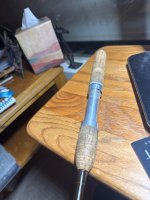
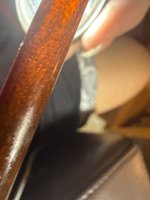
I saw your post about Russ Peak's assistant and thought I would ask if you know Robert Moore who another fisherman told me he built rods in Pasadena with him. I don't know much about fiberglass rods but he paid $200 for it from Moore. No markings on it though. It has no marks but the case has a model number305475 serial # 20467
It is beautiful 64" but trying to find out more. Hoping someone knows Moore made rods.
It is beautiful 64" but trying to find out more. Hoping someone knows Moore made rods.

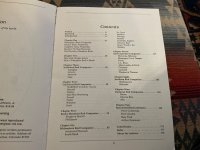
This 1996 work by the Johnsons is an excellent treatise on the subject.


I’ll just add that Kerry was very close friends with Tom Morgan, and rolled at least some of Tom’s blanks, including fiberglass. I broke the tip on a 2 piece 7wt fiberglass (Unity rod), after Tom passed. Eventually I reached out to Kerry for advice. He asked for the rod, which I shipped, and he built a new tip section that matches perfectly. In homage to Tom. Thanks Kerry!!!
Loved Tom and visited him every summer on Montana trips.. He was as picky as they come..
Fiberglass is incredibly difficult to work with and making blanks good enough to ease Tom was an amazing challenge.

What are some of the difficulties working with fiberglass over graphite?Loved Tom and visited him every summer on Montana trips.. He was as picky as they come..
Fiberglass is incredibly difficult to work with and making blanks good enough to ease Tom was an amazing challenge.
What are some of the difficulties working with fiberglass over graphite?
For starters it requires much cleaner working surfaces. At it is generally is creates a transparent rod blank every speck of dust or errant graphite fibers turn into glowing flaws in
An otherwise perfectly good blank.
Fiberglass prepreg is much stickier than graphite it tends to stick to the rolling table as much as it sticks to the mandrel. Also the parts don't come out as straight as graphite parts.
Also the fibers the prepreg are made from are stiffer and resist being rolled into a cylinder and lije to come unrolled.
Once cured the blank surface (resin) is much harder than graphite making the parts much harder to sand and prep for paint.
Lastly, and I do not understand this part. When applying the flow coat ( dipping the blank in a reservoir of rod finish) due to a magnetic field the solids that create the pigment will often be attracted to one side of the blank creating a dark stripe running down the blank.
Give me graphite all day every day

I’ve seen all those blems in fiberglass blanks I’ve built. But have seen a lot more graphite blanks struggling to be straightFor starters it requires much cleaner working surfaces. At it is generally is creates a transparent rod blank every speck of dust or errant graphite fibers turn into glowing flaws in
An otherwise perfectly good blank.
Fiberglass prepreg is much stickier than graphite it tends to stick to the rolling table as much as it sticks to the mandrel. Also the parts don't come out as straight as graphite parts.
Also the fibers the prepreg are made from are stiffer and resist being rolled into a cylinder and lije to come unrolled.
Once cured the blank surface (resin) is much harder than graphite making the parts much harder to sand and prep for paint.
Lastly, and I do not understand this part. When applying the flow coat ( dipping the blank in a reservoir of rod finish) due to a magnetic field the solids that create the pigment will often be attracted to one side of the blank creating a dark stripe running down the blank.
Give me graphite all day every day
Last edited:

That would be an interesting winter read.This 1996 work by the Johnsons is an excellent treatise on the subject.
View attachment 189681View attachment 189682