Rockhounding 101

Rob Allen

Life of the Party
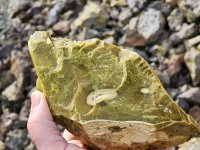
Common Opal

This is my first year finding this stuff but I have found that it is abundant and easy to find.
I thought others might like to know about it.

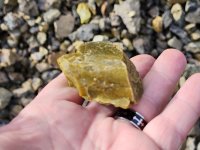
1. It tends to be creamy green , yellow or brown. Though we have found dome pieces with red striping.
2. It's much like obsidian just not black.
3. It's often crumbly but you can find large solid pieces.
4 it's easiest to find in road cuts in very old deteriorated basalt.
5. I don't know how widespread it is but it is common around the mid Columbia and it's tributaries on Washington's and Oregon
6. Pieces broken out of the seams are available in the rubble next to the road. No digging , hiking or climbing required. You'll climb anyway:) be careful
7 it breaks into sharp pieces so be careful there too.


Typical common opal20250222_112513.jpg
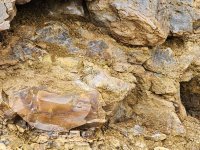
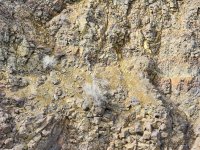
20250222_112614.jpgThis is the host rock for common opal notice how crumbly nature of the basalt and the yelloe mineralization.. 30 feet from the road near the john day river at cottonwood state park20250222_112418.jpg
 
Last edited:
Common Opal

This is my first year finding this stuff but I have found that it is abundant and easy to find.
I thought others might like to know about it.

1. It tends to be creamy green , yellow or brown. Though we have found dome pieces with red striping.
2. It's much like obsidian just not black.
3. It's often crumbly but you can find large solid pieces.
4 it's easiest to find in road cuts in very old deteriorated basalt.
5. I don't know how widespread it is but it is common around the mid Columbia and it's tributaries on Washington's and Oregon
6. Pieces broken out of the seams are available in the rubble next to the road. No digging , hiking or climbing required. You'll climb anyway:) be careful
7 it breaks into sharp pieces so be careful there too.


Typical common opalView attachment 142643

View attachment 142644This is the host rock for common opal notice how crumbly nature of the basalt and the yelloe mineralization.. 30 feet from the road near the john day river at cottonwood state parkView attachment 142645
Thanks for this! I hope you post some follow up on other kinds of rocks.
 
Thanks Rob. My wife is just getting into rock hounding and would love to look for rocks while I fish. I'll show this to her!

andy
 
I thought I remembered from my geology 101 class that that material was produced when the basalt flows hit water. Might not be accurate… as it was fifty years ago!
 
Most of my other rock hounding is just finding stuff randomly.
I was hoping other people might contribute their knowledge as well.
 
  • Like
Reactions: Zak
I've been a rock hound since I was very young.
Growing up In Southern Oregon, I was very lucky to have access to agates, jaspers, petrified wood, some little gold nuggets, etc.
Now I'm back and fishing the little blue lines here in Southern Oregon I C&R the trout, but I keep the rocks.
Rock on!!!!
 
I thought I remembered from my geology 101 class that that material was produced when the basalt flows hit water. Might not be accurate… as it was fifty years ago!
Yup. Pillow basalt forms when flows hit water. To answer Rob’s question, it is abundant in the mid-Columbia basin. One of the best outcrops of it is on the highway near Rock Island Dam near Wenatchee, approaching from the south.
 
I’ve always been a rock hound since I was a little kid. My dad was really into it, so I was too! From thunder egg agates from Oregon to any cool rocks period. When I fish salt water beaches, the only things I bring home are rocks or pieces of driftwood for fish carvings.
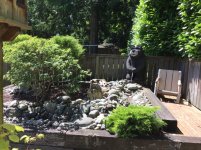
My wife and I collected rocks camping in our motor home for years…..we kept them in five gallon buckets by the shed…..25+ years we had a lot of buckets! Pre Covid we made a water feature in our backyard with the rocks. Our prized possession is a 175 lb piece of petrified wood my dad found back in the 60’s. A bunch of agates, obsidian, opal and colorful rocks make the stream pop!

IMG_1311.jpeg
 
Last edited:
Cool thread. Its become tradition that I bring back a cool looking rock on a fishing trip for my daughter. I never really know what they are. I'll pull some out tomorrow and post them up.
 
Never got into rock-hounding, other than picking up the occasional 'perty' rock. It's kind of on my radar though. A friend of mine here in Roseburg finds arrow heads and jasper. I also have a sister that's into it and has all the gear to cut and polish stuff. I might have to see if I can insert myself into one of his trips. I'm always looking for an excuse to get out in the woods.
 
I know a little about opal. Even though it is soft, its sheer beauty qualifies it to be a "precious gem stone". Opal gemstones are essentially made up of tiny "bubbles". Just like soap bubbles, they play tricks on light. Mexican fire opal, Australian Black opal, Honduras opal, Mojave dessert opal etc.. all are magical stones. Most of these stones will fluoresce under short wave and long wave fluorescent light.
 
Back
Top