
Navigation
Install the app
How to install the app on iOS
Follow along with the video below to see how to install our site as a web app on your home screen.
Note: This feature may not be available in some browsers.
More options
Style variation
You are using an out of date browser. It may not display this or other websites correctly.
You should upgrade or use an alternative browser.
You should upgrade or use an alternative browser.
Remember all the starfish dying a decade ago
- Thread starter Porter2
- Start date


Cool article, cool scientific sleuthing!
I guess it wasn't sea otters turning the seafloor into parking lots:
(quote from article follows)
Nowhere has the human and ecological toll of all this death been clearer than in northern California. Without their many-armed predators, purple sea urchins — one of sunflower stars’ key foods — have taken over the ocean bottom along the coast. Their population jumped 60-fold in a single year, so displacing the red sea urchins prized by sushi eaters that a commercial fishery for red urchin was declared a federal disaster in 2019. Livelihoods were shattered.
“Christmas this year was really hard,” says Grant Downie, a commercial diver in Fort Bragg, Calif., who once made up to $150,000 a year harvesting red urchin.
After sunflower stars were decimated by disease in northern California, red sea urchins like these — a commercially valuable species — also collapsed. (Shane Gross / Nature Picture Library)
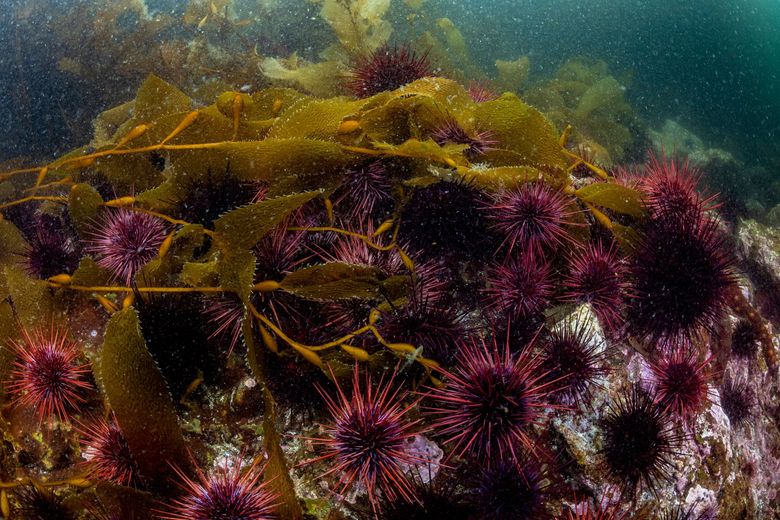
After sunflower stars were decimated by disease in northern California, red sea urchins like these — a commercially valuable species — also collapsed. (Shane Gross / Nature Picture Library)
The changes Downie has seen on the seafloor are nearly as troubling as those in his bank account. Voracious purple urchins, a species for which there is no market, have mowed down lush bull kelp; along a 217-mile stretch of coast in Sonoma and Mendocino counties, 90% of kelp died. That’s left no food for red abalone, causing a $44 million recreational abalone dive fishery to close.
Baby rockfish, which typically hide within long, waving kelp strands, have also dwindled, as have many other species. Much of the region now resembles underwater clear-cuts — a patchwork of overgrazed seafloor that scientists call “urchin barrens.”
“This ecosystem is predicated on balance — we need a certain combination of species to make it function,” says Tristin Anoush McHugh, kelp project director for The Nature Conservancy’s California Oceans Program. “The loss of sunflower stars transformed it.”
I guess it wasn't sea otters turning the seafloor into parking lots:
(quote from article follows)
Nowhere has the human and ecological toll of all this death been clearer than in northern California. Without their many-armed predators, purple sea urchins — one of sunflower stars’ key foods — have taken over the ocean bottom along the coast. Their population jumped 60-fold in a single year, so displacing the red sea urchins prized by sushi eaters that a commercial fishery for red urchin was declared a federal disaster in 2019. Livelihoods were shattered.
“Christmas this year was really hard,” says Grant Downie, a commercial diver in Fort Bragg, Calif., who once made up to $150,000 a year harvesting red urchin.
After sunflower stars were decimated by disease in northern California, red sea urchins like these — a commercially valuable species — also collapsed. (Shane Gross / Nature Picture Library)
After sunflower stars were decimated by disease in northern California, red sea urchins like these — a commercially valuable species — also collapsed. (Shane Gross / Nature Picture Library)
The changes Downie has seen on the seafloor are nearly as troubling as those in his bank account. Voracious purple urchins, a species for which there is no market, have mowed down lush bull kelp; along a 217-mile stretch of coast in Sonoma and Mendocino counties, 90% of kelp died. That’s left no food for red abalone, causing a $44 million recreational abalone dive fishery to close.
Baby rockfish, which typically hide within long, waving kelp strands, have also dwindled, as have many other species. Much of the region now resembles underwater clear-cuts — a patchwork of overgrazed seafloor that scientists call “urchin barrens.”
“This ecosystem is predicated on balance — we need a certain combination of species to make it function,” says Tristin Anoush McHugh, kelp project director for The Nature Conservancy’s California Oceans Program. “The loss of sunflower stars transformed it.”

Wayne Kohan
Life of the Party
Funny, but that was the first thing that came to my mind while reading this article. Unless this study was funded by Big Otter……Cool article, cool scientific sleuthing!
I guess it wasn't sea otters turning the seafloor into parking lots:
Our family has done a yearly vacation to Cannon Beach, and went several years without seeing any stars, it’s been great seeing them back in big numbers the past couple years.

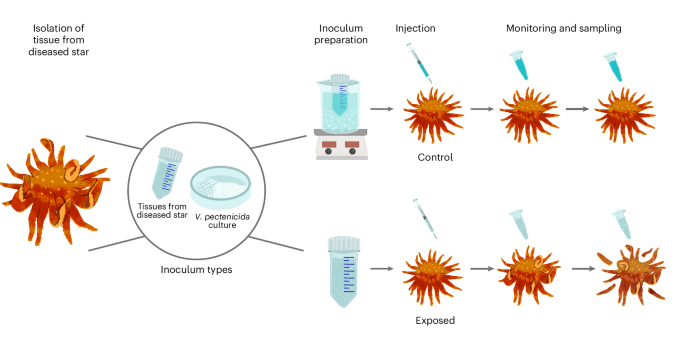
Vibrio pectenicida strain FHCF-3 is a causative agent of sea star wasting disease - Nature Ecology & Evolution
The causative agent of sea star wasting disease has been elusive. This study used genetic datasets and experimental exposures to demonstrate that a strain of the bacterium Vibrio pectenicida caused disease and mortality in sea stars.
 www.nature.com
Vibrio pectenicida strain FHCF-3 is a causative agent of sea star wasting disease
More than 10 years following the onset of the sea star wasting disease (SSWD) epidemic, affecting over 20 asteroid species from Mexico to Alaska, the causative agent has been elusive. SSWD killed billions of the most susceptible species, sunflower sea stars (Pycnopodia helianthoides), initiating a trophic cascade involving unchecked urchin population growth and the widespread loss of kelp forests. Identifying the causative agent underpins the development of recovery strategies. Here we induced disease and subsequent mortality in exposure experiments using tissue extracts, coelomic fluid and effluent water from wasting sunflower sea stars, with no mortality in controls. Deep sequencing of diseased sea star coelomic fluid samples from experiments and field outbreaks revealed a dominant proportion of reads assigned to the bacterium Vibrio pectenicida. Fulfilling Koch’s postulates, V. pectenicida strain FHCF-3, cultured from the coelomic fluid of a diseased sunflower sea star, caused disease and mortality in exposed sunflower sea stars, demonstrating that it is a causative agent of SSWD. This discovery will enable recovery efforts for sea stars and the ecosystems affected by their decline by facilitating culture-based experimental research and broad-scale screening for pathogen presence and abundance in the laboratory and field.
Jim in Anacortes
Life of the Party
I see no correlation with the Sea Star wasting disease and the destructive nature of Sea Otters. SSWD was perhaps the most destructive marine epidemic in history. I have always believed that this epidemic was directly responsible for the Purple Urchin population explosion, that has caused so much damage to the Kelp beds. I (and others) also believe that Red Sea Urchin populations were also decimated by a similar or the same "disease". One San Diego Red Sea Urchin processor claimed a sudden 90% reduction in Red Sea Urchins harvested. This was due to a mysterious "sickness" that simply wiped them out. All of this does not change the fact that introduced populations of Sea Otters will indeed, catastrophically harm the ecosystems in the kelp beds that they are introduced into. The otters have no interest in eating the empty purple urchins in the "urchin barrens" but they will eat mostly everything else. I know something about this stuff.

I look forward to reading your peer reviewed study on the subject.I see no correlation with the Sea Star wasting disease and the destructive nature of Sea Otters. SSWD was perhaps the most destructive marine epidemic in history. I have always believed that this epidemic was directly responsible for the Purple Urchin population explosion, that has caused so much damage to the Kelp beds. I (and others) also believe that Red Sea Urchin populations were also decimated by a similar or the same "disease". One San Diego Red Sea Urchin processor claimed a sudden 90% reduction in Red Sea Urchins harvested. This was due to a mysterious "sickness" that simply wiped them out. All of this does not change the fact that introduced populations of Sea Otters will indeed, catastrophically harm the ecosystems in the kelp beds that they are introduced into. The otters have no interest in eating the empty purple urchins in the "urchin barrens" but they will eat mostly everything else. I know something about this stuff.
Jim in Anacortes
Life of the Party
Years ago I jested that we could simply grow a bunch of Sea Stars, in a lab, and let them loose on the Purple Urchins. Apparently that is the basic plan in the OP. This might actually work, but it comes with risks. I remember when "Withering Syndrome of Abalone" completely decimated the commercial and sport fisheries of all species of Abalone in Southern California. Complete shutdown of all harvesting (still in effect) because of the catastrophic "die off". At that time, some people saw a direct correlation of timing and location to a "scientific" approach to "reintroducing" "lab grown" Abalone into the wild. Often times these (crowded) tanks in these labs can produce sick animals, and when introduced into the wild, can spread these horrible "diseases". Sometimes it's not nice to fool with Mother Nature. Food for thought.

Jim in Anacortes
Life of the Party
I have no dog in this fight. I am simply trying to shed some insights that very few people ever get the opportunity to see. Although my experiences have not been "peer reviewed" they might, just might, be worthy of consideration.
Sorry. I couldn't resist stirring the pot again.Here we go again, Otterbots Unite!


Jim in Anacortes
Life of the Party
There is some funding for divers in Northern California to try and "control" AKA kill a few Purple Urchins in Northern California. IMHO that "funding" is a noble effort, but is akin to a fart in the wind. A few divers make a few hard earned bucks, a lot of "scientists" make some easy money, but in the end....it aint gunna work. Grant Downie knows this, the "scientists" know this and the people "funding" this effort knows this. But hey...it's "funded" so why not take the money? I say roll the dice and let an army of lab grown Sea Stars loose on the Purple Urchin Barrens..... at this point what have we got to loose?