SFR Reapplication of Sunscreen?

Sorta fishing-related
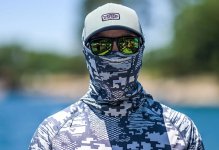
A question... a sun hoodie, sun gloves, long bill cap, sun gaiter, polarized wrap around sunglasses. No need to mess with any chemical sunblock? No need to re-apply anything, right?

It seems there is always some place that gets exposed a bit regardless of what protection you are wearing.
Earlier this year I fished a lake. I thought I was well protected but didn’t notice the area between my socks and end of my pants legs was exposed when sitting in the boat. Let’s just say I had a couple of inches of well done skin above my ankles. The sun will get you every time it’s given the opportunity.
SF
 
Baleaf makes a decent one, on Amazon for $22
I bought a couple of these several years ago but with the face mask, about $30 nowadays. They have been perfect so far and are used heavily not only for fishing but here on the frozen tundra as well. I was in a fly shop 2 years ago and saw one with a name brand logo that was $115. I can't imagine how it could have been 4X as good as the Baleaf, the fabric felt the same and for all intents and purposes it did the same thing but just cost X times more. But fly fishermen are a gullible bunch.....
 
I still apply some physical sunblock (zinc oxide cream) on places that end up exposed when I'm moving around. Like if I'm not wearing sun gloves, maybe my face if the gaiter isn't staying up all day. Just depends, but I always have a tube with me.
My sun protection is something like this, but a bit tighter fit. And it stays on 99% of time I am fishing, regardless if it's sunny or cloudy or whatever. The absolute mimimum exposed skin is the idea. I used to rely heavily on the stuff in the tube... no more. sun.jpg
 
my recent semi-annual visit to the derm was the first time in 30 years I left without a single freeze or biopsy, the Fluorouracil applied 2x yearly, at the start of winter and the beginning of spring, really doing the job on the actinic keratoses that usually get the freeze.
 
A question... a sun hoodie, sun gloves, long bill cap, sun gaiter, polarized wrap around sunglasses. No need to mess with any chemical sunblock? No need to re-apply anything, right?
I tried wearing buffs, but don't like the constriction, harder to breathe, and fogs up my glasses. So morning ritual on fishing days includes applying sunscreen to my face, front of my neck - basically the places the hoody doesn't cover, and the backs of my hands. I'm sold. No sunburns in 9 years so far.
 
I tried wearing buffs, but don't like the constriction, harder to breathe, and fogs up my glasses. So morning ritual on fishing days includes applying sunscreen to my face, front of my neck - basically the places the hoody doesn't cover, and the backs of my hands. I'm sold. No sunburns in 9 years so far.
Yeah I do wear buffs but not all the time. I have a strong Rx for my eyewear and can't be without it, and the buffs can fog them in certain situations. And like you, I don't particularly like something that constricts my breathing. So I'm about 50/50 on wearing buffs.
 
I tried wearing buffs, but don't like the constriction, harder to breathe, and fogs up my glasses. So morning ritual on fishing days includes applying sunscreen to my face, front of my neck - basically the places the hoody doesn't cover, and the backs of my hands. I'm sold. No sunburns in 9 years so far.
Agree, there are always tradeoffs involved. One has to choose depending on a specific situation.
 
Another benefit of the sun hoodie... I was hiking to the green sand beach on the big island. This involves a few miles along the southern cliff face of the big island. Nothing between you and Antarctica at that point and the wind acted like it. Solid 40-50 mph sustained wind. Never a gust, just full got.

This created something of a sandblaster effect when mixed with the dry, desert like ground on that side of the island. Anything exposed got a nice polish, including the outer layers of skin. The hoodie was a godsend that day
 
I am sure they were there but I can't seem to remember a case of sun cancer growing up in PA. People (including some very old people) worked in the sun all day. We helped the farmers put hay away from early morning through out the day and never gave sun cancer a second thought. I don't remember wearing a cap of any kind and neither did any of my friends. My brother, father, other relatives, and many friends followed similar routines. All this and no skin cancer to speak of.

So, I tried to dig up some research and was blasted by Blackle with countless reports and tables. I settled on a summarized version below but am left with two thoughts: (1) human kind has no doubt screwed up their immune systems from both consumption and exposure to hell knows what (2) our atmosphere has lost some of its ability to shield out harmful cancer driven rays.

Skin cancer rates have significantly increased from the 1950s to today. Below is a comparison of the estimated incidence rates.

Estimated Incidence Rates

  • 1950s:
    • Melanoma: Approximately 1.5 cases per 100,000 people.
    • Non-melanoma skin cancers (e.g., basal cell carcinoma, squamous cell carcinoma): Estimated around 100,000 cases annually in the U.S.
  • Today (2020s):
    • Melanoma: Approximately 22 cases per 100,000 people.
    • Non-melanoma skin cancers: Over 5 million cases annually in the U.S.
Factors Contributing to Changes
  • Increased UV Exposure: Higher rates of sun exposure and tanning bed use.
  • Awareness and Screening: Improved awareness and early detection have led to higher reported rates.
  • Aging Population: An older population is more susceptible to skin cancer.
Sources of Data
  • American Cancer Society
  • National Cancer Institute
  • Centers for Disease Control and Prevention (CDC)

 
There's a lot of science that suggests the modern diet is playing a factor. The skin being composed of layers rich in lipids (fats) and the types of fat you eat can shape the fatty acid composition of your skin. If the skin is loaded with poly unsaturated fats like linoleic acid it becomes more reactive under the sun.
 
Not sure if mentioned above, it is not just direct sunlight but also reflected light that can cause issues...
 
Skin cancer rates have significantly increased from the 1950s to today. Below is a comparison of the estimated incidence rates.

Estimated Incidence Rates

  • 1950s:
    • Melanoma: Approximately 1.5 cases per 100,000 people.
    • Non-melanoma skin cancers (e.g., basal cell carcinoma, squamous cell carcinoma): Estimated around 100,000 cases annually in the U.S.
  • Today (2020s):
    • Melanoma: Approximately 22 cases per 100,000 people.
    • Non-melanoma skin cancers: Over 5 million cases annually in the U.S.
Factors Contributing to Changes
  • Increased UV Exposure: Higher rates of sun exposure and tanning bed use.
  • Awareness and Screening: Improved awareness and early detection have led to higher reported rates.
  • Aging Population: An older population is more susceptible to skin cancer.
Sources of Data
  • American Cancer Society
  • National Cancer Institute
  • Centers for Disease Control and Prevention (CDC)
"Recently published research for the first time examines changes in ultraviolet (UV) radiation over a period of fifty years (1959-2009). The research found that there has been an overall annual increase in UV levels of 2% to 6% since the 1990s.
"The data shows that during the 1970s and early 1980s, clear-sky UV Index levels were fairly stable. But over the last twenty years, there has been an overall annual increase in UV levels corresponding to ozone depletion."
"When ozone levels are depleted, the atmosphere loses its protective filter resulting in more solar UV radiation reaching the Earth's surface."
The Montreal Protocol, which came into force 25 years ago today, was specifically designed to phase out the use and production of substances that were known to deplete ozone in the stratosphere.
The Protocol has been very successful, and new modelling research shows that without it, about two million more people per year would have developed skin cancer by the year 2030 world-wide, 16% more than current estimates of skin cancer incidence. However, it will still take time for the ozone layer to fully recover, as is reflected in the higher UV levels over the past 20 years."

And some would have you believe ozone depletion is as much nonsense as climate change.
 
I am sure they were there but I can't seem to remember a case of sun cancer growing up in PA. People (including some very old people) worked in the sun all day. We helped the farmers put hay away from early morning through out the day and never gave sun cancer a second thought. I don't remember wearing a cap of any kind and neither did any of my friends. My brother, father, other relatives, and many friends followed similar routines. All this and no skin cancer to speak of.

So, I tried to dig up some research and was blasted by Blackle with countless reports and tables. I settled on a summarized version below but am left with two thoughts: (1) human kind has no doubt screwed up their immune systems from both consumption and exposure to hell knows what (2) our atmosphere has lost some of its ability to shield out harmful cancer driven rays.

Skin cancer rates have significantly increased from the 1950s to today. Below is a comparison of the estimated incidence rates.

Estimated Incidence Rates

  • 1950s:
    • Melanoma: Approximately 1.5 cases per 100,000 people.
    • Non-melanoma skin cancers (e.g., basal cell carcinoma, squamous cell carcinoma): Estimated around 100,000 cases annually in the U.S.
  • Today (2020s):
    • Melanoma: Approximately 22 cases per 100,000 people.
    • Non-melanoma skin cancers: Over 5 million cases annually in the U.S.
Factors Contributing to Changes
  • Increased UV Exposure: Higher rates of sun exposure and tanning bed use.
  • Awareness and Screening: Improved awareness and early detection have led to higher reported rates.
  • Aging Population: An older population is more susceptible to skin cancer.
Sources of Data
  • American Cancer Society
  • National Cancer Institute
  • Centers for Disease Control and Prevention (CDC)
I think if my father-in-law knew what was coming , if his parents knew also . Things would have been done different . Born in 1919, died in 1999 of melanoma . Can't tell you all they cut off him ,until it metastasized to his brain , from the time is was detected there until death was 15 days . He said as a kid ,he got sunburned so bad ,his sisters would peel the dead skin off is back , and shoulders etc. He went thru a lot .
 
Last edited:
I think if my father-in-law knew what was coming , if his parents knew also . Things would have been done different . Born in 1919, died in 1999 of melanoma . Can't tell you all they cut off him ,until it metastasized to his brain , from the time is was detected there until death was 15 days . He said as a kid ,he got sunburned so bad ,his sisters would peel the dead skin off is back , and shoulders etc. He went thru a lot .
what he must have gone through. It's been established that a single bad sunburn as a kid, especially a 'skin peeler', exponentially escalates the chance for melanoma later in life.
Prevention is vital, early detection is critical. Get those regular check-ups, check yourself over regularly, have your wife/husband/partner do it as well, If you find something even minor take a cell phone photo of it to establish size, shape and color and then monitor it for changes.
 
what he must have gone through. It's been established that a single bad sunburn as a kid, especially a 'skin peeler', exponentially escalates the chance for melanoma later in life.
Prevention is vital, early detection is critical. Get those regular check-ups, check yourself over regularly, have your wife/husband/partner do it as well, If you find something even minor take a cell phone photo of it to establish size, shape and color and then monitor it for changes.
I got my share of sunburns growing up here in Montana in the 50's ,and 60's . I doubt no where near what my father -in-law got growing up ,working in the fields ,or just playing unprotected as child ,and young man . Same as us going swimming in the summer ,no sunscreen , no shirts etc.

I'm sure my melanoma was directly related to not protecting myself like I should. Now I get checked every six months .
 
The backs of my hands often get burnt. I recently bought Patagonia fingerless sungloves and they are very comfortable. I was uncertain about the palmless design but a few days ago I relied heavily on my wading staff and the exposed palms gave me a better grip.
 
Last edited:
I wonder what the skin cancer rate for inhabitants around the equator is?
 
Well shit, I just got a biopsy done yesterday for a spot on my nose. I should get the results by late next week. Crossing my fingers for some good news but no matter what happens, I’ll be covering up when on the water from here on out. I’ve been pretty good about making sure to apply sunscreen but rarely reapply. That will change as well.
 
Back
Top