Puget Sound

If coho shaker counts remain low in test fishery data could there be an emergency closure in both MA9 and MA10?

WDFW just reduced the limit for coho to 1 in MA10. Kings are closed now too.

Rules: Salmon daily limit two (2) including no more than one (1) coho. No minimum size. Release Chinook and chum.

Reason for action: The current estimate of Chinook sublegal encounters for the summer fishery is 9,471 of 7,748 total sublegal encounters (122%) agreed to in this year’s List of Agreed Fisheries (LOAF). Therefore, WDFW will close the fishery to Chinook retention.

Additionally, the current estimate of coho catch for the month of July is 11,665 coho. The preseason expected catch of coho in the month of July was 4,810 coho, almost 250% above the expected catch. The retention limit for coho is being reduced to minimize impacts on coho stocks of concern.


I didn't know we had a quota for coho now :rolleyes:
 
You could see the king closure coming when the first quota drop showed 30% of subs taken in the first 3 days.

On one hand I understand the reasoning for the change on coho. Selfishly, I hope these changes thin out pressure a bit as some won't consider it "worth it".

On the other hand, changes like this make that LOAF look real loosey goosey IMO. Frankly that wouldn't be the worst thing assuming both co-managers are working in good faith and from equal footings.
 
I didn't realize that Coho were on a quota limit like Chinook? MA9 will be opening the last 2 weeks of September for non selective coho retention because of a Coho run that is forecast to be larger than the past several years. But we're limiting coho retention in MA10 in to protect resident hatchery coho that are all of a sudden a stock of concern? Since when? WTH is going on here? Not to mention that MA11 seems likely to not even reopen at all. I don't fully understand why 3 different areas that are close in proximity have entirely different standards for setting rules. I understand the Chinook quota, I get that, but I don't get why one area can close for Chinook and stay open for other salmon, and why another area closes for everything and can't even reopen for Coho and Pinks. Maybe there's logical answers to this, and normally I don't run around complaining about WDFW, but I've been stewing on this all day and none of this makes any sense to me.
 
The problem I have with WDFW is that they are giving us less opportunity to chime in and give our input in setting seasons.

During the season setting process, there used to be regular in-person meetings where the public can ask questions and what not.

Now it seems that the entire salmon season setting process is behind closed doors and gets presented on a short zoom meeting every year, where there is minimal opportunity for public participation.
 
I didn't realize that Coho were on a quota limit like Chinook? MA9 will be opening the last 2 weeks of September for non selective coho retention because of a Coho run that is forecast to be larger than the past several years. But we're limiting coho retention in MA10 in to protect resident hatchery coho that are all of a sudden a stock of concern? Since when? WTH is going on here? Not to mention that MA11 seems likely to not even reopen at all. I don't fully understand why 3 different areas that are close in proximity have entirely different standards for setting rules. I understand the Chinook quota, I get that, but I don't get why one area can close for Chinook and stay open for other salmon, and why another area closes for everything and can't even reopen for Coho and Pinks. Maybe there's logical answers to this, and normally I don't run around complaining about WDFW, but I've been stewing on this all day and none of this makes any sense to me.
It's dumber because according to the outdoorline article, area 11 was closed due to Jack encounters, while area 10s closure was for legitimate sublegals. There are genuine wild Resident Coho, from 1-18% of sampled stocks according to "Factors Affecting Partial Migration in Puget Sound Coho Salmon" (Rohde, Fresh, Quinn) but thanks to low clip rates, who knows how many there actually are.

Elliot Bay is gonna be a shitshow on Saturday, since it's now the only game in town for Kings. I have to ask what percentage of those sublegals were from the yearling program intended to create a Blackmouth season. If that percentage is high, I would argue that that program is not only a poor investment in our fisheries, but rather an active detriment to it. A bunch of mindbogglingly terrible management decisions this year. Closing the Skykomish for Summer Run Chinook impacts when it's Snoqualmie Fall fish under threat is another one.

If I was in charge of test fisheries, I would seek to evaluate what percentage of sublegal encounters are Jacks, what percentage are Yearling, and what percentage are standard fingerlings. Once calculating rates for each group, I would increase the sublegal encounter rate to offset the Jack encounter rate, (If 500 of 1500 sublegal encounters were estimated to be Jacks, the new sublegal limit is 2000) and as for the yearling encounters, start taking away encounters from the Winter fishery. IMO an opportunity exclusively for boat anglers aimed at chasing 4-6lb Juvenile "Kings" should not take away from other opportunities
 
Do they do any in season evaluation of forecasted run size to forecast encounters against actual run size to actual encounters? This is speaking to the reduced coho limit in 10.

Basic metrics 101. If actual run size is bigger the forecast run size then encounters/harvest can increase. Seems like they are making decisions based on one side of a basic equation.

That said, same could be said for chinook jack encounters as well. More = more most likely but still a problem because we based decisions off forecast numbers based on data known 8 months ago???

Edit:..or maybe livescope is that good. Forecast fish runs are on the money but encounters/harvest from anglers playing video game fishing on their boats with new technology like livescope has significantly bumped encounters…
 
Last edited:
I'm not a scientist but reading the link and subsequent link within it. It sounds like VTR data is rarely if ever used to determine sub-legal encounters? Instead the ratio is determined by test fishing and applied to the fleet?

"In most cases we assume the test fishery data, when available, provides the best estimate (i.e.,least biased and most precise) of Chinook encounter rates in a mark-selective Chinook fishery.We make this assumption considering the training and experience of our WDFW scientific technicians who conduct the test fishery sampling (i.e., high level of salmon identification expertise and fishing skills), and considering our focused efforts to emulate the fishing patterns of the recreational fleet, both in terms of gear types used and sub-areas fished. However, in limited specific cases (e.g., WDFW 2010a) we may elect to use the VTR data in combination with test fishery data to increase the sample size of the Chinook encounters data set for use in fishery-impact estimation steps (Appendix B). In such cases we pool season-total VTR and test fishery data sets only if homogeneity tests (i.e., chi-square tests; significantly different if p>0.05)indicate that the two data sets were not statistically different (i.e., reject null hypothesis that the two data sets exhibit the same encounter rate proportions [LM, LU, SM, and SU) if p<0.05).Further, in limited cases, even when test fishery data are available, we may elect to use the VTR data rather than the test fishery data (e.g., Area 11 summer 2009 selective Chinook fishery;WDFW 2010e); i.e., if the test fishery sample size is low combined with significant differences between VTR and test fishery data sets."
 
F985CC5F-F9F1-438C-8CA9-D0F5116437C2.jpeg

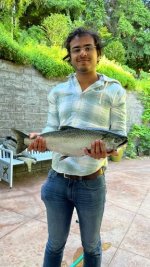
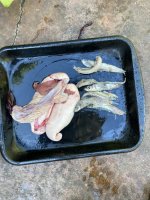
On a less depressing note. Here’s potentially my last king of the year. Smallish fish, 8lbs but his stomach was completely gorged. Looks like he was feeding on a mix of green label sized herring and extremely large sand lance.
 

Attachments

  • 3A14F9AB-D0CA-4D16-8243-0971F428D62D.jpeg
    3A14F9AB-D0CA-4D16-8243-0971F428D62D.jpeg
    757.5 KB · Views: 30
I'm not a scientist but reading the link and subsequent link within it. It sounds like VTR data is rarely if ever used to determine sub-legal encounters? Instead the ratio is determined by test fishing and applied to the fleet?

"In most cases we assume the test fishery data, when available, provides the best estimate (i.e.,least biased and most precise) of Chinook encounter rates in a mark-selective Chinook fishery.We make this assumption considering the training and experience of our WDFW scientific technicians who conduct the test fishery sampling (i.e., high level of salmon identification expertise and fishing skills), and considering our focused efforts to emulate the fishing patterns of the recreational fleet, both in terms of gear types used and sub-areas fished. However, in limited specific cases (e.g., WDFW 2010a) we may elect to use the VTR data in combination with test fishery data to increase the sample size of the Chinook encounters data set for use in fishery-impact estimation steps (Appendix B). In such cases we pool season-total VTR and test fishery data sets only if homogeneity tests (i.e., chi-square tests; significantly different if p>0.05)indicate that the two data sets were not statistically different (i.e., reject null hypothesis that the two data sets exhibit the same encounter rate proportions [LM, LU, SM, and SU) if p<0.05).Further, in limited cases, even when test fishery data are available, we may elect to use the VTR data rather than the test fishery data (e.g., Area 11 summer 2009 selective Chinook fishery;WDFW 2010e); i.e., if the test fishery sample size is low combined with significant differences between VTR and test fishery data sets."
My head hurts reading all this academic claptrap
 
I am new to the beach scene and thanks for the comment! I can tell you for certain this forum, you and all the other beach veterans and contributors have helped shorten my learning curve immeasurably. I've really enjoyed and learned from all the conversations, posts, pics, etc re beaches, currents, tides, lines, fly patterns, materials, methods etc, etc!

Really good stuff, it's been a fun journey so far and like everyone (I think) I sure hope it doesn't get shut down prematurely as I'd like to keep making some casts!
 
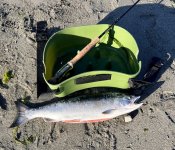
1-2 this morning during a two hour session before work. Pretty slow on the beach in general except a small 5 minute flurry right at daybreak where a few of us hooked up and/or missed fish simultaneously. 1 fish for the grill but good quality.

IMG_2939.jpeg

Another beautiful sunrise….

IMG_2940.jpeg

Did not bring the surfboard so called it a morning when a big cargo shipped rolled through….

IMG_2941.jpeg
 
1-2 this morning. Pretty slow on the beach in general except a small 5 minute flurry right at daybreak where a few of us hooked up and/or missed fish simultaneously. 1 fish for the grill but good quality.

View attachment 75906

Another beautiful sunrise….

View attachment 75905

Did not bring the surfboard so called it a morning when a big cargo shipped rolled through….

View attachment 75904

Those freighter waves can bone a beach pretty quickly.

Has anyone experienced any big waves coming in this year when no freighters go by? I’ve had it happen twice so far this year. Very odd, bigger waves just coming out of nowhere and it isn’t like I’m fishing the straits or something like that.
SF
 
Last edited:
Those freighter waves can bone a beach pretty quickly.

Has anyone experienced any big waves coming in this year when no freighters go by? I’ve had it happen twice so far this year. Very odd, bigger waves just coming out of nowhere and it isn’t like I’m fishing the straits or something like that.
SF
Pretty sure those waves were disappointed when I wasn't there :)
Regarding phantom waves, I got thoroughly hosed last year a couple times in one day. I was told from others that one occurrence was out of nowhere... A sub maybe?
 
Pretty sure those waves were disappointed when I wasn't there :)
Regarding phantom waves, I got thoroughly hosed last year a couple times in one day. I was told from others that one occurrence was out of nowhere... A sub maybe?

Yeah, it is odd. I always keep an eye out for freighters, as you know what will be happening after they pass. You can be fishing a beach for a few hours with no freighters passing by then big waves show up out of nowhere. I got douched earlier this year by a set of them that I wasn’t expecting.
SF
 
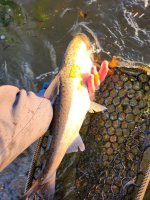
2 for 5 on pink salmon this morning at a MA9 beach that is very tricky for fly casting. Visited a second beach and had some resident coho follow the fly, but too much sun to commit.
 
Back
Top