Puget Sound

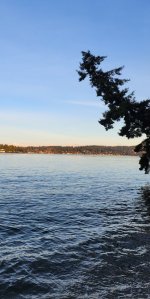
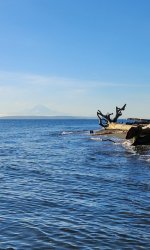
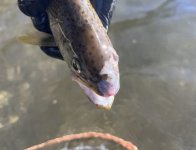
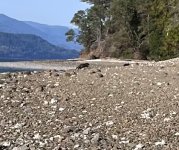
Hit the sound this morning. Windy as heck with gusts to 30+ where I was at. Had to time casts between the gusts. Fished a short line to try and keep things reasonable while attempting to not hook myself with the cross face wind. Two fish to hand, nothing great size wise. Called it a day at 10:00 as the water was getting filthy from the waves pounding the shore.
Like an idiot, I forgot daylight was an hour later with the time change, so sat in the car and listened to some tunes for an hour waiting for it to get light. 😂
Looks like some mid 60’s or better weather starting on Thursday.
SF
 
Hit the sound this morning. Windy as heck with gusts to 30+ where I was at. Had to time casts between the gusts. Fished a short line to try and keep things reasonable while attempting to not hook myself with the cross face wind. Two fish to hand, nothing great size wise. Called it a day at 10:00 as the water was getting filthy from the waves pounding the shore.
Like an idiot, I forgot daylight was an hour later with the time change, so sat in the car and listened to some tunes for an hour waiting for it to get light. 😂
Looks like some mid 60’s or better weather starting on Thursday.
SF
Stonefish listening to Time is on my side by the Stones :)
 
Something that is going to change my beach fishing game is (Very belatedly) realizing that slack time is very off the actual low or high tides. In the case of central Puget Sound, it's around 1.5-2 hours after high tide, not sure about the low tide.
 
Something that is going to change my beach fishing game is (Very belatedly) realizing that slack time is very off the actual low or high tides. In the case of central Puget Sound, it's around 1.5-2 hours after high tide, not sure about the low tide.
In my short time on the beach fishery I've wondered about this. In your experience is it consistently off or does it vary throughout the year?
 
In my short time on the beach fishery I've wondered about this. In your experience is it consistently off or does it vary throughout the year?
I am not sure because I didn't pay close enough attention, but I imagine it would vary. Think about it this way: A bigger tide exchange has more water, and probably has higher inertia that takes longer to stop. I bet a smaller tide exchange would take less time to reach slack, and a larger tide exchange more time to reach slack
 
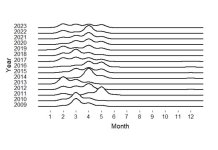
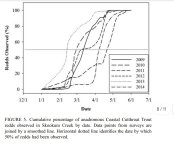
The CCC posted this regarding peak cutthroat spawning time (observed redds) by years. Pretty interesting data, with the peak being anywhere from Feb out to May.
SF

IMG_6730.jpeg
 
The CCC posted this regarding peak cutthroat spawning time (observed redds) by years. Pretty interesting data, with the peak being anywhere from Feb out to May.
SF

View attachment 106787
Cool! Would love to see this disaggregated by stream size. And would really like to know the story with 2011 - looks like a crazy outlier year.
 
Cool! Would love to see this disaggregated by stream size. And would really like to know the story with 2011 - looks like a crazy outlier year.

No doubt. I wonder what was key that year to cause such early spawning by the majority of the fish. Flows, water temps????
Just a quick google search shows air temps were above normal for the month that year, so maybe warmer water temps as well?
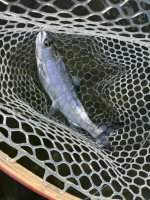
Cool fish for sure.
SF
 
Cool! Would love to see this disaggregated by stream size. And would really like to know the story with 2011 - looks like a crazy outlier year.
Still reading, but this data comes just from Skoomum Creek.

"The purpose of the present study was to document the spawn timing of anadromous Coastal Cutthroat Trout in a coastal tributary that is representative of the Puget Trough
Ecoregion (Landscope America 2014). We measured the morphology of Coastal Cutthroat Trout redds as well as the substrate and hydraulics at redd locations in Skookum Creek,
Washington. In addition, we quantified interannual variability in the timing of redd construction by Coastal Cutthroat Trout
in the creek during six spawning seasons (2008–2014), and weprovide several descriptive metrics from spawning sites to aid managers in distinguishing between the redds of Coastal Cutthroat Trout and the redds of sympatric fish species."
 
Still reading, but this data comes just from Skoomum Creek.

"The purpose of the present study was to document the spawn timing of anadromous Coastal Cutthroat Trout in a coastal tributary that is representative of the Puget Trough
Ecoregion (Landscope America 2014). We measured the morphology of Coastal Cutthroat Trout redds as well as the substrate and hydraulics at redd locations in Skookum Creek,
Washington. In addition, we quantified interannual variability in the timing of redd construction by Coastal Cutthroat Trout
in the creek during six spawning seasons (2008–2014), and weprovide several descriptive metrics from spawning sites to aid managers in distinguishing between the redds of Coastal Cutthroat Trout and the redds of sympatric fish species."
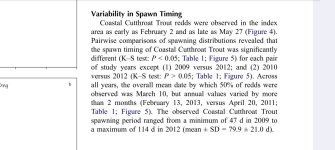
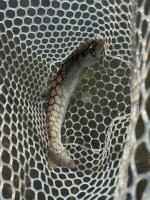
Shit...I may have misspoken earlier. I didn't find that figure in the article I linked, perhaps it's a different study and includes different data. A couple of things I did find interesting for the 2014 Skookum Creek study.Screenshot_2024-03-14-17-17-54-86_e2d5b3f32b79de1d45acd1fad96fbb0f.jpgScreenshot_2024-03-14-17-19-07-44_e2d5b3f32b79de1d45acd1fad96fbb0f~2.jpg
Spawning in 2011 didn't conclude until nearly June!
 
Gonna be a nice couple of days

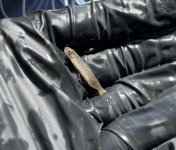
Awesome, time well spent. How hard was it to scoop up one of those little frys?
Not too easy, the schooled up pink fry and chum were easily spooked. This one was a Lone Ranger cruising the top column, and even after multiple failed scoops just kept slowly cruising along.

Something tells me that one’s genetics won’t last long 😁 I did find an empty joint tube so maybe it was one fried fry.
 
In my short time on the beach fishery I've wondered about this. In your experience is it consistently off or does it vary throughout the year?
I've played around a bit on this site: https://www.deepzoom.com/ It shows predicted current, you can compare it with a tide chart to see how long after high or low tide slack is.
Kayakers and sailboaters pay attention
 
I am not sure because I didn't pay close enough attention, but I imagine it would vary. Think about it this way: A bigger tide exchange has more water, and probably has higher inertia that takes longer to stop. I bet a smaller tide exchange would take less time to reach slack, and a larger tide exchange more time to reach slack
Slack is when I find myself a log to sit on, get out a snack, have some hot tea, and just watch for a bit; keeping an eye on flotsam and developing rips. I check my tippet & fly, maybe change flies... perhaps move to another area.
 
Back
Top