PART 1: Sharks, Stingrays, and Giant Trevally
I then fell into a contemplation of the secret springs of Providence, and how wonderfully we are delivered, when insensible of it; and when intricated in uncertain mazes or labyrinths of doubt or hesitation, what secret hint directs us in the right way, when we intended to go out of it, nay, perhaps contrary to our business, sense or inclination.
Daniel Defoe - Robinson Crusoe
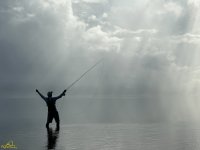
Providence - Easter 2023
Refreshing cool air seeped into the narrow passages of the Maya’s Dugong, and the ship’s roll rocked me steadily in my narrow bunk. Had a weather front moved in overnight? When my group of anglers arrived at Providence two days earlier, the four FlyCastaway guides were hung-over and feeling somber about the doldrums. “It’s been extremely hot guys without a puff of wind. The water on the flats has heated up and it’s put the flats fish down.” Our fortunes improved on this second morning. I felt the wind out on the deck, and banks of dark clouds pushing into the atoll dimmed the still spectacular Indian Ocean sunrise. The exchange today would be at maximum with the full moon, a classic big GT tide. Down in the galley area I bumped into laconic head guide Tim Babich who was also up early to grab the first batch of coffee. I would be fishing on his boat with my partners Bryan and Pam. “Finish your breakfast early today, I want to be the first boat out. I have a plan, but it’s going to be a bit of a gamble.”
We motored over the flats and scanned for congregations of mudding stingrays. “This time of year, we see big groups of stingrays coming onto the flats to feed. If we find them, there will be GT on them. Be ready.” Rays and sharks find hidden prey by detecting their weak bioelectric signals using a network of small sensory organs called the ampullae of Lorenzini. The giant trevally cleverly exploits the hunting strategy of certain stingray and shark species by closely following them, like a prospector behind a metal detector. Fish, crustaceans, and mollusks that escape a whiptail stingray or nurse shark are quickly devoured by the waiting trevally. It didn’t take long to find a large congregation feeding in the shallow turtle grass flat, puffing up a line of silty water. We waded towards them quietly, looking for GT dorsal and tail fins to break the surface and direct our casts. The stingrays were huge, the size of adult halibut. At one point they moved onto my position, and I was surrounded by four or five tall, slender tail whips raised up in alarm. I kept my feet still and made a cast over them to a group of GT bow waking on the edge of the mudline. My hookset and the GT’s panicked run spooked the stingrays, and the thick pectoral fin of one explosively pushed off my right leg in retreat. I would need to intentionally jump onto the back of a big stingray to provoke a strike from the poisonous barb, so I was not too nervous wading around them. We each landed modest sized GT, and I also caught a beautiful plump golden trevally from this group of rays before leaving them in peace. The FlyCastaway guides were very conscientious about limiting fishing pressure to prevent changing their natural behavior and feeding patterns.
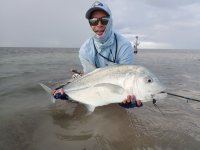
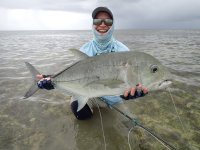
Giant trevally caught near mudding stingrays on the flats. Fins breaking the surface give away their location.
“That was the easy part. Now if you are all willing to take a risk, we can go up to the northern part of the atoll and look for the big boys in the channels up there.” We accepted Tim’s challenge, understanding that our options in that remote area would be slim if the fish were not in the expected location. We motored north a long distance until shallow turtle grass flats and coral heads halted us. Everyone got out of the boat and pushed it through acres of thick grass and sand holes. The water was warm as tea, but the thickening clouds and light rain kept us cool enough. I smiled thinking about Humphrey Bogart in the African Queen.
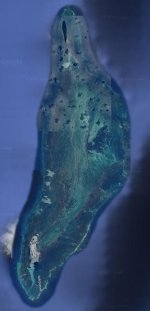
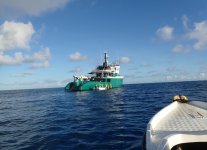
Providence atoll is a complex and underexplored ~200 square kilometer fly fishing paradise of islets, seagrass meadows, channels, coral reefs, and blue water drop offs. The only dry land is Providence Island in the north and several islands collectively called Cerf Island in the south. Small tender boats launched from the Maya’s Dugong mothership are the only way to effectively fish the atoll.
Providence is such a vast and featureless labyrinth of lagoons, channels, flats, and deep holes that we would never be able to find a specific location without GPS. Many years of fishing experience have filled the guide’s GPS database, but predicting how tidal movement, wind, and seasonal food sources will concentrate the gamefish is a black art. A detailed three-dimensional topography map of the atoll structure matched with accurate tidal predictions and wind data might give anglers a chance to predict fish movements. None of this information exists to my knowledge, and it would take some serious computer power to process it in real time.
We arrived at a set of deep channels decorated with tall coral heads, which were draining water on the falling tide from an unseen lagoon system. Clouds were thick, producing a harsh flat light on the water. Fish spotting would be a serious challenge, but the trevally would also not see us until they were very close. “Okay, we will be looking for large sharks with GT riding on their tails moving up and down this channel. The light is tough guys, so you will have to make quick casts once they appear.” No sooner had Tim finished his sentence when we simultaneously noticed a big brown nurse shark lazily moving toward the boat with what appeared to be several dark violet blobs behind it. Without thinking, I sent out a backhand cast onto the shark’s tail, and a furious boil set upon the black brush fly. I hooked a monster GT that swam past the boat before hitting the afterburners into my backing. “That fish is at least 130cm!” Tim dropped the motor and tried to start it up. I made sure my drag was maxed out and held on as the big GT swam up current into the channel and the hazardous coral heads. The motor wouldn’t start though, and I helplessly cringed as my line was ruthlessly flossed into the coral by this beast. Snap went the 80-pound gel-spun backing. We retied a doubled Bimini loop onto the backing and replaced the Airflo GT SuperDri fly line. I tied on my biggest black/purple brush fly using straight 130lb test leader and was ready again. This time I jumped into the water and waited at the edge of the channel just in front of the bow of the tender boat. Another big nurse shark appeared at close casting range swimming toward my knees. I hooked a bus GT of similar size and fury to the first. I climbed back into the boat and fought this fish hard as it powered its way upstream into the channel. Unfortunately, we stayed on anchor and didn’t chase it. My second fly line was mangled and snapped below the loop on a coral head. The trophy GT were ahead 2-0. We repaired the fly line loop and quickly replaced the leader and fly despite my shaking hands and adrenaline surge. After this inglorious start, I hooked into about seven other GT and landed each of them. It was a thrilling blur of casting and fish fighting as GT cruised the channel as singles or scattered groups on large lemon or nurse sharks. I hooked GT from inside the boat and while wading uncomfortably close to the sharky channel. There was hardly any time for rest or a drink of water before another GT came within casting range and we were hooked up again.
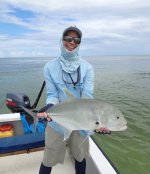
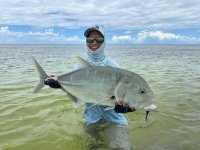
Most of the GT we caught were solid fish in the 80 – 95 cm size range. However, before the action ended, I redeemed myself and caught a big GT of 108 cm (~57 pounds). This was my first landed and measured GT bigger than one meter. Over the years I’ve lost several big meter-plus GT in a variety of circumstances and mishaps, and I was thrilled to finally pull it off at Providence. One of the stand-out moments of the day was when my partner Bryan was hooked into a nice ~90cm GT and Tim shouted that another big GT was sneaking up on me, heading for the backs of my knees. I quickly dropped my back cast, pivoted around into a crouch position, and watched this GT inhale my fly from close range on the first strip. After a great fight, Bryan and I landed our fish together for a GT double. It was an incredible day!
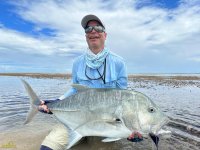
A thick wristed donkey GT measuring 108cm.
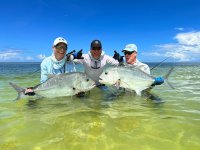
A GT double with head guide Tim Babich and excellent fishing partner Bryan.
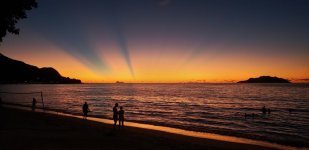
The morning of Easter Sunday I was up on deck early sorting out my fishing gear when the sunrise built into the most vivid and soft array of colors I’ve seen in many years. I couldn’t imagine any cathedral having a more striking illumination. Our guide for the day was Brendan, a professor of the Providence flats and contributor to The Mission fly fishing magazine. “You’re going to have to lose your Farquhar mentality DimeBrite. It is totally one dimensional there, Providence is vastly more complex and unexplored.” Brendan studied the massive aerial map of Providence each evening and was the most willing to show in detail where we had fished over the course of the day and why. Today he would be taking us deep into an interior lagoon system he had long been scouting that had previously never been fished. Much of Providence atoll has never been fished in fact.
The changing tide allowed us to gradually move from lagoon to lagoon as we identified low “passes” in the raised turtle grass covered fingers and ridges that segregated them. Reading the topography of the atoll helps to predict where to find the cooler moving water that attracts concentrations of fish. Each time we found a pass with some current, we cast our lines and found a wide range of species. In time, we reached a lagoon full of live coral heads and giant clams, the coral gardens. The violets, yellows, purples, and reds of the coral were spectacular. Blacktip sharks inquisitively swam up to the boat, but GT were few and scattered. Moving further into the next lagoon system, we found deep white sand flats and long causeways of turtle grass covered ridges we could wade and stalk. Brendan had me on the right side of edge on the lookout for GT. The water on my side was stagnant, with only a few small emperor fish darting out of cover as I passed. A few hundred meters in the distance, I saw what appeared to be a shallow pass over the turtle grass ridge. I labored to wade over to it quickly and bypass the dead water. Brendan called after me from a distance “Slow down!”, but my intuition was screaming that I needed to get up there. I approached a large shallow pond of crystal-clear water, and on its inside edge three sets of GT dorsal and tail fins were gliding along the turtle grass bank. With no time to move closer, I shot my best cast into the corner of the pond before they turned south for the narrow exit channel. The two closest GT surged onto the fly, and I hooked one in a spray of saltwater and grass. Unlike my other GT fights this one was stress free, because it was trapped inside the pond. Brendan caught up to me as I landed the 90cm GT and was howling with excitement from the shallow water eat. We were both stunned that such nice GT would still be swimming in such skinny water at that stage in the tide. My only GT of that day was one of the most memorable of the trip.
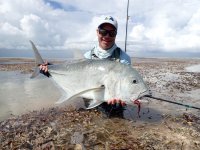
90cm GT caught while stalking shallow ponds and turtle grass channels.
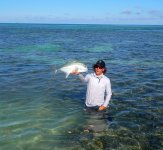
They are not all monsters. Guide Stu with a smaller ray-riding GT.
Up Next... The Other Fish and A Blue Water Surprise
I then fell into a contemplation of the secret springs of Providence, and how wonderfully we are delivered, when insensible of it; and when intricated in uncertain mazes or labyrinths of doubt or hesitation, what secret hint directs us in the right way, when we intended to go out of it, nay, perhaps contrary to our business, sense or inclination.
Daniel Defoe - Robinson Crusoe
Providence - Easter 2023
Refreshing cool air seeped into the narrow passages of the Maya’s Dugong, and the ship’s roll rocked me steadily in my narrow bunk. Had a weather front moved in overnight? When my group of anglers arrived at Providence two days earlier, the four FlyCastaway guides were hung-over and feeling somber about the doldrums. “It’s been extremely hot guys without a puff of wind. The water on the flats has heated up and it’s put the flats fish down.” Our fortunes improved on this second morning. I felt the wind out on the deck, and banks of dark clouds pushing into the atoll dimmed the still spectacular Indian Ocean sunrise. The exchange today would be at maximum with the full moon, a classic big GT tide. Down in the galley area I bumped into laconic head guide Tim Babich who was also up early to grab the first batch of coffee. I would be fishing on his boat with my partners Bryan and Pam. “Finish your breakfast early today, I want to be the first boat out. I have a plan, but it’s going to be a bit of a gamble.”
We motored over the flats and scanned for congregations of mudding stingrays. “This time of year, we see big groups of stingrays coming onto the flats to feed. If we find them, there will be GT on them. Be ready.” Rays and sharks find hidden prey by detecting their weak bioelectric signals using a network of small sensory organs called the ampullae of Lorenzini. The giant trevally cleverly exploits the hunting strategy of certain stingray and shark species by closely following them, like a prospector behind a metal detector. Fish, crustaceans, and mollusks that escape a whiptail stingray or nurse shark are quickly devoured by the waiting trevally. It didn’t take long to find a large congregation feeding in the shallow turtle grass flat, puffing up a line of silty water. We waded towards them quietly, looking for GT dorsal and tail fins to break the surface and direct our casts. The stingrays were huge, the size of adult halibut. At one point they moved onto my position, and I was surrounded by four or five tall, slender tail whips raised up in alarm. I kept my feet still and made a cast over them to a group of GT bow waking on the edge of the mudline. My hookset and the GT’s panicked run spooked the stingrays, and the thick pectoral fin of one explosively pushed off my right leg in retreat. I would need to intentionally jump onto the back of a big stingray to provoke a strike from the poisonous barb, so I was not too nervous wading around them. We each landed modest sized GT, and I also caught a beautiful plump golden trevally from this group of rays before leaving them in peace. The FlyCastaway guides were very conscientious about limiting fishing pressure to prevent changing their natural behavior and feeding patterns.
Giant trevally caught near mudding stingrays on the flats. Fins breaking the surface give away their location.
“That was the easy part. Now if you are all willing to take a risk, we can go up to the northern part of the atoll and look for the big boys in the channels up there.” We accepted Tim’s challenge, understanding that our options in that remote area would be slim if the fish were not in the expected location. We motored north a long distance until shallow turtle grass flats and coral heads halted us. Everyone got out of the boat and pushed it through acres of thick grass and sand holes. The water was warm as tea, but the thickening clouds and light rain kept us cool enough. I smiled thinking about Humphrey Bogart in the African Queen.
Providence atoll is a complex and underexplored ~200 square kilometer fly fishing paradise of islets, seagrass meadows, channels, coral reefs, and blue water drop offs. The only dry land is Providence Island in the north and several islands collectively called Cerf Island in the south. Small tender boats launched from the Maya’s Dugong mothership are the only way to effectively fish the atoll.
Providence is such a vast and featureless labyrinth of lagoons, channels, flats, and deep holes that we would never be able to find a specific location without GPS. Many years of fishing experience have filled the guide’s GPS database, but predicting how tidal movement, wind, and seasonal food sources will concentrate the gamefish is a black art. A detailed three-dimensional topography map of the atoll structure matched with accurate tidal predictions and wind data might give anglers a chance to predict fish movements. None of this information exists to my knowledge, and it would take some serious computer power to process it in real time.
We arrived at a set of deep channels decorated with tall coral heads, which were draining water on the falling tide from an unseen lagoon system. Clouds were thick, producing a harsh flat light on the water. Fish spotting would be a serious challenge, but the trevally would also not see us until they were very close. “Okay, we will be looking for large sharks with GT riding on their tails moving up and down this channel. The light is tough guys, so you will have to make quick casts once they appear.” No sooner had Tim finished his sentence when we simultaneously noticed a big brown nurse shark lazily moving toward the boat with what appeared to be several dark violet blobs behind it. Without thinking, I sent out a backhand cast onto the shark’s tail, and a furious boil set upon the black brush fly. I hooked a monster GT that swam past the boat before hitting the afterburners into my backing. “That fish is at least 130cm!” Tim dropped the motor and tried to start it up. I made sure my drag was maxed out and held on as the big GT swam up current into the channel and the hazardous coral heads. The motor wouldn’t start though, and I helplessly cringed as my line was ruthlessly flossed into the coral by this beast. Snap went the 80-pound gel-spun backing. We retied a doubled Bimini loop onto the backing and replaced the Airflo GT SuperDri fly line. I tied on my biggest black/purple brush fly using straight 130lb test leader and was ready again. This time I jumped into the water and waited at the edge of the channel just in front of the bow of the tender boat. Another big nurse shark appeared at close casting range swimming toward my knees. I hooked a bus GT of similar size and fury to the first. I climbed back into the boat and fought this fish hard as it powered its way upstream into the channel. Unfortunately, we stayed on anchor and didn’t chase it. My second fly line was mangled and snapped below the loop on a coral head. The trophy GT were ahead 2-0. We repaired the fly line loop and quickly replaced the leader and fly despite my shaking hands and adrenaline surge. After this inglorious start, I hooked into about seven other GT and landed each of them. It was a thrilling blur of casting and fish fighting as GT cruised the channel as singles or scattered groups on large lemon or nurse sharks. I hooked GT from inside the boat and while wading uncomfortably close to the sharky channel. There was hardly any time for rest or a drink of water before another GT came within casting range and we were hooked up again.
Most of the GT we caught were solid fish in the 80 – 95 cm size range. However, before the action ended, I redeemed myself and caught a big GT of 108 cm (~57 pounds). This was my first landed and measured GT bigger than one meter. Over the years I’ve lost several big meter-plus GT in a variety of circumstances and mishaps, and I was thrilled to finally pull it off at Providence. One of the stand-out moments of the day was when my partner Bryan was hooked into a nice ~90cm GT and Tim shouted that another big GT was sneaking up on me, heading for the backs of my knees. I quickly dropped my back cast, pivoted around into a crouch position, and watched this GT inhale my fly from close range on the first strip. After a great fight, Bryan and I landed our fish together for a GT double. It was an incredible day!
A thick wristed donkey GT measuring 108cm.
A GT double with head guide Tim Babich and excellent fishing partner Bryan.
The morning of Easter Sunday I was up on deck early sorting out my fishing gear when the sunrise built into the most vivid and soft array of colors I’ve seen in many years. I couldn’t imagine any cathedral having a more striking illumination. Our guide for the day was Brendan, a professor of the Providence flats and contributor to The Mission fly fishing magazine. “You’re going to have to lose your Farquhar mentality DimeBrite. It is totally one dimensional there, Providence is vastly more complex and unexplored.” Brendan studied the massive aerial map of Providence each evening and was the most willing to show in detail where we had fished over the course of the day and why. Today he would be taking us deep into an interior lagoon system he had long been scouting that had previously never been fished. Much of Providence atoll has never been fished in fact.
The changing tide allowed us to gradually move from lagoon to lagoon as we identified low “passes” in the raised turtle grass covered fingers and ridges that segregated them. Reading the topography of the atoll helps to predict where to find the cooler moving water that attracts concentrations of fish. Each time we found a pass with some current, we cast our lines and found a wide range of species. In time, we reached a lagoon full of live coral heads and giant clams, the coral gardens. The violets, yellows, purples, and reds of the coral were spectacular. Blacktip sharks inquisitively swam up to the boat, but GT were few and scattered. Moving further into the next lagoon system, we found deep white sand flats and long causeways of turtle grass covered ridges we could wade and stalk. Brendan had me on the right side of edge on the lookout for GT. The water on my side was stagnant, with only a few small emperor fish darting out of cover as I passed. A few hundred meters in the distance, I saw what appeared to be a shallow pass over the turtle grass ridge. I labored to wade over to it quickly and bypass the dead water. Brendan called after me from a distance “Slow down!”, but my intuition was screaming that I needed to get up there. I approached a large shallow pond of crystal-clear water, and on its inside edge three sets of GT dorsal and tail fins were gliding along the turtle grass bank. With no time to move closer, I shot my best cast into the corner of the pond before they turned south for the narrow exit channel. The two closest GT surged onto the fly, and I hooked one in a spray of saltwater and grass. Unlike my other GT fights this one was stress free, because it was trapped inside the pond. Brendan caught up to me as I landed the 90cm GT and was howling with excitement from the shallow water eat. We were both stunned that such nice GT would still be swimming in such skinny water at that stage in the tide. My only GT of that day was one of the most memorable of the trip.
90cm GT caught while stalking shallow ponds and turtle grass channels.
They are not all monsters. Guide Stu with a smaller ray-riding GT.
Up Next... The Other Fish and A Blue Water Surprise


 ?
?