I’m doing most of my fishing early in the morning these days in order to be off the water before the temps rise. What color of nymphs do you prefer in pre-sunup or heavy overcast conditions? Thanks!

Navigation
Install the app
How to install the app on iOS
Follow along with the video below to see how to install our site as a web app on your home screen.
Note: This feature may not be available in some browsers.
More options
Style variation
You are using an out of date browser. It may not display this or other websites correctly.
You should upgrade or use an alternative browser.
You should upgrade or use an alternative browser.
Nymphs, Light or Dark?
- Thread starter Hobbyranch
- Start date

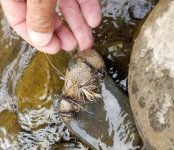
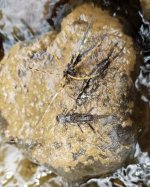
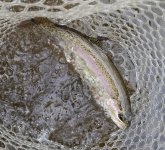
Whatever I see around, like these on this overcast morning. Rarely it is I don't see something, but if that's the case, it's a middle shade like the hare's ear.
Attachments
Last edited:

Rob Allen
Life of the Party
nymphs? I don't like catching whitefish..
kidding of course..
I was on the Arkansas last Saturday fishing a hopper dropper most of the fish ignored my nymph and took the hopper. but 2 fish did take the nymph it was a purple copper john.
Impressionistic is better than realistic. I suggest fishing a double nymph rig, one dark and one light and see how they perform..
kidding of course..
I was on the Arkansas last Saturday fishing a hopper dropper most of the fish ignored my nymph and took the hopper. but 2 fish did take the nymph it was a purple copper john.
Impressionistic is better than realistic. I suggest fishing a double nymph rig, one dark and one light and see how they perform..

my current fave all purpose nympha purple copper john.

Atherton Medium.

 thefeatherbender.com
Atherton Medium nymph
Atherton medium nymph. Although this nymph is approaching 70 years old, it's originator, Artist & illustrator John Atherton used a hot spot.
thefeatherbender.com

Creatch’r
Potential Spam
Start your day by flipping rocks in a riffle and let the creepy crawlers tell you what you should try. Even if you don’t know what you’re looking at you can get a general idea of shapes, sizes and colors and get a feel for what your fly should look like and will help you be more effective. Not everything the trout eat are under the stones or look the same while in an active hatch but it’s a solid start. A seine is another great tool for getting familiar with what is active and moving about and is something I so rarely see people doing. Being effective doesn’t mean having the perfect match and the most realistic pattern. But being in the ballpark certainly helps.


Start with one of each. This past week at one point in the stream the bottom was covered with cased caddis that were mostly black. A black hare's ear was close enough to get their interest in the bright sunlight.
Today fishing a light yellow soft hackle ahead of a green caddis pupa soft hackle produced fish on a cloudy day, the yellow soft hackle doing best. We have been stream fishing for 10 straight days and every day something different seems to be the hot ticket. Just keep experimenting until something works, there is no one size fits all solution.
Today fishing a light yellow soft hackle ahead of a green caddis pupa soft hackle produced fish on a cloudy day, the yellow soft hackle doing best. We have been stream fishing for 10 straight days and every day something different seems to be the hot ticket. Just keep experimenting until something works, there is no one size fits all solution.

Fully illustrates the dynamic nature of flyfishing! Ten days, same water, and new surprises everyday.Start with one of each. This past week at one point in the stream the bottom was covered with cased caddis that were mostly black. A black hare's ear was close enough to get their interest in the bright sunlight.
Today fishing a light yellow soft hackle ahead of a green caddis pupa soft hackle produced fish on a cloudy day, the yellow soft hackle doing best. We have been stream fishing for 10 straight days and every day something different seems to be the hot ticket. Just keep experimenting until something works, there is no one size fits all solution.

jaredoconnor
Peabrain Chub
In my experience, fish barely care about color. All my nymphs are medium brown, because it is a good catch-all.
I suggest learning how to tight-line, before worrying about color. It makes a much bigger difference; folks usually at least double their catch rate.
I suggest learning how to tight-line, before worrying about color. It makes a much bigger difference; folks usually at least double their catch rate.

tkww
Life of the Party
But that's just because they don't know how to indicator fish.I suggest learning how to tight-line, before worrying about color. It makes a much bigger difference; folks usually at least double their catch rate.
jaredoconnor
Peabrain Chub
But that's just because they don't know how to indicator fish.
Nope.
Most people who get into tight-lining spend many years fishing conventionally, beforehand. In my case, it was some 20 years.
You can't beat physics; fluid dynamics, specifically. Surface anchors are a major limitation, in many river nymphing scenarios. The only people that disagree are people who don't know what they're talking about.
Whether someone enjoys fishing that way, or whether it is optimal for where they live, are orthogonal matters.
In any case, you can still fish indicators on a tight-line system. That gives you some of the benefits of both. When you high-stick an indicator, with a 9ft 5wt, you basically are tight-lining, just really poorly.
Last edited:

One of the best!Atherton Medium.
Atherton Medium nymph
Atherton medium nymph. Although this nymph is approaching 70 years old, it's originator, Artist & illustrator John Atherton used a hot spot.
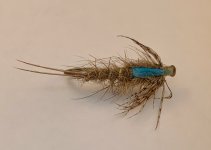 Here's one tied by Buzz Buzek in the 60's.
Jack Devlin
Life of the Party
I'd turn over a few rocks and see what was there and pick a fly to match.

For the most part I agree with Rob's statement that impressionistic is better than realistic. In my experience a lot of the best nymphs imitate multiple different things.
Maybe this is obvious but I'm gunna say it anyway. The exception is if there is actually a hatch going on. Even if it is a small hatch, if you see bugs coming off, that's a good place to start.
I've had a fair amount of experiences where I do quite well fishing a fly that I know they have seen recently, even if there are none currently on the water. If I know they've seen a bunch of mayfly's recently, I may put one on.
Maybe this is obvious but I'm gunna say it anyway. The exception is if there is actually a hatch going on. Even if it is a small hatch, if you see bugs coming off, that's a good place to start.
I've had a fair amount of experiences where I do quite well fishing a fly that I know they have seen recently, even if there are none currently on the water. If I know they've seen a bunch of mayfly's recently, I may put one on.