Nooksack raft flip

I like everything you said until the last sentence. Even if true, going out without a fight is not something I intend to do or encourage.

I’m sure your experiences have driven strong reasoning but I can’t help say, the game for me will have just begun. Which I also think might correlate with the differences in where we stand in taking on a whitewater trip currently in our lives.
The fight is a given. And lasts about 40 seconds in frigid water.
 
Last edited:
Sorry for the topic but good thread. I've had my adventure, and someone I know went through one recently. Mine was wading, and I had practiced in my waders with others beforehand, and got out. He was in a new to him pontoon, fortunately he had help. I guess my point is we should practice in a safe environment to be prepared and somewhat familiar with what it feels like, and what your true abilities are, to have a better shot if things go wrong.
 
Years ago I took a white water trip down the upper Skagit that had an emphasis on survival techniques in cold white water. The guides told everyone in the group they would be getting wet. What they didn’t say was they were going to get you wet when you least expected it. I kinda figured out their MO early on. I was the last to be sent out of the raft and it was a total surprise. I think they planned my dunking to be especially sudden. Nothing has been a more eye opening experience to the dangers of cold water immersion than what happened to me that day. Thank god I was surrounded by professionals that knew what they were doing for if what happened had happened when I was alone I would surely have drowned. I learned more about survival in cold water in that four or five hour float then in my entire life prior and I had been around water and boats most of my life. If available to you take a cold water survival course. It very well could save a life.
 
Theres nothing like being Maytaged in a big hydraulic...noisy as hell, bubbles going every direction, banging off rocks...no sense of up or down.
My whitewater kayak days, while short in duration, were very insightful as to how quickly sh!t goes south.
 
This is generally given as advice to raft customers to prevent foot entrapment. Like Jay I've been kayaking for almost three decades and two of those decades in class five plus water. There is rules and sometimes rules need to be broken. Knowing when to get to shore and when to stay in the flow is an instinct and art built through time in. Always sad to hear about someone passing in a river. It's such a sacred place that makes you feel free. It's a shame when it sets one free from their early vessel.
If there's anything that you think that I missed, under-or-over emphasized, or that'd be useful to fisherfolks in a more likely scenario I hope you'll chime in.

The only thing I can think of is that it's hard to overstate how much worse having waders filled with even a few liters of water can make any swim in moving water. One of the more stunning fatalities in my peer group came about when the guy that everyone felt safer paddling with due to his skill, experience, and granular knowledge of the local runs wound-up flush drowning in a drop he'd run dozens and dozens of times before when the legs of his dry pants (he was wearing a dry-pant/dry-top combo) rapidly filled with water when he was getting recirculated in a hydraulic, and if overwhelmed the bouyancy of his PFD. All this despite the fact that there were two full-tilt Class V boaters on the scene trying to effect a rescue.

The odds that anything other than a full-bore drysuit will keep water out if someone's getting trashed in a nasty hole are pretty low, but one step I've taken in the wake of hearing many stories about water-filled waders/pants, etc is wear a drytop over my waders if I'm on a float where the temps/gradient/etc are considerable enough to warrant that (rare).

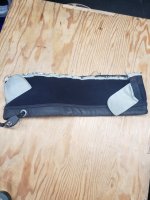
If I think there's a reasonable chance that I might be doing some heavy wading, I bring along a beefed up wading-belt out of a waist-gasket that I cut off of an old drtyop (Pic below), and jf conditions warrant it I pull it up and secure it near the tops of my waders. It won't keep all of the water out either, but I've tested it out vs the standard issue waist-belt and it dramatically reduces the amount of water intrusion if you go full immersion.

Probably not something many people would want or need, but it's worked for me.

 
If I bring the old neoprene waist-gasket I just keep it around my waist over my normal wading belt, and if it looks like I'll encounter conditions that warrant it, I'll take a few seconds to pull it up to just-under-armpit level and secure it in place. Once I've "activated" the gasket I tend to leave it in place until I'm coming off the water.
 
If there's anything that you think that I missed, under-or-over emphasized, or that'd be useful to fisherfolks in a more likely scenario I hope you'll chime in.

The only thing I can think of is that it's hard to overstate how much worse having waders filled with even a few liters of water can make any swim in moving water. One of the more stunning fatalities in my peer group came about when the guy that everyone felt safer paddling with due to his skill, experience, and granular knowledge of the local runs wound-up flush drowning in a drop he'd run dozens and dozens of times before when the legs of his dry pants (he was wearing a dry-pant/dry-top combo) rapidly filled with water when he was getting recirculated in a hydraulic, and if overwhelmed the bouyancy of his PFD. All this despite the fact that there were two full-tilt Class V boaters on the scene trying to effect a rescue.

The odds that anything other than a full-bore drysuit will keep water out if someone's getting trashed in a nasty hole are pretty low, but one step I've taken in the wake of hearing many stories about water-filled waders/pants, etc is wear a drytop over my waders if I'm on a float where the temps/gradient/etc are considerable enough to warrant that (rare).

If I think there's a reasonable chance that I might be doing some heavy wading, I bring along a beefed up wading-belt out of a waist-gasket that I cut off of an old drtyop (Pic below), and jf conditions warrant it I pull it up and secure it near the tops of my waders. It won't keep all of the water out either, but I've tested it out vs the standard issue waist-belt and it dramatically reduces the amount of water intrusion if you go full immersion.

Probably not something many people would want or need, but it's worked for me.

I think you're covering it all really well. I really like the gasket idea. Solid garage engineering there. Probably would buy a guy a little time if the bad action happens in waders.
 
Thanks for the lesson JayB.

The N. Fork is a tricky river. It is in a constant state of change. It is narrow at points and it always runs fast.
 
If there's anything that you think that I missed, under-or-over emphasized, or that'd be useful to fisherfolks in a more likely scenario I hope you'll chime in.

The only thing I can think of is that it's hard to overstate how much worse having waders filled with even a few liters of water can make any swim in moving water. One of the more stunning fatalities in my peer group came about when the guy that everyone felt safer paddling with due to his skill, experience, and granular knowledge of the local runs wound-up flush drowning in a drop he'd run dozens and dozens of times before when the legs of his dry pants (he was wearing a dry-pant/dry-top combo) rapidly filled with water when he was getting recirculated in a hydraulic, and if overwhelmed the bouyancy of his PFD. All this despite the fact that there were two full-tilt Class V boaters on the scene trying to effect a rescue.

The odds that anything other than a full-bore drysuit will keep water out if someone's getting trashed in a nasty hole are pretty low, but one step I've taken in the wake of hearing many stories about water-filled waders/pants, etc is wear a drytop over my waders if I'm on a float where the temps/gradient/etc are considerable enough to warrant that (rare).

If I think there's a reasonable chance that I might be doing some heavy wading, I bring along a beefed up wading-belt out of a waist-gasket that I cut off of an old drtyop (Pic below), and jf conditions warrant it I pull it up and secure it near the tops of my waders. It won't keep all of the water out either, but I've tested it out vs the standard issue waist-belt and it dramatically reduces the amount of water intrusion if you go full immersion.

Probably not something many people would want or need, but it's worked for me.
Don't dry top over your waders if you can help it.. that false sense of security almost killed me at Hoodsport about 12 years ago. I had a dry top , a wading belt, and a set of neoprenes and the combo didn't work. Waders filled up fast. Took several other people to help me get up and i couldnt walk unassisted because of the weight. (carry a cheap sharp knife to cut yourself out of them so you can swim if you have to)

Yes do use a double belt system, they work really well. After that incident, i tossed the "belt" that came with my waders and bought two much wider ones that give better sealing coverage
 
Back
Top