Hit Martha again bloom in full swing, it was moving around ? Is it turning, not heard of this till this spring. Anyway I went 2 for 3 on my cronimids. Happy times, 14" on the nose.

Navigation
Install the app
How to install the app on iOS
Follow along with the video below to see how to install our site as a web app on your home screen.
Note: This feature may not be available in some browsers.
More options
Style variation
You are using an out of date browser. It may not display this or other websites correctly.
You should upgrade or use an alternative browser.
You should upgrade or use an alternative browser.
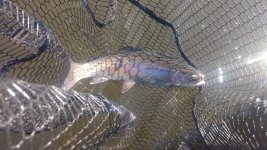

I remember your favorite game was the "Trifecta" one of each in a single outing at MarthaI've caught them in the past, but that was quite a long time ago. They were very tough to find and catch. And they were never interested in any of the flies that worked on the RBs and BTs. My best there was 16". I haven't checked the recent plantings, so can't speak to matters of holdovers and such.
 Most of the cutts were long and skinny compared to the other 2.
True that! But much harder to do these days: I no longer have Rhode Island Red hens to tie flies from.I remember your favorite game was the "Trifecta" one of each in a single outing at Martha
T
Tombraider
Guest
T
Tombraider
Guest
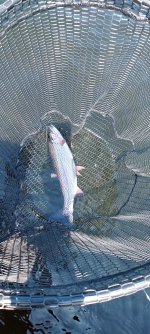
Was an older guy again I've seen before. He left before me. Was a net on bank I think he forgot. I have it and would like to return if you know him. Drives a white Ford pickup.
T
Tombraider
Guest
Been to the lake twice looking for new owner, thought today I found him, Nope. Had fish, I asked if he was catching any keeper size fish ? Ahhhh, I think so, showed me, Nope. Kept my trap shut. I give up on these folks. Won't be back till it cools off.
It’s my thought that, in the same way certain tactics work better for Brown trout, versus Rainbows, likewise applies to cutthroats. I’ve read that cutts can be easily spooked. Adjusting flies and presentation to address that might yield better results.
Martha has experienced quite a number of changes since the first couple of years I fished there. The most obvious thing is how bass have taken over a lot of the habitat the brown trout used to occupy in the Spring, especially late Spring. During that same time, the perch show up in the shallower zones where rainbows were common. This has always been the case with the perch. However, the bass have really come on strong over the past couple of years.
All together, I can’t help but wonder if the increase in bottom weeds, like milfoil and other plants, have favored the spiny ray fish. I really feel this has changed the fish habitats enough that trout are no longer remaining so much in the areas I used to easily find them. It was like I could just point to spots and know I could find a trout there. Not so much anymore. It feels like a displacement has happened.
Martha has experienced quite a number of changes since the first couple of years I fished there. The most obvious thing is how bass have taken over a lot of the habitat the brown trout used to occupy in the Spring, especially late Spring. During that same time, the perch show up in the shallower zones where rainbows were common. This has always been the case with the perch. However, the bass have really come on strong over the past couple of years.
All together, I can’t help but wonder if the increase in bottom weeds, like milfoil and other plants, have favored the spiny ray fish. I really feel this has changed the fish habitats enough that trout are no longer remaining so much in the areas I used to easily find them. It was like I could just point to spots and know I could find a trout there. Not so much anymore. It feels like a displacement has happened.

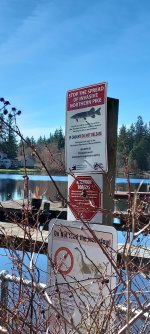

I wonder if WDFW has some intel or the signs are going up everywhere as a precaution?Took a look, what's this ?

I'm going to assume it's because of this-

 www.spokesman.com
Washington releases northern pike response plan
Washington fisheries officials have drafted a plan that lines out how they’ll respond if northern pike invade more waterbodies in the state.
www.spokesman.com

Uptonogood
PNW raised
interesting, I don’t know of a waterway that connects Washington waters with native northern pike population. Therefore, a “bucket biologist” must have said to him or herself, “Self, big northern pike would be a great addition to this lake, river, pond. I think I’ll put some in. We love them in Michigan, Montana, Wisconsin…”.
Such incredible stupidity. There in lies the introduction of lake trout into Yellowstone National Park waters and others.
Such incredible stupidity. There in lies the introduction of lake trout into Yellowstone National Park waters and others.

Time to get a pair of kevlar waders for float tubing!Took a look, what's this ?
Yep. People are dumb.interesting, I don’t know of a waterway that connects Washington waters with native northern pike population. Therefore, a “bucket biologist” must have said to him or herself, “Self, big northern pike would be a great addition to this lake, river, pond. I think I’ll put some in. We love them in Michigan, Montana, Wisconsin…”.
Such incredible stupidity. There in lies the introduction of lake trout into Yellowstone National Park waters and others.
Now, locally, birds can spread species as well. For example, a gull, heron or osprey picks up a pike in the Columbia above Grand Coulee and then drops it on the other side. If that little dude survives, now we have at least 1 pike in that part of the river. If he gets really lucky and a couple females get dropped as well, then we have little pike families.
And then the same thing happens below Wells dam. So then we would have pike in an anadromous salmon & steelhead system. Do they eat more baby salmon & steelhead than our native pike minnow? Or the introduced walleye, bass and carp?
Alaska has the same problem. Interesting info from the article below-
Pike are very tough critters. Under the right conditions, pike can live up to 13 hours out of the water, and can survive even torn gills. Pike can travel 50 miles or more in search of new food sources.
Here's the article from 2004- https://www.adfg.alaska.gov/index.cfm?adfg=wildlifenews.view_article&articles_id=50
Here's one from 2014- https://www.fishsens.com/invasive-p...once-thriving-alaskan-chinook-salmon-fishery/
Uptonogood
PNW raised
I haven’t seen documentation of birds introducing non native fish, particularly predators like pike. I someone has one, please,post it.Yep. People are dumb.
Now, locally, birds can spread species as well. For example, a gull, heron or osprey picks up a pike in the Columbia above Grand Coulee and then drops it on the other side. If that little dude survives, now we have at least 1 pike in that part of the river. If he gets really lucky and a couple females get dropped as well, then we have little pike families.
And then the same thing happens below Wells dam. So then we would have pike in an anadromous salmon & steelhead system. Do they eat more baby salmon & steelhead than our native pike minnow? Or the introduced walleye, bass and carp?
Alaska has the same problem. Interesting info from the article below-
Pike are very tough critters. Under the right conditions, pike can live up to 13 hours out of the water, and can survive even torn gills. Pike can travel 50 miles or more in search of new food sources.
Here's the article from 2004- https://www.adfg.alaska.gov/index.cfm?adfg=wildlifenews.view_article&articles_id=50
Here's one from 2014- https://www.fishsens.com/invasive-p...once-thriving-alaskan-chinook-salmon-fishery/
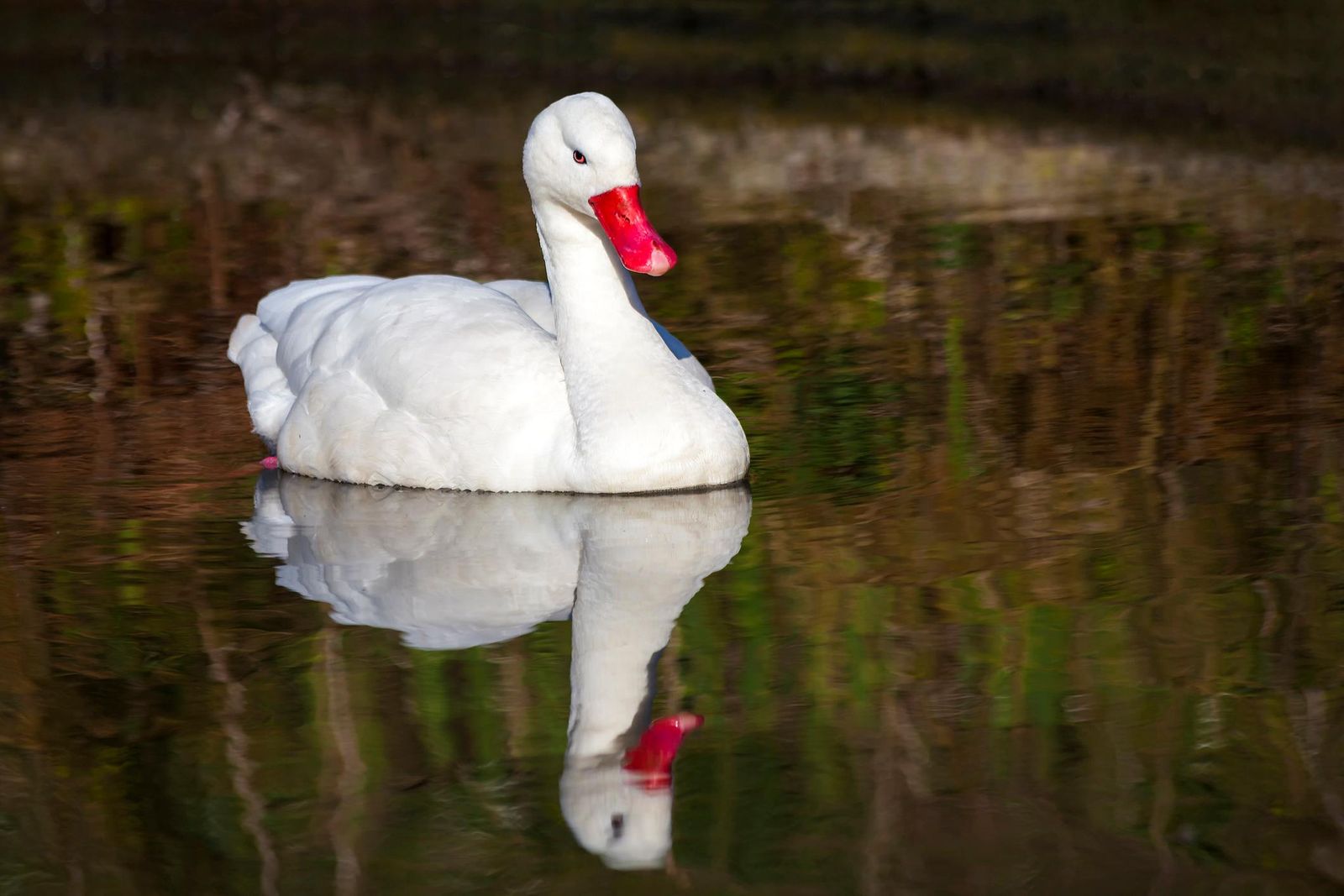
A Swan Swallowed This Fish Egg, Pooped It Out—and Then 49 Days Later, It Hatched
The new study is one of the first to demonstrate fish egg dispersal via avian fecal matter
 www.smithsonianmag.com

Fish eggs can hatch after being eaten and pooped out by ducks
In the lab, a few carp eggs survived and even hatched after being pooped out by ducks. The finding may help explain how fish reach isolated waterways.
 www.sciencenews.org
And this is just the poop it out theory.
Not sure if anyone has studied it but I've personally watched osprey on the Columbia drop multiple shad, bass and panfish.
How thick is Wells Dam? An osprey or eagle can cover that distance in just a few seconds.
I've read a few articles that say most wildlife scientists are so confident in the theory that it doesn't need studied. That's not always a good thing, but usually a sign that the odds are in the favor.
Took a look, what's this ?
Could. It. Be. Time. For. A. Northern Pike. Clave?
Aggression
The northern pike is a relatively aggressive species, especially with regard to feeding. For example, when food sources are scarce, cannibalism develops, starting around five weeks in a small percentage of populations.[16] This cannibalism occurs when the ratio of predator to prey is two to one.[16] One can expect this because when food is scarce, Northern pike fight for survival, such as turning on smaller pike to feed; this is seen in other species such as tiger salamanders. Usually, pike tend to feed on smaller fish, such as the banded killifish. However, when pike exceed 700 mm (28 in) long, they feed on larger fish.[17]Because of cannibalism when food is short, pike suffer a fairly high young mortality rate.[18] Cannibalism is more prevalent in cool summers, as the upcoming pike have slow growth rates in that season and might not be able to reach a size to deter the larger pike. Cannibalism is likely to arise in low growth and low food conditions.[18] Pike do not discriminate siblings well,[citation needed] so cannibalism between siblings is likely.
Aggression also arises from a need for space.[19] Young pike tend to have their food stolen by larger pike.[19] Pike are aggressive if not given enough space because they are territorial.[20] They use a form of foraging known as ambush foraging. Unlike species such as perch, pike undergo bursts of energy instead of actively chasing down prey. As such, a fair amount of inactive time occurs until they find prey. Hunting efficiency decreases with competition;[20] the larger the pike, the larger the area controlled by that particular pike. An inverse relation to vegetation density and pike size exists, which is due to the possibility of cannibalism from the largest pike.[21] This makes sense, as the smaller pike need more vegetation to avoid being eaten. Large pike do not have this worry and can afford the luxury of a large line of sight. They prefer a tree structure habitat.[21]
There has been at least one instance of a pike attacking a dog.[22]
Pike are occasionally preyed upon by otters.[23]
Physical behavioural traits
Pike are capable of "fast start" movements, which are sudden high-energy bursts of unsteady swimming.[24] Many other fish exhibit this movement as well. Most fish use this mechanism to avoid life-threatening situations. For the pike, however, it is a tool used to capture prey from their sedentary positions. They flash out in such bursts and capture their prey. These fast starts terminate when the pike has reached maximum velocity.[24] During such motions, pike make "S" conformations while swimming at high rates. To decelerate, they, simply make a "C" conformation, exponentially slowing down their speed so that they can "stop".[24] An interesting behavioural trait that pike have is that they have short digestion times and long feeding periods.[17] They can undergo many of these fast bursts to collect as much prey as they can. Pike are least active during the night.[20]
Last edited:
No new sign at shoecraft. Some jack ass dumped loads of crap in the parking area and in woods. I reported it to wdfw. There on the hook, not the tribe to clean it up. Sad, last yr cars and crap.
Cheers to WDFW, that garbage is cleaned up.
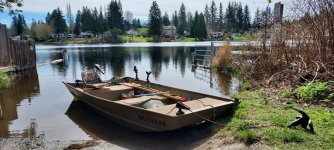
Had high hopes today, dood came in on paddle board and fly rod, got few on streamers. Had one bobber down popped off. Seen some lips here n there. Small black bugs ? Moved and my battery died ? Old, wind was tough so rapped it up. Costco for a new battery.
Attachments
Last edited:


Mike Bacca
Steelhead
But Martha!