
NFR Let's talk about generators

Non-fishing related

Evan B

Bobber Downey Jr.
Staff member
Admin
My wife and I have hemmed and hawed about getting a backup generator since we got this house in 2017. We live just west of the end of the Columbia River Gorge, and wind+ice can be quite an issue here in the winter.

We've procrastinated because really, we've only lost power for more than a few hours twice now. But both times were pretty rough. Had it not been so cold during this last ice storm event in early 2024 where we lost power for 4 days, I would have lost a significant pile of salmon, halibut and albacore meat. So it's starting to seem like we should get on this before we experience any true hardships.


SKIP TO HERE IF YOU DON'T CARE ABOUT MY LIFE OR MOTIVATIONS


After a bit of research, I'm having a hard time justifying spending more money on a Honda because these Harbor Freight Predators seem to be plenty adequate as backup power. Briggs & Stratton motors, twice as much juice for the money, and seem well reviewed.


I think that one should be enough for keeping a couple freezers cold and powering some home basics. We have a natural gas furnace, so I don't think heating should be much of an issue. But am happy to hear from people here smarter than me.

As far as hooking it in to my home power, is an interlock kit the way to go? I'd obviously get an electrician to do this part, but am just trying to get an idea for budge now.

GenCap Generator Interlock Kit Compatible with Square D QO or Homeline 150 and 200 AMP Panels, for Safe Usage of Portable Power During Outage, for Emergency in Snowstorm Thunderstorm Weather https://a.co/d/75vBzfN
 
Last edited:
As far as I know, Honda generators are more expensive than other brands. I bought one anyway because of their reputation for dependability, and they are quiet. I value quiet quite a lot. I have only a 3,000 watt model. It won't run the whole house, but it is enough for the refrigerator, freezer, a few lights and outlets, and importantly, the fireplace fan. (My fireplace is a Fireplace Extraordinaire that requires the fan to put out the heat.) The unhandy thing is that I store it in the garage on a dolly. So I have to wheel it out into the breezeway and plug it into the main electrical panel interlock I had installed. It could have electric start, but one pull on the starter cord and it powers up. Runs a very long time on 3 gallons of gas that I treat with Stabil.
 
Generac Guardian 24k w/ transfer switch.
Runs off propane or natural gas.
Runs the whole place easily.
They seem to last forever, and being on a well, septic, with freezers etc. it just makes sense.
Power goes out, generator comes on...worth it out in the areas where power goes south frequently.

Smaller sized models for just a few circuits on your panel, another option.
 
I too, own a Honda generator, for use with our RV and as a house backup power source. I totally agree with Salmo-g comments. Dependability and quietness were my main justification for the added expense. Mine is going on 12 years old, with no maintenance issues, and also starts on the first pull.
 
Honda....they're worth the money, last longer, and have 'cleaner power'. Our house came with a 6500, we brought a basically new 7000 with us, as well as a pair of 2000's that can be synched together to make a 4000. The problem with any of these type of generator is that you need to be there to fire them up...we went to Hawai'i for our anniversary for 8 days, the day after we arrived we lost power for 8 days. Came home to a large reefer/ freezer and a large freezer full of destroyed foods, much of it prepared - lasagna, pot pies, chili, chicken soup, homegrown homemade spaghetti sauce, fruit pies, chile verde, gumbo, fish & meat. Wife was not happy.
So we now have a 32000 kWh Generac that we bought at Costco....getting an electrician to come out to the island to hook it and a transfer switch up was a pain, and cost as much as the Generac. And it's still not perfect. If we are gone long term, we have no way of turning it on or off, it will run until it drains the dedicated 500 gallon propane tank or the power comes back on. If we are home, no problem. The bigger Hondas will soon go on craigslist, we'll keep the two 2000's to run our Fireplace Extrodinaire when we shut down the Generac.
 
I've heard pretty good things about those HF ones for what they are. For a "not gonna need it all that often and if we do, we won't die if it doesn't work", they'll probably be fine. But HF is what it is. Honda probably stands behind their stuff better.
 
A big problem for generators (small ones, anyway) is an electric hot water tank. Those puppies draw some power and will require a larger generator if you plan on powering one with the generator. Size accordingly. You mentioned you have a gas furnace. If you also have gas hot water, you'll still have those luxurios showers.

Regarding your gas furnace, most are hardwired. There are ways to "un-hardwire" your furnace to use a 120V outlet and appliance cord if you don't use the interlock.. I would get the interlock, otherwise it gets to be extension cord city. As flyfishers, at least we're adept at handling tangles.

Also, be sure to consider your sepic and well pumps if you have them. Finally, test the generator before the weather arrives.

Our power goes out when a moth farts, even though we live in town. The more you have to deal with it, the more creative you get.
 
since you already have natural gas, would strongly recommend getting a genset that can operate on NG, which would more than pay itself off going forward with reduced operating costs, reliability and zero time spent purchasing and filling fuel. If reasonably handy, running galvanized gas pipe is usually at most a weekend job. ,
A hard piped NG generator wired to a transfer interlock makes transferring power a simple matter of 'flicking a switch', makes worrying about length of power outages and required fuel refills a non-issue, and also improves the value of your house as a hard piped NG genset become a value plus feature.
 
Timely thread. We've never really worried, even though we spent several days in the RV one year, but now that mom is with us a gas generator for the whole house sounds interesting. I've done some research but always like to hear what real people whose opinions I value are doing.
 
Problem with natural gas is, if the grid goes down including pipeline pumping stations then no pressure. It does happen in a bad enough event. My wife works for a utility company.
I never thought about it being possible until it actually happened.
 
I've a portable 10KW generator. If you go this route, here's some tips.
Get 10 gallons of gas and have at least 5 on hand all winter. That'll give you power while you go get more gas.
Change the oil and filter after every use. Drain the gas and the carb out as well.
Go to Harbor Freight and get solid tires. 200 lb. generators don't push so good in the rain and dark with flat tires.
Have a electrician wire in a transfer panel. Hook up those circuits you must have. For me that's my well, freezer and a few lights. I added in my furnace after I converted to gas a few years ago, so now we've heat, too. Mine is a generac, I bought it used from a hurricane refugee, paid about 30 cents on the dollar for it. It's loud, and uses about 9 gallons of gas per day.

If it was me, I'd get the harbor freight model and put the rest of my money into a transfer switch and extension cord.

The instant-on ones are very nice, but spendy, and yeah, my neighbor just found a great deal on one at a local large big box warehouse retailer but that great deal is now sitting unconnected until he finds someone who will install it. Lots of heating/cooling contractors are advertising equip/install packages right now, I wonder what would be the most economical. Also, there are locational standards for that equipment, setbacks to doors, windows, clearance for walls, etc., etc., so find out about those if you were unaware. I've no real good spot for one.
 
losing NG is a very rare event, as the distribution center compressor pumps are backed up by diesel generators, so it would take a cascade event to lose NG pressure (spent decades managing facilities that included hospitals and data centers with extensive genset arrays.)
As it is, the smaller gensets are available as tri-power (NG, propane and gas) for pretty much the same cost.
 
And, what about solar panels and a big ass battery? Lowers your electricity cost every day, lasts no matter how long the outage, of use to neighbors with no power, and pretty expensive up front.
I'm talking about spending like $1500 on a generator. Spending 10-20x that to have solar with battery backup is waaaaay beyond what I can swing for.

I am looking at a tri fuel model. Just need to see what it'd take to get a NG hookup in a spot I could use in case I go that route.
 
losing NG is a very rare event, as the distribution center compressor pumps are backed up by diesel generators, so it would take a cascade event to lose NG pressure (spent decades managing facilities that included hospitals and data centers with extensive genset arrays.)
As it is, the smaller gensets are available as tri-power (NG, propane and gas) for pretty much the same cost.

Would an earthquake event take out the natural gas network for an extended time?
 
This is a timely thread I've been considering the same thing. The problem with my property is the well pump has its own electrical service that I share with my neighbor, so if I want power in the house AND water I'd need 2 generators 😞. Not sure there is any other solution for that.
 
Would an earthquake event take out the natural gas network for an extended time?
Likely, as well as power, water, roads, bridges, and obviously gas stations, which don't have gensets to run the pumps with the grid down.
Emergency planning always comes down to preparing for the most likely events per location. And if earthquakes could be in play, the best preparation would be having the stem wall of your house bolted/strapped to the foundation.
 
I've a portable 10KW generator. If you go this route, here's some tips.
Get 10 gallons of gas and have at least 5 on hand all winter. That'll give you power while you go get more gas.
Change the oil and filter after every use. Drain the gas and the carb out as well.
Go to Harbor Freight and get solid tires. 200 lb. generators don't push so good in the rain and dark with flat tires.
Have a electrician wire in a transfer panel. Hook up those circuits you must have. For me that's my well, freezer and a few lights. I added in my furnace after I converted to gas a few years ago, so now we've heat, too. Mine is a generac, I bought it used from a hurricane refugee, paid about 30 cents on the dollar for it. It's loud, and uses about 9 gallons of gas per day.

If it was me, I'd get the harbor freight model and put the rest of my money into a transfer switch and extension cord.

The instant-on ones are very nice, but spendy, and yeah, my neighbor just found a great deal on one at a local large big box warehouse retailer but that great deal is now sitting unconnected until he finds someone who will install it. Lots of heating/cooling contractors are advertising equip/install packages right now, I wonder what would be the most economical. Also, there are locational standards for that equipment, setbacks to doors, windows, clearance for walls, etc., etc., so find out about those if you were unaware. I've no real good spot for one.
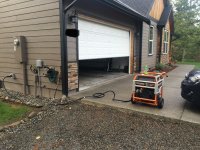
This is exactly the set up we have, General XG10000E, and a separate sub panel with essential circuits like the well pump, hot water tank, septic pump and a lot of outlets.

25ft monster cable to connect the Generator to the side of the house, then flip the Frankenstein switch from PSE to generator when the power is out.

It works well but still doesn’t power everything, like the garage outlets. There was only so much room in the 50 amp sub panel so I had to choose carefully which circuits to move over. And it obviously can’t run the heat pump/furnace. So it still gets cold in the house and we huddle next to the propane fireplace.

I’ve considered a whole house generator but would probably need a 32kW unit to run it all.
IMG_0606.jpeg
 
Last edited:
One other thing to be aware of is the cheaper generators like Harbor Freight are not going to have as “clean” a sine wave of power, it’s more like a saw tooth pattern. Which works fine for most applications but can cause newer arc-fault breakers to trip. Our house is newer and has those arc fault breakers and when we’re on generator power they are more prone to tripping when I use a higher current device like a coffee maker or microwave in the kitchen. I bet the Honda generators have a cleaner output.
 
Back
Top