
Navigation
Install the app
How to install the app on iOS
Follow along with the video below to see how to install our site as a web app on your home screen.
Note: This feature may not be available in some browsers.
More options
Style variation
You are using an out of date browser. It may not display this or other websites correctly.
You should upgrade or use an alternative browser.
You should upgrade or use an alternative browser.
ID ?
- Thread starter Paul_
- Start date


Mark Melton
Life of the Party
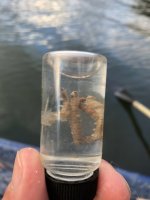
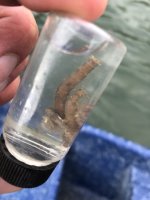
They look like Crane Fly larvae, especially the ass end where it appears to flare out.
You can also google tipulidae larvae and get quite a few different species.
You can also google tipulidae larvae and get quite a few different species.
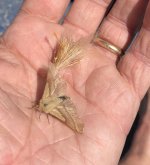

They are classed as semi-aquatic.Thanks! I’m assuming they are terrestrial and were washed into the lake by a rain event?
Here is what Pat McCafferty says about them on pages 366-367 of Aquatic Entomology:
NOCTURID MOTHS
(Family Nocturidae)
LARVAL DIAGNOSIS: (Figs. 18.7, 18.8) These generally measure 30-70
mm when mature. Thoratic legs are well developed. Prolegs are present on
abdominal segments 5, 6, and 10.
ADULT DIAGNOSIS: (Fig. 18.9) These are generally large, somewhat
drab moths. Mouth siphon is well developed.
DISCUSSION: A few species of this otherwise large and important ter-
restrial family are miners and petiole or stem borers, especially if water
lilies. These particular species are sometimes known as "diver moths."
The Yellow Water Lily Borer (Bellura gortynoides) mines leaves as a
young caterpillar, then becomes a petiole borer. Within the petiole, larvae
are submerged in water and must periodically back out in order to expose
specialized posterior spiracles (Fig. 18.8) to the air before submerging for
another few minutes, Larvae swim to shore to overwinter in dry protected
areas.
Host plants of the semi-aquatic noctuids include water lilies, water
lotus, water hyacinth, arrowhead, pickerelweed, burreed, rushes, cattail,
and bulrush.
Mark Melton
Life of the Party
You were right, Roger.
No problem; I promise not to make a practice of it.You were right, Roger.
