

I haven’t done much fishing in the past year, for a variety of reasons. But it is time to get back into it hard. So, with temperatures forecast to reach the low 90’s in the lowlands, a friend of mine and I decided that it was a great opportunity to head to the mountains, specifically to “Icewater Lake”. We had a blast…
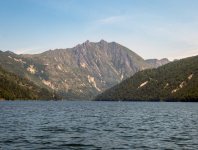
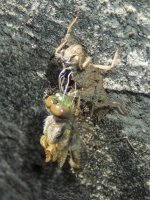
This is a deep oligotrophic (low nutrients) lake with clear water and not much autochthonous production (a $10 Greek word for primary production that is produced in the same area where it is produced). This time of year, the midge hatches have petered out, but there are some dragonflies and damselflies emerging. I hadn’t even launched my pontoon boat when I noticed a dragonfly emerging on the cement base for the floating dock. It had climbed out of its nymphal carapace but had not yet inflated its wings.
In fact, the trout here are known opportunists for terrestrial resources (allochthonous production). I had seen a few winged carpenter ants flying along the shoreline (and being attacked by wasps). That made the choice of what to tie onto the dry fly rod pretty easy. Later in the day, we saw several moths and butterflies flitting over the lake surface.
I started out trolling with a full-sinking line on my Sage 5wt. and a pair of seal leaches (one chocolate and one olive). Once I was in the channel of the submerged creek valley, I picked up three 8-12” rainbows, all on the trailing olive seal leach.
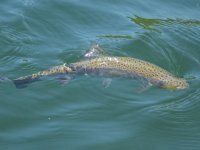
After trolling down to the outfall, I switched to the dry fly rod (3 wt. Reddington CT) and began a slow progression along the dropoff from the flats into the depths, prime ambush position. I could see the submerged aquatic vegetation (“SAV” to aquatic biologists, “weeds” to everyone else) was growing up toward the surface but hadn’t reached it yet. The wind was coming over my back and pushing me along the edge. I was surprised as how quiet it was along the edge; usually there will be someone home that is willing to crash a trapped ant at the surface. I turned away from the flats to a submerged reef. I figured that there might be trout lying in ambush at the upwind edge and there were. Five rainbows from the top of that reef thought that the black ant fly was worth hitting. They were their usual acrobatic selves and pulled better than you would have predicted for their size (8-12”).
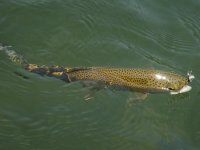
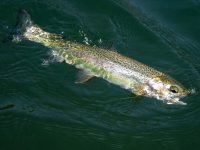
When I somehow lost the ant after the fifth fish, I tied on a tan stimulator, a reasonable moth mimic. I thought that I would retrace my path. So, I trolled back to the outflow stream and picked up one more nice rainbow on the olive seal leach.
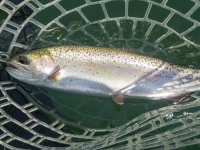
and then redrifted up the edge with the stimulator. But things were quiet along the drop-off and even at the submerged reef. My friend and I decided to fin our ways to the eastern shore. There might be trout looking for insects dumped from the alders into the drink by the spotty winds. I picked up one rainbow on the troll. It had a shortened upper jaw but it was otherwise in good condition.
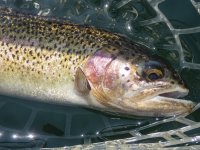
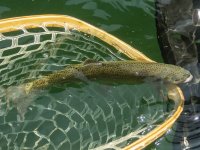
Now at the east shore of the lake, I could hear juncos and warbling vireos calling in trees. No sign of tent caterpillars. The same game here. Cast the stimulator to the drop-off, let it sit while I finned a bit farther along the shore, pick up the fly, and reposition it. I covered several hundred feet of shoreline, mostly without any action. But I saw a swirl a bit further along the shore and was rewarded with a vicious rocket strike. It pulled off some line, made a few jumps, and generally resisted my efforts to guide it into my net. But eventually, I netted the fish, removed the fly, revived the fish and set it on its way. Two more fish, the better fish of the day (12-14”) fell for the same game.
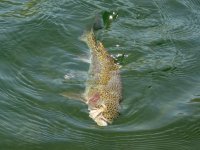
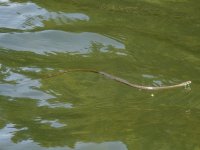
This young garter snake tried to hitch a ride with me until it had second thoughts and continued its way to hunt along the shoreline.
Now, late afternoon, my friend and trolled our pontoon boats back to the launch. My efforts were half-assed as I had already had a good day and I was more interested in catch-up conversation with my friend. But he managed to hook and land a dandy on the troll back. So, he ended a slow day for him on a high note. We’ll be back when the hoppers begin to rain down on the lake in a month or so.
Steve
This is a deep oligotrophic (low nutrients) lake with clear water and not much autochthonous production (a $10 Greek word for primary production that is produced in the same area where it is produced). This time of year, the midge hatches have petered out, but there are some dragonflies and damselflies emerging. I hadn’t even launched my pontoon boat when I noticed a dragonfly emerging on the cement base for the floating dock. It had climbed out of its nymphal carapace but had not yet inflated its wings.
In fact, the trout here are known opportunists for terrestrial resources (allochthonous production). I had seen a few winged carpenter ants flying along the shoreline (and being attacked by wasps). That made the choice of what to tie onto the dry fly rod pretty easy. Later in the day, we saw several moths and butterflies flitting over the lake surface.
I started out trolling with a full-sinking line on my Sage 5wt. and a pair of seal leaches (one chocolate and one olive). Once I was in the channel of the submerged creek valley, I picked up three 8-12” rainbows, all on the trailing olive seal leach.
After trolling down to the outfall, I switched to the dry fly rod (3 wt. Reddington CT) and began a slow progression along the dropoff from the flats into the depths, prime ambush position. I could see the submerged aquatic vegetation (“SAV” to aquatic biologists, “weeds” to everyone else) was growing up toward the surface but hadn’t reached it yet. The wind was coming over my back and pushing me along the edge. I was surprised as how quiet it was along the edge; usually there will be someone home that is willing to crash a trapped ant at the surface. I turned away from the flats to a submerged reef. I figured that there might be trout lying in ambush at the upwind edge and there were. Five rainbows from the top of that reef thought that the black ant fly was worth hitting. They were their usual acrobatic selves and pulled better than you would have predicted for their size (8-12”).
When I somehow lost the ant after the fifth fish, I tied on a tan stimulator, a reasonable moth mimic. I thought that I would retrace my path. So, I trolled back to the outflow stream and picked up one more nice rainbow on the olive seal leach.
and then redrifted up the edge with the stimulator. But things were quiet along the drop-off and even at the submerged reef. My friend and I decided to fin our ways to the eastern shore. There might be trout looking for insects dumped from the alders into the drink by the spotty winds. I picked up one rainbow on the troll. It had a shortened upper jaw but it was otherwise in good condition.
Now at the east shore of the lake, I could hear juncos and warbling vireos calling in trees. No sign of tent caterpillars. The same game here. Cast the stimulator to the drop-off, let it sit while I finned a bit farther along the shore, pick up the fly, and reposition it. I covered several hundred feet of shoreline, mostly without any action. But I saw a swirl a bit further along the shore and was rewarded with a vicious rocket strike. It pulled off some line, made a few jumps, and generally resisted my efforts to guide it into my net. But eventually, I netted the fish, removed the fly, revived the fish and set it on its way. Two more fish, the better fish of the day (12-14”) fell for the same game.
This young garter snake tried to hitch a ride with me until it had second thoughts and continued its way to hunt along the shoreline.
Now, late afternoon, my friend and trolled our pontoon boats back to the launch. My efforts were half-assed as I had already had a good day and I was more interested in catch-up conversation with my friend. But he managed to hook and land a dandy on the troll back. So, he ended a slow day for him on a high note. We’ll be back when the hoppers begin to rain down on the lake in a month or so.
Steve

