Hiking boots and a bit more

I need more structure underfoot than trail runners usually provide. One pointy rock to the mid foot/arch without a sturdy shank and my plantar fasciitis goes wild. I put well over 1000 miles on a pair of Vasque hikers (can't recall the model) but they finally gave out last year. Currently wearing La Sportiva Ultra Raptor II. I like them well enough but not as much as the Vasque.
 
I have a pair of Keen gore tex hiking boots. Bought them before I learned that gore tex is a waste in hiking boots, as the water gets in the tops anyway and then takes much longer to dry out. Also, with not that many miles, the lugs on one sole began delaminating already with the boots barely looking used. Bought Merrill Moabs for desert hiking 13 years ago and been using them ever since. The ankle support of taller heavier boots isn't as real as we'd like to think, as Mcswny mentions in his post above. I've adopted the practice of the hard core distance hikers: if it rains, or the grass is wet, or you have to cross an unbridged stream, you get wet feet. Keep hiking, they dry out faster than heavy leather boots. I also read that a pound of boot on your foot is like an additional six pounds on your back. At my age, I want to keep my load light.

I still have an old pair of Vasque Sundowners. Nice boots, but heavy as a tank compared to modern trail runners. I'm sold on Merrill Moabs (or similar) for cross country and boulder scrambling, not just trails that are smooth as side walks.

^^^True, all of my casual footwear and light hikers are actually lightweight anatomically correct medium cushioned zero drop running-walking shoes, trail runners, and oxfords. But I thought I'd mention that despite advances(?) in hiking boot technology that make a boot lighter and more comfortable out of the box (but way-way less durable supportive and protective), well maintained old school full grain veg-tanned all-leather upper boots with a fully gusseted tongue, soft leather lining, heel counter, veg-tanned leather insole & midsole, fiberglass half shank, cork lining, and Vibram outsole have some real advantages for extreme off-trail use that include providing comprehensive protection in wildland firefighting, lumberjacking, rescue work, and rockhounding (on steepish rocky and dirt gullies that were once ancient riverbeds) to name a few.

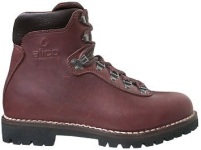
I loved my Galibier Peuterey climbing boots built on a wider last, were lighter and slightly lower cut for more comfort and flexibility (nice on rock for mixed climbing) than the very popular Super Guides but rodents got to them :cry: . My lighter Alico Summit boots (sadly no longer available in the US, apparently) don't have as durable of a lining (a soft glove leather instead) but have the same incredible craftsmanship as the Galibier and I only paid $154 shipped (60% off) in 2016 from STP when they were still a killer discount outlet. Yes, mine in size 12 weigh 4.5 lbs for the pair but during break-in that admittedly can take a couple of weeks of gradually increasing use with "recovery periods" in between, the inner sole "stack" molds itself to the foot to fit like a glove and literally becomes armor for the feet that can stop an axe. The Rose Anvil YT channel that analyzes and dissects boots by cutting them in half speaks a lot about it. I happen to be going rockhounding in a couple of weeks and got 'em out to check the fit again.
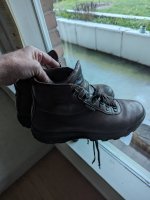
Dang! these feel good on my feet with over-the-calf support stocking liners under midweight-cushioned merino socks. They will definitely outlive me. 🤠
1710355021856.png
 
Last edited:
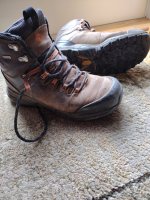
These Merrells have a dozen or more years on them. 3/4 of that as every day work boots.
I don't know how many thousands of miles...
View attachment 106563
Nice looking mostly-leather boot that looks like it also has some good ventilation. Is there any stitching under that rand or is it cemented construction? Resolable? Discontinued?
 
Nice looking mostly-leather boot that looks like it also has some good ventilation. Is there any stitching under that rand or is it cemented construction? Resolable? Discontinued?
I don't have much in the way of answers for you but the salesman commented when I mentioned that I like the rubber toes. "Good for kicking guys in the ass to get 'em going." They were water proof (up to the fabric part) for quite a few years and are still somewhat resistant. Cemented I think. The tops of the toes is what would wear out first on my boots because of all the kneeling I do when working. As you can see, this pair has really hung in there. They were on sale when I bought them at Holiday Sports so it may be that they are discontinued...you know...because they last so long. However...the salesman was right! :)

If I have to buy another pair of work boots they will definitely be my last pair.
 
An update...
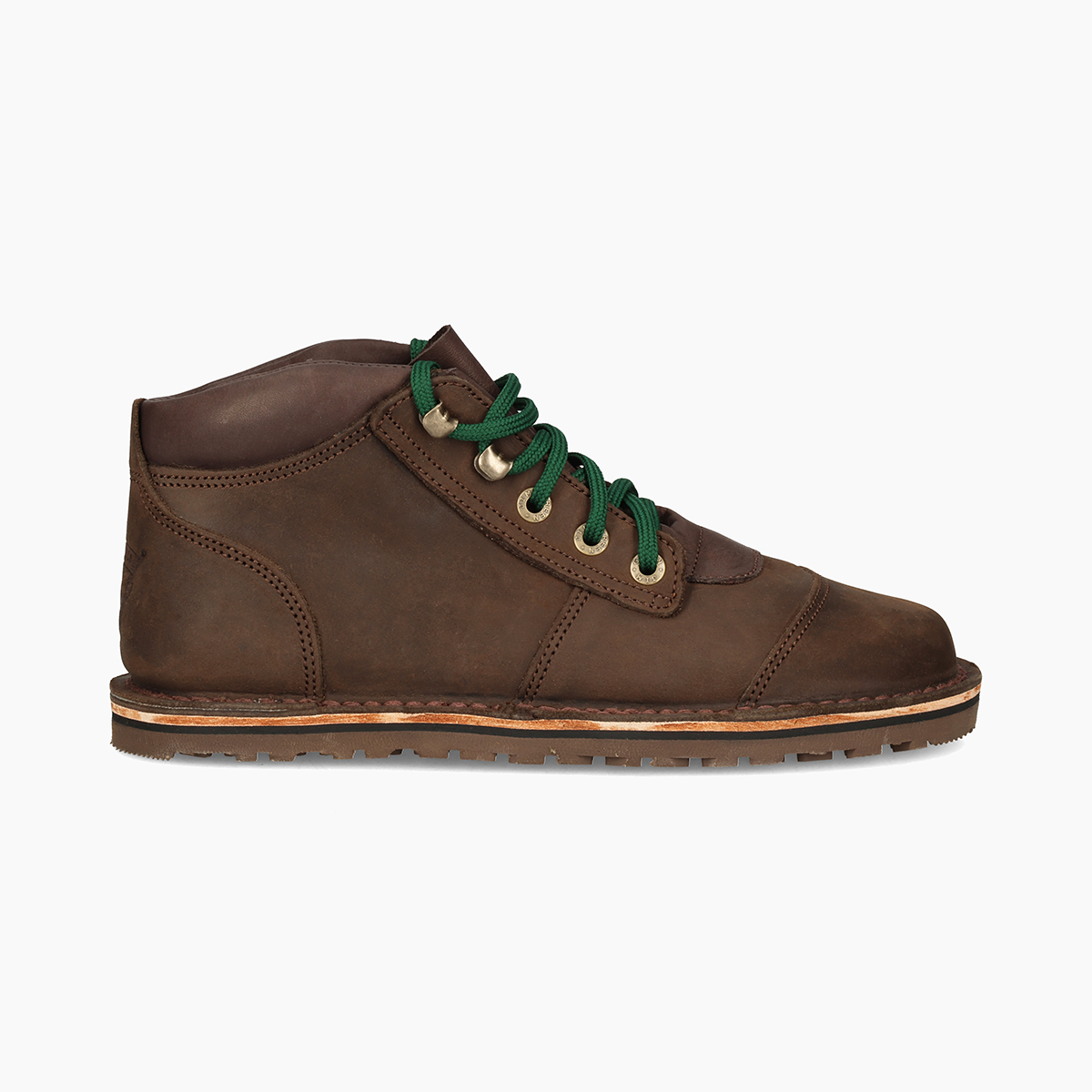
For awhile I have been interested in getting a new pair of *lighter-weight* anatomically correct zero drop *hiking boots* that would give me more support than my Altra Timp trail runners to fill a niche for camping to moderate backpacking and even yardwork around our property. I had heard about these Jim Green African Ranger "barefoot" boots from the Rose Anvil YT channel's Weston Kay who did a collaboration with Jim Green.
They are highly durable yet extremely flexible for a leather boot. They have a high quality veg-tan Nubuck (lightly sanded full grain) upper with a wide toe box, a true toe cap, fully gusseted tongue, leather heel counter, 2.5mm veg-tan "sock" liner insole in the heel (so technically not "zero drop"), a veg-tan midsole with a rubber outsole designed by Anvil that has good multi-surface traction lugs that won't hold caked on mud and reportedly (by another YT reviewer) even make it "sticky" on water ice, cemented to a rubber "slipsole" that is 360° stitched to the upper and midsole adding to the boot's durability and making the cemented outsole bond very strong yet extremely easy (therefore inexpensive) to resole, for $190 with free shipping. I ordered them and should have them by the time I go rockhounding with my brother to use as a comfy commute and in-town boot for a Nick Zentner Geology lecture we're going to attend, and if necessary as a "recovery" shoe after wearing my Alico boots for several hours of hiking and working on steep hillsides.


Last edited:
Back in the 70s I used to have a heavy pair of Vasque hikers that were like Frankenstein boots. I never did get used to them. They gave me the worst blisters. For a while I had an old pair of combat boots that my brother gave me when he got out of the army. They were good boots but I outgrew them. I have a pair of Vasque Sun downers that are nice lightweight boots, very comfortable but the older I get the more susceptible I have become to getting plantar faciitis. I am now on my fourth pair of Zamberlan Vios boots. Those are by far the most comfortable boots I have owned.
 
lessons from two decades working at a podiatric medical school with ongoing exposure to all things feet and running shoes/hiking boots.

-always start with matching foot type to sole shape. A lower arch, narrower foot will do best in a sole with a straighter, narrower and less curvy sole. Conversely, a higher arch, wider foot will do better with a curvier sole with a wider forefoot.
-better to buy less expensive running shoes/boots and replace them once they have lost structural stability than buy a much more expensive pair and run them into the ground.
-best way to test structural support stability, grab the heel in one hand, the forefoot in the other, and twist along the length. The more resistant the shoe is to the twist, the more supportive it is.
-high laces-ups do prevent more serious ankle sprains by limiting the angle of roll which does the more serious ligament damage, which is why a serious sprain is treated with a shin high brace to immobilize the sprain.
Custom orthotics a whole other discussion..Superfeet and such just expensive foam...
 
lessons from two decades working at a podiatric medical school with ongoing exposure to all things feet and running shoes/hiking boots.

-always start with matching foot type to sole shape. A lower arch, narrower foot will do best in a sole with a straighter, narrower and less curvy sole. Conversely, a higher arch, wider foot will do better with a curvier sole with a wider forefoot.
-better to buy less expensive running shoes/boots and replace them once they have lost structural stability than buy a much more expensive pair and run them into the ground.
-best way to test structural support stability, grab the heel in one hand, the forefoot in the other, and twist along the length. The more resistant the shoe is to the twist, the more supportive it is.
-high laces-ups do prevent more serious ankle sprains by limiting the angle of roll which does the more serious ligament damage, which is why a serious sprain is treated with a shin high brace to immobilize the sprain.
Custom orthotics a whole other discussion..Superfeet and such just expensive foam...
Interesting points!

As one might suspect, the Marine Corps tends to abuse recruits' feet; in the 1970's they (the Navy, because the Corps doesn't have its own doctors or corpsman) maintained a podiatry medical facility at Marine Corps Recruit Depot San Diego that was much larger than any of its other medical units. Some of their podiatrists went on to become leading technical consultants for running shoe manufacturers that blossomed during the emerging running craze in the following decades.

No doubt recruit foot problems are exacerbated (along with extended periods of intense physical activity) by the practical necessity of one boot configuration for all, which means the considerations you list simply couldn't be addressed....which, in my case resulted in matching first metatarsal stress fractures. It turned out my high arches did not work well with the issued no arch boots or Converse tennis shoes for 6 mile runs with full gear.

I got through the experience through the help of 'a few good men' from the Navy....and went on to run marathons in the following years because effective footwear became widely available.
 
Last edited:
Back
Top