
Navigation
Install the app
How to install the app on iOS
Follow along with the video below to see how to install our site as a web app on your home screen.
Note: This feature may not be available in some browsers.
More options
Style variation
You are using an out of date browser. It may not display this or other websites correctly.
You should upgrade or use an alternative browser.
You should upgrade or use an alternative browser.
Got any bird pics?
- Thread starter Wadin' Boot
- Start date
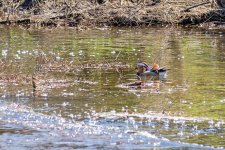
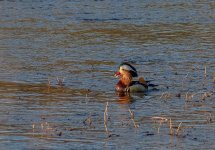
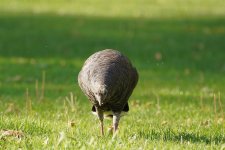
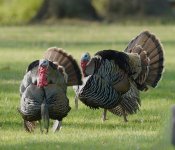
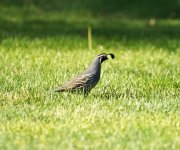
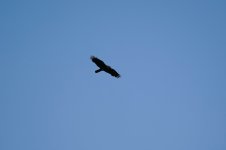
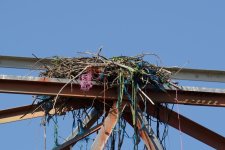

A Mandarin Duck.
Wow! Color me jealous. Nicely done!

The Cornell app ID is house finch.They look more like house finches to me. Tail is long for pine siskin and the beak looks more finch-like. But that’s just me.
 Neat tool.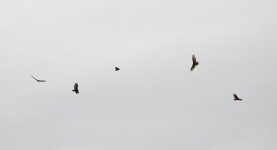
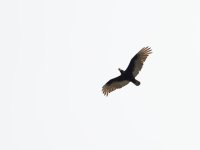
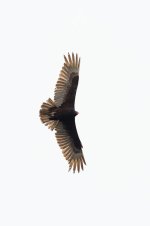
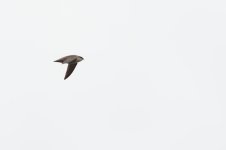
I saw Ravens doing that yesterday.I don't know if it was a "thermal" or some other reason, but several Turkey Vultures were circling and then eventually wheeled out and downwind.
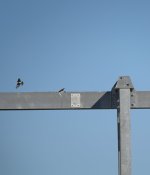
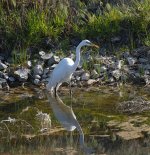


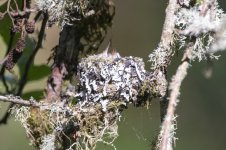
Nisqually and McLane Creek, May 2025. Mothers and Babies. On a previous to Nisqually NWR in mid-April, another birder had pointed out a hummingbird nest near the northern stretch of the boardwalk. The nest was attached to a dead, lichen-covered side branch under a second thicker branch that provided shade. The female was on the nest incubating her eggs.
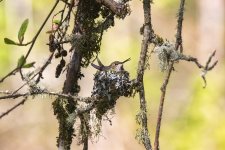
A female hummingbird uses spider webs to glue lichen fragments to the outside of the tiny cup-shaped nest. This covering provides camouflage.
Due to other explorations, I hadn’t been able to get back to Nisqually until Friday morning. I was a bit concerned that I would not remember where the nest was, but there were already three telephoto lenses trained on the nest when I arrive in the area. Several thin beaks poked above the rim of the nest waiting for mom to return with more food.
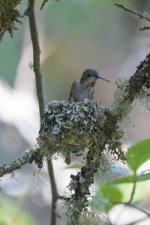
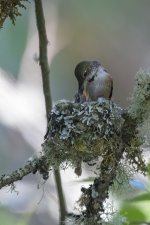
Not only was the original nest visible, but there was another nest perhaps 50’ west along the boardwalk. The photographers at the second nest were waiting for the female rufous hummingbird to return to the next to feed her two chicks. After a wait, she showed up and fed both before she zoomed off to collect more food.
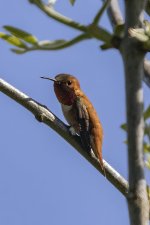
Later in my walk, I encountered a brilliant male rufous hummingbird hawking insects.
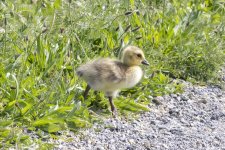
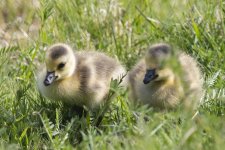
During my mid-April visit, I saw several solo Canada geese scattered in the freshwater marsh. I suspected that these were male hanging out in the area while their mates were incubating a clutch of eggs. Unlike hummingbirds and ducks, both Canada geese parents protect their young. On this May visit, there were at least five family groups of Canada geese with their cute, fuzzy goslings on either side of the causeway separating the freshwater and saltwater marsh.
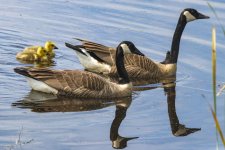
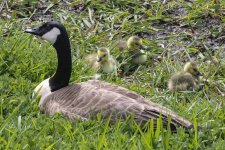
Two pair of adults emerged from the tall grasses with their goslings close by. The parents bobbed their heads up and down several times as the groups approached each other, but there was no direct hostility.
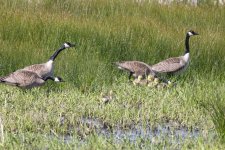 The Canada goose goslings kept tight to their parents, typically with one parent leading the group and the other coming up the rear.
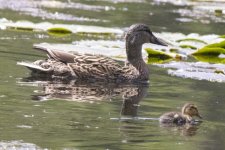
If there were goslings here, I suspected that there might be ducklings at McLane Creek pond. On my previous visit in mid-late April, I encountered only drake mallards and drake wood ducks, but no hens. I hypothesized that the hens were on nests and the boys were enjoying their free time having completed their evolutionary duties already. While the drakes were still hanging around on the pond Friday, there were now several hens shepherding their cute ducklings around the lake. The four mallard ducklings stayed fairly close to the hen, but still demonstrated more independence than did the goslings.
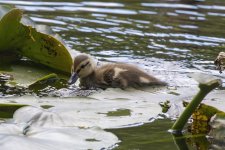
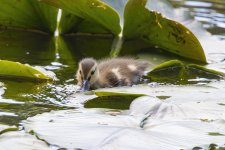
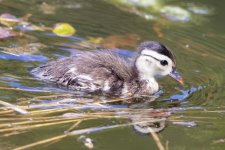
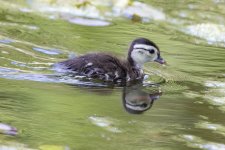
The wood duck ducklings were wild, zooming around in all directions without much care of where the hen was.
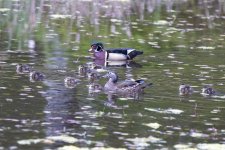
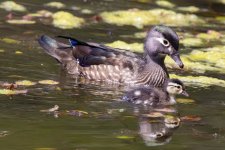
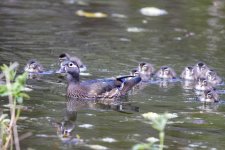
One hen appeared to have four ducklings, but another appeared to be trying to keep track of at least ten ducklings.
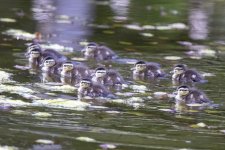
Not all of these ducklings may be her offspring as hen wood ducks are known to sneak eggs into the nests / nest boxes of other females when the incubating hen temporarily heads off to eat. The wood duck ducklings were in constant motion, like frenetic wind-up boats scurrying around the edges of the lake.
Steve
A female hummingbird uses spider webs to glue lichen fragments to the outside of the tiny cup-shaped nest. This covering provides camouflage.
Due to other explorations, I hadn’t been able to get back to Nisqually until Friday morning. I was a bit concerned that I would not remember where the nest was, but there were already three telephoto lenses trained on the nest when I arrive in the area. Several thin beaks poked above the rim of the nest waiting for mom to return with more food.
Not only was the original nest visible, but there was another nest perhaps 50’ west along the boardwalk. The photographers at the second nest were waiting for the female rufous hummingbird to return to the next to feed her two chicks. After a wait, she showed up and fed both before she zoomed off to collect more food.
Later in my walk, I encountered a brilliant male rufous hummingbird hawking insects.
During my mid-April visit, I saw several solo Canada geese scattered in the freshwater marsh. I suspected that these were male hanging out in the area while their mates were incubating a clutch of eggs. Unlike hummingbirds and ducks, both Canada geese parents protect their young. On this May visit, there were at least five family groups of Canada geese with their cute, fuzzy goslings on either side of the causeway separating the freshwater and saltwater marsh.
Two pair of adults emerged from the tall grasses with their goslings close by. The parents bobbed their heads up and down several times as the groups approached each other, but there was no direct hostility.
The Canada goose goslings kept tight to their parents, typically with one parent leading the group and the other coming up the rear.If there were goslings here, I suspected that there might be ducklings at McLane Creek pond. On my previous visit in mid-late April, I encountered only drake mallards and drake wood ducks, but no hens. I hypothesized that the hens were on nests and the boys were enjoying their free time having completed their evolutionary duties already. While the drakes were still hanging around on the pond Friday, there were now several hens shepherding their cute ducklings around the lake. The four mallard ducklings stayed fairly close to the hen, but still demonstrated more independence than did the goslings.
The wood duck ducklings were wild, zooming around in all directions without much care of where the hen was.
One hen appeared to have four ducklings, but another appeared to be trying to keep track of at least ten ducklings.
Not all of these ducklings may be her offspring as hen wood ducks are known to sneak eggs into the nests / nest boxes of other females when the incubating hen temporarily heads off to eat. The wood duck ducklings were in constant motion, like frenetic wind-up boats scurrying around the edges of the lake.
Steve

Winds on Sunday weren't exactly light and variable...
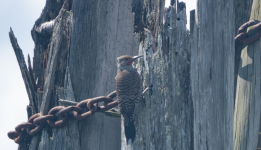
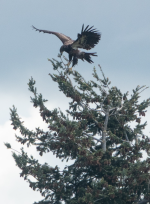
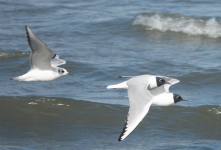
Jim - Bonaparte's gulls, so yes, black headed gullsAre those Black Headed Gulls?
Thanks, Boot. Rather striking birds and apparently quite agile in the air.Bonaparte's gulls,

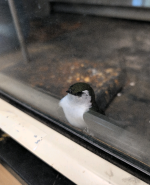
Somehow this specimen somehow flew into the exhaust for my fume hood and got stuck in there. I netted it with a butterfly net and released it outside unharmed. It was surprisingly docile. My best guess is violet-green swallow female. What do you think?

tkww
Life of the Party
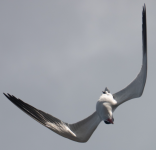
Jim, is your "agile" comment with regards to the last pic? I believe that is a Caspian Tern. (Red bill, dark wing tips, black cap not head.)Thanks, Boot. Rather striking birds and apparently quite agile in the air.
that one that is upside down is a Caspian, numbers seem a mite better than last year so farJim, is your "agile" comment with regards to the last pic? I believe that is a Caspian Tern. (Red bill, dark wing tips, black cap not head.)
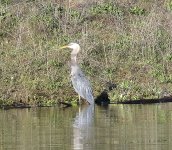
Couldn't quite get the phone in time for the trout consumption shot.

At least Jonathan Livingston Seagull does!Thanks. I wasn't sure. I do believe that Gulls in general genuinely enjoy flying for the sheer joy of flying.
Him too! My favorite quote:At least Jonathan Livingston Seagull does!
“Don’t believe what your eyes are telling you. All they show is limitation. Look with your understanding. Find out what you already know and you will see the way to fly.”

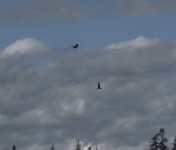
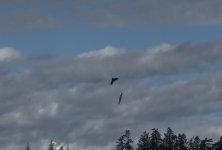
Crow mobbing a hawk. They put on quite a show.
SF
SF