
Navigation
Install the app
How to install the app on iOS
Follow along with the video below to see how to install our site as a web app on your home screen.
Note: This feature may not be available in some browsers.
More options
Style variation
You are using an out of date browser. It may not display this or other websites correctly.
You should upgrade or use an alternative browser.
You should upgrade or use an alternative browser.
Got any bird pics?
- Thread starter Wadin' Boot
- Start date

The sound of a falcon stooping is incredible. Had one at Dry Falls going after a duck. I heard it before I saw it. There was another one in Costa Rica that hit a swift. The swift was tumbling through the air and the falcon made a U-turn and got the bird.
Beautiful photos. You clearly know what you are doing with a camera. I was in Tucson last week and spent several days visiting Madera Canyon, Sweetwater wetlands, Sonoita Creek, and Saguaro NP. It is a special place.Arizona, late March 2025. Part 6 of Many: Mixed insectivores. We will start with the flycatchers (family Tyrannidae). We saw both large and small members of this family. Among the smaller flycatchers (size of a medium-size sparrow), we saw black phoebes at many sites, especially those sites with streams or ponds from which they could hawk emerging insects. The white breast of a black phoebe contrasts with the black plumage elsewhere.
View attachment 150085
We also encountered several Say’s phoebes. This species prefers drier locations than black phoebes.
Flamboyant vermillion flycatchers are common in Southern Arizona and we saw them at several sites. The males are very distinctive with a bright red crest, neck, and breast contrasting with a dark gray back, tail, and wings.
View attachment 150086
View attachment 150087
Per usual, a female is more subdued with a gray crest and mantle, white throat, and peach breast.
View attachment 150088
You will typically find them perched on an outside branch from which they can intercept passing insects. At Sweetwater Regional Park, we were fortunate to find a female on a nest.
View attachment 150089
We also saw two species of larger flycatchers: Cassin’s kingbird and Western kingbird. Each is larger than a sparrow but smaller than a robin. At Ron Morriss County Park, individuals of both species were hawking insects that were being blown off a freshwater march; we had a great opportunity to compare the two species. An adult Western kingbird has a light gray cap and mantle, a very light gray / white throat and breast, and a light yellow breast. They are also notable for the presence of white outer tail feathers.
View attachment 150090
Western kingbirds breed across the Western U.S. through the western Canadian provinces. Cassin’s kingbirds are similar to Western kingbirds. Their head, mantle, and throat are much darker gray than a Western kingbird and contrast with their white throat. The yellow on the breast is more intense.
View attachment 150091
View attachment 150092
Cassin’s kingbird prefers drier habitats than a Western kingbird; this species ranges from Mexico into the Southwest U.S.
In more forested areas, we encountered a diverse collection of smaller insectivorous birds. These included white-breasted nuthatches,
View attachment 150093
View attachment 150094
bridled titmice (a favorite of my wife),
View attachment 150095
View attachment 150096
bushtits,
View attachment 150097
and ruby-crowned kinglets.
View attachment 150098
In more open areas dominated by shrubs, we encountered cute verdins,
View attachment 150099
View attachment 150101
cactus wrens,
View attachment 150102
View attachment 150103
blue-gray gnatcatchers,
View attachment 150104
and several swallows, like this rough-winged swallow.
View attachment 150105
Steve

The sound of a falcon stooping is incredible. Had one at Dry Falls going after a duck. I heard it before I saw it. There was another one in Costa Rica that hit a swift. The swift was tumbling through the air and the falcon made a U-turn and got the bird.
I had a similar experience on Dry Falls. As you said, the sound is incredible.
It hit a smaller bird above me and feathers floated down around me landing on the lake while I was sitting in my boat. I really wish I had a video of that.
SF

Gyrfalcon22
Legend
Boot, looks like you have a very good looking 1 year (last year's hatch) Peale's peregrine. Those are the largest subspecies of Peregrine.Was paddling back taking photos of this big dunlin murmuration and heard some loud whoosing/pumping noise and took the camera down and saw a falcon zoom past, chasing one dunlin it had separated from the flock. Went right past me, maybe 15 feet away, pivoting and changing direction on a dime, holy smokes the sound coming from his wings was really cool! I am glad I am not a dunlin. I guess one take home is there's probably a reason they are flocking....
View attachment 151236
Super cropped when I could sorta track the falcon...
View attachment 151246
Eagle wanted what the osprey had...
Kinda reminded me of a horror movie....
Nice shots of the Ruler of the Skies !
Last edited:

Kinda reminded me of a horror movie....
Some great shots, Boot! Looks like "Lake Eerie" to me . . .Here's the set of the apocalyptic horror movie

Gyrfalcon22
Legend
A good mystery is always fun in nature. Wild geese seem to show leucism quite regularly-or I just see so many geese that it is normal a % and when you get to see thousands a season the odds go up finding oddities. Like the storm version of wigeon ducks, it makes it worthwhile to scan through a whole flock to make sure you aren't missing anything.
Like a couple years ago locally.
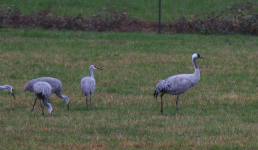
A 15-year old birding phenom in our state picked out an ultra-rare for north america, Common crane individual out of a flock of Sandhill cranes that was local. Some folks booked flights to come and see as they are a lister's must.
This shot I took is a bit deceiving as the Common crane is not that much larger than the sandhills on the left
Back to the more recent mystery bird. I see partially white/leucistic geese every couple of years. They look just like their fellow geese they are in a flock with but have various sized single or multiple white patches. Usually on the head or neck. Wild geese also mix with domestic geese quite often. One interesting bird that popped up recently was traveling with Greater White-fronted geese that would mingle with 100's of Cackler geese, but it definitely liked its speckled pals more. I decided to research some and have come up to the hypothesis it is a hybrid of the two geese species in the flock of 1000. Snow goose was in the play, as was Barnacle goose, but company kept lends it to the more likely answer I think of GWFxCack
So, if I go with the Greater white-fronted x Cackler goose hybrid I must also add a shot of another goose, a Cackler, with white speckles on its neck. Hmmmm. Hybrids are not always a perfect blend of two plumages so color is not the best way to know. @RRSmith and @Cabezon are our waterfowl experts so will hopefully get them to add on to this. That second goose may just have some leucism going on.
Pretty bird by any definition.
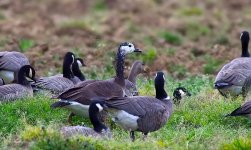
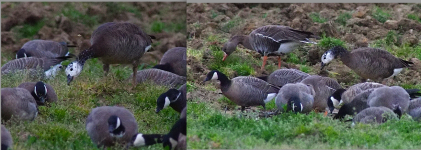
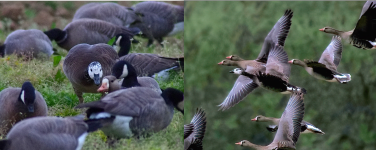
Below: the Cackler with some extra white speckles like the other suspected hybrid.. Leucism or hybrid genes sneaking through?
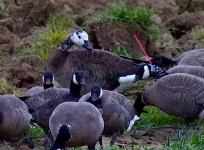
Cackling geese are very cool waterfowl. The smallest, the minima subspecies, is about the size of a Mallard duck !
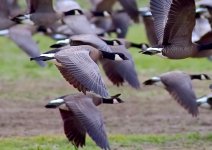
Like a couple years ago locally.
A 15-year old birding phenom in our state picked out an ultra-rare for north america, Common crane individual out of a flock of Sandhill cranes that was local. Some folks booked flights to come and see as they are a lister's must.
This shot I took is a bit deceiving as the Common crane is not that much larger than the sandhills on the left
Back to the more recent mystery bird. I see partially white/leucistic geese every couple of years. They look just like their fellow geese they are in a flock with but have various sized single or multiple white patches. Usually on the head or neck. Wild geese also mix with domestic geese quite often. One interesting bird that popped up recently was traveling with Greater White-fronted geese that would mingle with 100's of Cackler geese, but it definitely liked its speckled pals more. I decided to research some and have come up to the hypothesis it is a hybrid of the two geese species in the flock of 1000. Snow goose was in the play, as was Barnacle goose, but company kept lends it to the more likely answer I think of GWFxCack
So, if I go with the Greater white-fronted x Cackler goose hybrid I must also add a shot of another goose, a Cackler, with white speckles on its neck. Hmmmm. Hybrids are not always a perfect blend of two plumages so color is not the best way to know. @RRSmith and @Cabezon are our waterfowl experts so will hopefully get them to add on to this. That second goose may just have some leucism going on.
Pretty bird by any definition.
Below: the Cackler with some extra white speckles like the other suspected hybrid.. Leucism or hybrid genes sneaking through?
Cackling geese are very cool waterfowl. The smallest, the minima subspecies, is about the size of a Mallard duck !
Last edited:
Gyrfalcon22
Legend
Shorebirds bring it up to another level of craziness. Trying to pick though flocks of thousands x thousands of smaller birds is birding insanity (no one ever accused birders of being sane anyway, of course..).
This guy was either Andre the Giant of the Dunlin world, or something else. And that something else is a much more rare Red Knot mixed in.
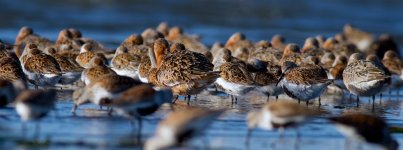
This guy was either Andre the Giant of the Dunlin world, or something else. And that something else is a much more rare Red Knot mixed in.

Your images are spectacular as always - thanks for sharing! Oh boy, the hybrid thing is always a toughie. I am going to send those images to a buddy that has worked a lot with YK Delta geese and get his thoughts. In the meantime, I tend to agree that it might be a CACG/GWFG hybrid.Back to the more recent mystery bird. I see partially white/leucistic geese every couple of years. They look just like their fellow geese they are in a flock with but have various sized single or multiple white patches. Usually on the head or neck. Wild geese also mix with domestic geese quite often. One interesting bird that popped up recently was traveling with Greater White-fronted geese that would mingle with 100's of Cackler geese, but it definitely liked its speckled pals more. I decided to research some and have come up to the hypothesis it is a hybrid of the two geese species in the flock of 1000. Snow goose was in the play, as was Barnacle goose, but company kept lends it to the more likely answer I think of GWFxCack

I don't know what these colorful regular visitors are, but they have gotten used to the dog and I and are not as skittish as they used to be.
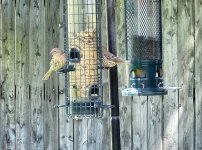

I am tempted to say pine siskins. They have very musical calls. You might download the free Merlin app from the Cornell Lab of Ornithology. The app can identify birds by sound, from a photograph, or via series of questions.I don't know what these colorful regulars are, but they have gotten used to the dog and I and are not as skittish as they used to be.
View attachment 151569
Steve
I will check that out, thanks.I am tempted to say pine siskins. They have very musical calls. You might download the free Merlin app from the Cornell Lab of Ornithology. The app can identify birds by sound, from a photograph, or via series of questions.
Steve
Yes, they do have musical calls, and are quite vocal, especially when they first come in.


Osprey is back, bald eagles haven't caught on yet.The lake very near me just got stocked (opening day is this weekend) and I'm waiting for the osprey to catch on and show up.

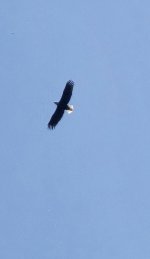

Nice shot!Trying to work in the yard today and some stupid bird circling overhead keeps distracting me with its shadow. Super annoying!
View attachment 151744
I suffer a similar issue, trying to work in the yard and I keep hearing a hawk so I have to stop what I'm doing and scan the sky to see if I can spot him - rarely do. Neighbors must think "there's that dumb ole man again, staring blankly into the sky"
cheers

Bonefish Jack
Steelhead
Sorry for no pics … All week, I have been hearing/seeing Red Crossbills and Evening Grosbeaks up in the Douglass Firs around my house.