
Arizona, late March 2025. Part 11 of 11 (last bird post): New World Sparrows (family Passerellidae), part B. The dramatic and the subtle.
Black-throated sparrows are one of my favorites. The black and white markings on the head and throat are so distinctive.
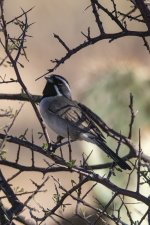
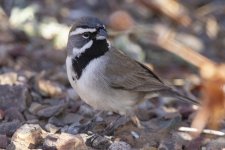
We have seen them foraging around or perched on desert shrubs in Anza Borego State Park in California and in Saguaro NP in Arizona. Their contact calls sound like tinkling bells. They consume insects during the breeding season (protein) and seeds in the non-breeding season. They are permanent residents of the desert Southwest and Mexico. During the breeding season, some birds migrate into the Great Basin (inland Washington and Oregon, Nevada and Utah, and mountainous areas of California, Colorado, and New Mexico.
Chipping sparrows are another distinctive species. These medium-sized sparrows have a bright brown crest and black eyeline, and a gray belly.
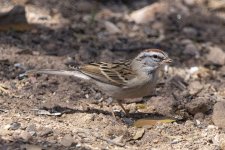
As their name indicates, individuals make chip calls to stay in contact. During the breeding season, males make a long trill of high notes. In winter, they are found in Southern California, parts of Mexico, Florida, Caribbean Islands. There are also non-migratory populations in Central America. They live on the margins of forests, especially evergreens. In winter, they feed primarily of grass and herb seeds. In the breeding season, they include more insects.
Lark sparrows are also quite distinctive, large sparrows. They have a black spot in the center of a white breast. The throat is white with a black mustache stripe. The crown has a pair of chestnut stipes and cheek and black stripes through the eye.
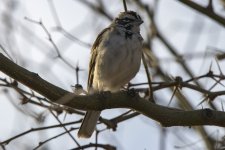
Populations in Western California, the desert Southwest and Texas, are non-migratory. Other birds overwinter in Mexico and migrate north throughout the U.S. (except the eastern quarter) to breed. In the breeding season, they are most likely to be found in grass fields, but in the winter they expand their range of habitats to include pine-oak forests and thorn scrub. Like the other sparrows on this list, they consume more seeds in winter and more insects in summer.
We had great looks at Lincoln sparrows. These can be shy, but we were cautious and had great views of this distinguished sparrow. They have a gray head with a pair of brown stripes across the crest and a thin brown stripe through the eye. From a white chin, thin dark streaks run down the cafe-au-lait-colored upper chest.
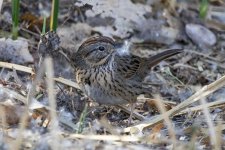
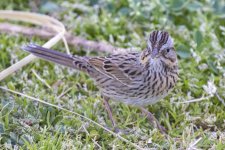
In summer, they are found in riparian habitats. In winter, they inhabit pine-oak forests, tropical scrub, and tropical forest. They have the same feeding pattern as the previous species.
Rufous-crowned sparrows are another distinctive sparrow species. They have a bright rufous cap, bordered by a white stripe, a white eye ring, a thin rufous stripe through the eye, and a black mustache on a white throat. The breast is a light gray.
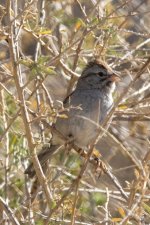
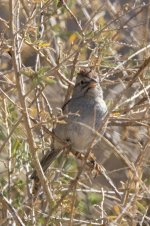
This species prefers dry hillsides with scattered shrubs and trees in coastal California, the desert Southwest, Texas, and the mountains of Mexico. They cover a wide altitude range from sea level to 10,000 feet. They have the same diet as the other sparrows.
I will start the presentation of the more subtle sparrows with Brewer’s sparrow. This species of relatively indistinct. The crest of this sparrow has a series of several dark brownish streaks on a light gray background. They have a thin eyebrow stripe and a white mustache.
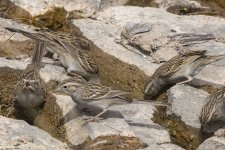
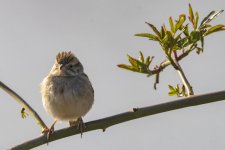
This species specializes on sagebrush habitats and clearing in pinyon pine – juniper woodlands in the breeding season. In winter, they will also inhabit desert scrub habitats. Most individuals migrate to Southern California, the desert Southwest, and Northern Mexico in winter. They breed in sagebrush areas east of the Sierra Nevada and Cascades through the Rockies. They have similar diets to these other sparrows.
Lark buntings were one of the harder birds for me to identify at first. In the field guide, breeding males are mostly black with a distinct white section of white coverts that look like a wide white band above the streaked breast. But in the non-breeding season, the males molt to a much browner plumage but fortunately retain the white wing patch. Both females and non-breeding males have thick blueish bills and white throats bordered by a thin black line.
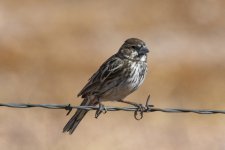
The males that we saw had some darker areas, especially around the face, indicating progress toward their summer breeding plumage.
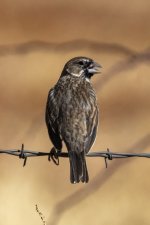
I would love to find males in full breeding plumage. We encountered large flocks of these sparrows at the Historic Canoa Ranch near Green Valley. They were foraging on the grasslands, perching on a barb-wire fence, and drinking at the edge of the small spring there.
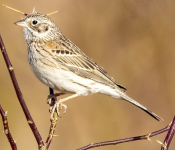
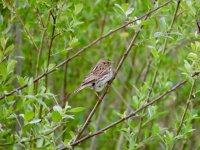
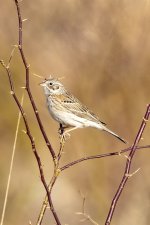
Our last sparrow species (and last bird species) is the vesper sparrow. It does have a few distinctive features that help with its identification. It has fine streaks on the upper breast and central dark spot. This species has a distinctive white eye ring and white outer tail feathers. And while not always visible, there is a rusty brown shoulder patch.
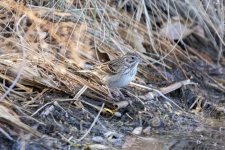
This species overwinters in the states along the southern edge of the U.S. and into Mexico. They migrate into the Central and Northern U.S. and Canadian provinces to breed. They have the same diet as the other sparrows in this group.
Steve
Black-throated sparrows are one of my favorites. The black and white markings on the head and throat are so distinctive.
We have seen them foraging around or perched on desert shrubs in Anza Borego State Park in California and in Saguaro NP in Arizona. Their contact calls sound like tinkling bells. They consume insects during the breeding season (protein) and seeds in the non-breeding season. They are permanent residents of the desert Southwest and Mexico. During the breeding season, some birds migrate into the Great Basin (inland Washington and Oregon, Nevada and Utah, and mountainous areas of California, Colorado, and New Mexico.
Chipping sparrows are another distinctive species. These medium-sized sparrows have a bright brown crest and black eyeline, and a gray belly.
As their name indicates, individuals make chip calls to stay in contact. During the breeding season, males make a long trill of high notes. In winter, they are found in Southern California, parts of Mexico, Florida, Caribbean Islands. There are also non-migratory populations in Central America. They live on the margins of forests, especially evergreens. In winter, they feed primarily of grass and herb seeds. In the breeding season, they include more insects.
Lark sparrows are also quite distinctive, large sparrows. They have a black spot in the center of a white breast. The throat is white with a black mustache stripe. The crown has a pair of chestnut stipes and cheek and black stripes through the eye.
Populations in Western California, the desert Southwest and Texas, are non-migratory. Other birds overwinter in Mexico and migrate north throughout the U.S. (except the eastern quarter) to breed. In the breeding season, they are most likely to be found in grass fields, but in the winter they expand their range of habitats to include pine-oak forests and thorn scrub. Like the other sparrows on this list, they consume more seeds in winter and more insects in summer.
We had great looks at Lincoln sparrows. These can be shy, but we were cautious and had great views of this distinguished sparrow. They have a gray head with a pair of brown stripes across the crest and a thin brown stripe through the eye. From a white chin, thin dark streaks run down the cafe-au-lait-colored upper chest.
In summer, they are found in riparian habitats. In winter, they inhabit pine-oak forests, tropical scrub, and tropical forest. They have the same feeding pattern as the previous species.
Rufous-crowned sparrows are another distinctive sparrow species. They have a bright rufous cap, bordered by a white stripe, a white eye ring, a thin rufous stripe through the eye, and a black mustache on a white throat. The breast is a light gray.
This species prefers dry hillsides with scattered shrubs and trees in coastal California, the desert Southwest, Texas, and the mountains of Mexico. They cover a wide altitude range from sea level to 10,000 feet. They have the same diet as the other sparrows.
I will start the presentation of the more subtle sparrows with Brewer’s sparrow. This species of relatively indistinct. The crest of this sparrow has a series of several dark brownish streaks on a light gray background. They have a thin eyebrow stripe and a white mustache.
This species specializes on sagebrush habitats and clearing in pinyon pine – juniper woodlands in the breeding season. In winter, they will also inhabit desert scrub habitats. Most individuals migrate to Southern California, the desert Southwest, and Northern Mexico in winter. They breed in sagebrush areas east of the Sierra Nevada and Cascades through the Rockies. They have similar diets to these other sparrows.
Lark buntings were one of the harder birds for me to identify at first. In the field guide, breeding males are mostly black with a distinct white section of white coverts that look like a wide white band above the streaked breast. But in the non-breeding season, the males molt to a much browner plumage but fortunately retain the white wing patch. Both females and non-breeding males have thick blueish bills and white throats bordered by a thin black line.
The males that we saw had some darker areas, especially around the face, indicating progress toward their summer breeding plumage.
I would love to find males in full breeding plumage. We encountered large flocks of these sparrows at the Historic Canoa Ranch near Green Valley. They were foraging on the grasslands, perching on a barb-wire fence, and drinking at the edge of the small spring there.
Our last sparrow species (and last bird species) is the vesper sparrow. It does have a few distinctive features that help with its identification. It has fine streaks on the upper breast and central dark spot. This species has a distinctive white eye ring and white outer tail feathers. And while not always visible, there is a rusty brown shoulder patch.
This species overwinters in the states along the southern edge of the U.S. and into Mexico. They migrate into the Central and Northern U.S. and Canadian provinces to breed. They have the same diet as the other sparrows in this group.
Steve