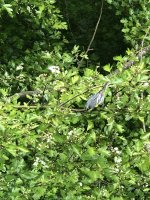
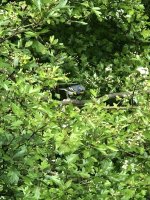
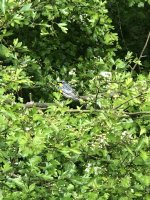
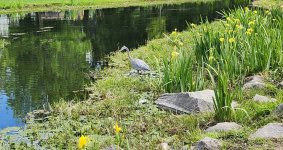
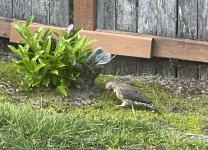
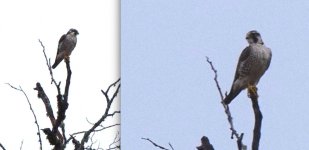
The pace of change really accelerates by mid-spring in the PNW. Some bird species are migrating in, others migrating through, while some birds that have spent the winter are migrating out. Summer residents and newly-arrived migrants are busy with establishing and defending breeding territories, attracting mates, and building nests. And there is a window in time when the birds are very active, but the trees haven’t yet fully leafed-out that you can capture some great views.
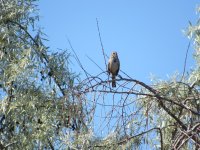
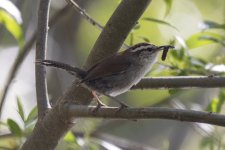
Bewick’s wrens have spent the winter at Nisqually National Wildlife Refuge, but they have tended to be elusive, chittering at you from deep cover. But now the males have been perched on high vantage points and singing their hearts out to attract mates and discourage rivals.
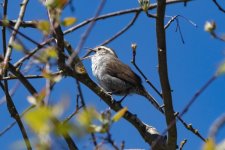
When not singing, they are harvesting the flush of spring insects like this caterpillar.
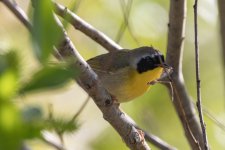
The common yellowthroat warblers have arrived from their overwintering grounds in Central America. With their distinctive calls and songs, you know that they are around. But they can be very elusive when they want to be. Your best bet is to find a male singing in the freshwater marshes
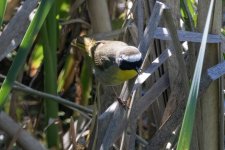
or in the riparian trees around the pond at Nisqually.
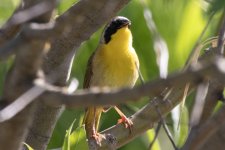
The females can be even more elusive. You can hear their harsh “chip” calls from deep cover, but finding them out in the open where you might snap a quick picture is more challenging – patience. grasshopper.
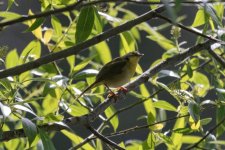
From their locations at the water’s edge, common yellowthroats are in perfect position to ambush newly emerged aquatic insects, such as this damselfly.
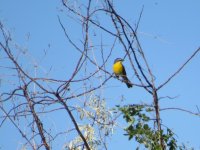
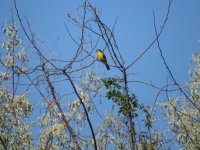
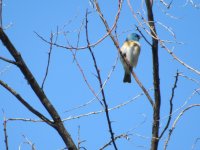
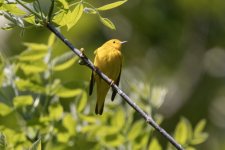
In my recent walks, the Merlin app (and my own mediocre ear) has been identifying lots of singing yellow warblers. They are also adept at using cover, such as the new leaves at the top of big-leaf maples, as cover while they sing. But if you are persistent, you might have a brief view. This bird had been calling from deep cover at the top of a neighboring maple, but popped over to its neighbor whose leaves were a bit less developed.
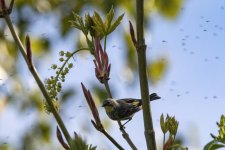
One of the most common birds that you see in the canopy this time of year are yellow-rumped warblers (aka, “butter-butts”). They will carefully glean leaves and branches for insects. But they will also find prominent perches to “hawk” insects that are flying past. This time of year, there is a heavy hatch of midges from the pond and canals at Nisqually. The displaying / mating midges assemble into dense clouds in sheltered areas and that attracts the yellow rumps.
But the story gets more interesting when you notice that in the spring there are two versions of yellow-rumped warblers foraging in the trees: Audubon’s warblers and myrtle’s warblers. Audubon’s warblers are found exclusively along the West Coast, ranging from Southern California into the British Columbia and east to the Rockies. Myrtle’s warblers are found along the East Coast and range across Canada into Alaska. Any myrtle’s warblers that you see in spring in Washington are just passing through on their way north. A third, non-migratory member of the “yellow-rumped warbler” complex, the black-fronted warbler is found in the mountains of Mexico. And a fourth non-migratory member of this group, Goldman’s warbler, is found in Guatemala.
At various times, these four “forms” have been treated as four separate species, three separate species with the black-throated as a subspecies of Audubon’s (which is the current status on the IOC World list), or one species (current status according to the American Ornithologists Union [what would they strike over? Cost of bird seed? Binocs?]).
While the ranges of the black-throated warbler and Audubon’s warbler do not overlap at present, the breeding ranges of Audubon’s and myrtle’s forms do overlap in B.C. over about an 80-mile wide zone and they can form hybrids. But the size of the hybrid zone is quite stable and there is some evidence of selection against hybrids.
Does it really matter if there are one, two, three, or four species here? A subset of hard-core birders (“twitchers”) care VERY much about these decisions. In some cases, they will seek out “subspecies” in anticipation that a subspecies will be elevated to full species status in the future. These folks care very much about the number of species on their life lists and what this means for their “big year” calculations. [I’m too lazy to care much about this.]
As a life-long biologist, I feel some “chagrin” that the field has had such a hard time defining just what a species is / is not. There are over 20 different definitions of “species” floating around, ranging from the pre-Darwinian “morphospecies” such as described by Linnaeus, the “biological species concept” of Ernst Mayr (1942), the “evolutionary species concept” of Simpson (1951), the “ecological species concept”, the “genetic species concept” used often with microbes, and the “cladistic species concept”. Unlike chemists who can define an element based simply on the number of protons in the nucleus, there is no consensus of how to determine what a species is, leading to debates between lumpers (siding toward fewer species) and splitters (leaning toward more species). Beyond the vanity of birders, identifying what is vs. what is not a species has huge implications for conservation biology and allocation of scarce resources (see distinct populations of Pacific salmon…).
So, what does this mean for our “yellow-rumped” warblers.? All four forms have yellow patches at the base of the tail. A western Audubon’s warbler (
Setophaga coronata auduboni) has four distinctive features: 1) a yellow throat that does not extend past the eye, 2) arcs of white above and below the eye, 3) blue to dark gray “cheek” (auricular feathers, and 4) a solid (or close to it) black chest. [Great comparison here.]. The black-fronted form (
S. c. nigrifrons) of Mexico is even darker on the head and chest.
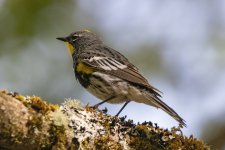
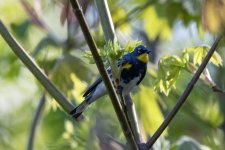
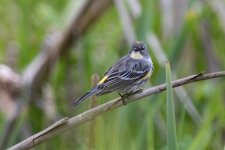
The eastern/northern myrtle’s warbler has 1) a white throat patch that extends past the eye, 2) arcs of white below and above the eye that extends as a white eyebrow (supercilium) stripe, 3) dark cheeks that contrast with the extended white throat patch, and 4) dark streaks along the breast.
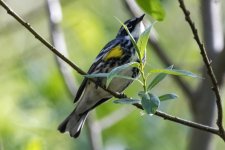
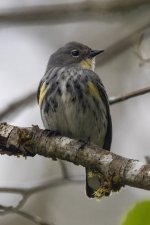
And as you can see, I have clear pictures of both classic Audubon’s warblers and classic myrtle’s warblers from Nisqually Wildlife Refuge. But the confusion comes when I looked at a yellow-rumped warbler that I photographed at McLane Creek a day or so later. It has a mostly-white throat (= myrtle’s), but with some yellow (= Audubon’s). The throat patch does not extend beyond the eye and there is no white eyebrow stripe (= Audubon’s). But the chest has dark streaks (= myrtle’s), not solid black. So, this would appear to be an intergrade bird.
So, are Audubon’s, black fronted, and myrtle’s one species or three? A
paper by Toews et al. in the Journal Evolution examined this question at several levels.
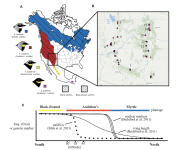
First, except for a small zone of overlap in B.C., the three forms are geographically separated (allopatric in biogeography speak) and they have distinctive morphologies = 3 species. But if you look at differences in nuclear DNA, you would conclude that there are just two species and if you used mitochondrial DNA, you would also conclude that there are just two species, but who is dancing with whom is different based on the different genetic markers. Maybe this species question is harder than it first appears…
Steve